Saturday, February 8, 2014

Bushmeat and the African Trade to Europe

Last week I was in Peru and met an experienced airline steward who has flown with major airlines for many years into, and more to the point, out of several West African capitals. We got chatting about the bushmeat situation, something I have written about in books and on blogs for several years.
 
One of Amman's many pictures of the bushmeat trade

Of course writers with bigger followings, like the remarkable Karl Amman have written and photographed bushmeat and poaching stories to a wide audience. He also graciously allowed me to use some of his images in my book The Trouble With Lions .

The late Anna Mertz, who worked as an engineer in West Africa for many years reported on the horror show of truck loads of dead and badly injured antelopes appearing almost in food markets in Ghana long before the bushmeat trade issue reached a wider global audience.

My steward acquaintance told me that loads of bushmeat continue to come out of Africa bound for the UK with every flight. It is packed in passenger luggage, and the security officers who check bags before departure have no interest in, and probably no jurisdiction over it.  They are concerned with weapons.

The airplane staff can do little about it either. They do try to curtail the excess baggage situation, but even that is a hopeless task, as the routine response from Nigerian passengers is that a white-skinned staff member is picking on a black person. Inevitably some of the bags leak their contents and many planes end up with bloodstains and bad smells.

In Kenya Ann Olivecrona told me how she chanced to witness a bushmeat import at London’s Heathrow airport. As I wrote in 2008:

“in May 2004 she witnessed an amazing interchange involving bushmeat at London’s Heathrow airport. Her plane happened to arrive at more or less the same time as a flight from Lagos. During the time that she watched the procession, customs officials stopped every one of the Nigerian passengers and asked for the huge suitcases to be opened. Almost all were packed with smoked bushmeat.”

The bushmeat trade poses serious risks at both ends.

In Africa it is leading the rapid depletion of wildlife populations. Many species are involved. While primates are the most evocative for most people, the most popular species is the cane rat of the genus Thryonomys, known locally as cutting grass. They can weigh as much as 10 kg in the wild and in most West Africa countries efforts have been made to rear them for the meat market.  

Credit: Aurélia Zizo/Wikipedia

Here is a picture from the Wiki of one such rat, a male Greater Cane Rat (Thryonomys swinderianus) in a breeding station in Owendo, Gabon

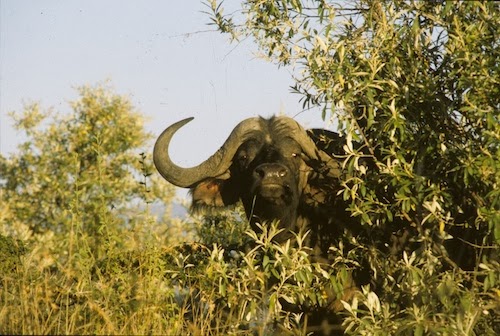
Many tribes in the region have long held certain species taboo. Not any more. Anything goes.  One example is the African buffalo, long deemed off limits to one clan in Ghana. In October 2001 Ghanaian journalist Vivian Baah wrote a series of articles under the title “Guess What’s Cooking for Dinner?” in the Evening News of Accra. She related how in parts of Ghana:

“among the Ekona clan of the Ashanti's, it is a taboo to kill the Ekuo (buffalo). But these days, the members of this clan themselves are the worst offenders. Having turned their backs on the taboo, they now butcher the Ekuo with cheeky ease.”
Cape buffalo - aka Ekuo in Ghana

Of course this process will inevitably lead to the law of diminishing returns. Species will simply disappear or become rare.

In Europe there are serious disease risks. Much of the continent has an endemic foot-and-mouth disease status. If the disease gets into UK, for instance, it will cause billions of dollars worth of economic damage. All it needs is for some improperly preserved meat to carry the virus to destination. A little bad luck or carelessness and the explosion would take place. If this seems unlikely one only has to look at my home province of Saskatchewan, where, in 1952, illegally imported smoked meat from Poland led to the last outbreak of FMD.

Fruit bats roositng in Uganda


It is not just livestock diseases. Ebola and the closely related and equally deadly Marburg virus can infect humans who handle primate and fruit bat carcasses (fruit bats are a popular bushmeat item).

 HIV/Aids came to humans via chimpanzees and sooty mangabeys. No doubt there are other examples.

In a TTWL chapter titled Bushmeat and Bureaucrats I tried to make the point that thousands of words on paper would achieve nothing much. One example of such verbiage came from the European parliament. A tome from that body that took four years to reach “Provisional Edition” status came out in 2004.

Bureaucrats the world over are famous for producing complex, usually lengthy documents about almost any subject one can think of. The more pen pushers involved the more complex the end product. Only this human sub-species could have come up with the title EuropeanParliament resolution on Petition 461/2000 concerning the protection andconservation of Great Apes and other species endangered by the illegal trade inbushmeat (2003/2078(INI).” 

The material has ten Having regards to” clauses, fifteen appearances of “Whereas,” and twenty-one “Urges” and the like, a few with sub-clauses. There are no teeth to the document, just urges.

It is obvious, from my airline steward’s account, that the teeth are either absent or false.


Friday, January 10, 2014

Elephants, Ivory, Africa and China #2

This posting may have better news on the ivory crisis. Hope so.

Let’s start with this from the online group One Green Planet. It opens with
Many never thought they’d see the day come, but it finally has – China, one of the world’s largest importers of ivory, has announced, that it, along with 29 other nations, will help protect the world’s elephants by criminalizing poaching.

Now, that’s something to celebrate.

A Space For Giants newsletter of December rejoices in the growing tide of goodwill and scale of responses to the elephant/ivory story.

Three days ago I posted on a small part of the ugly mess of the current ivory crisis (not the first) as this 1983 book title indicates. 
For good reviews of this very long-standing issue get hold of either this book by Ian Parker and the late Mohamend Amin  or Ian Parker’s more recent What I Tell You Three Times is True. The latter is a really in-depth examination of the subject.
There has been a considerable amount of social media traffic on many aspects of it. I have picked up some thirty postings in the last month alone. Like the two I opened with about half of them take a slightly different and hopefully more optimistic view of the situation, many of them reporting seizures of ivory, either as raw tusks or worked items. Others deal with criminal trials.

In South Africa, where rhino poaching is a major concern, they are preparing for the elephant war with publicity. This video is well worth the watching. Indeed if you have time for nothing else do spend the ten minutes with it.

Namibia is also being pro-active and investing in technology 
that includes drones, infra-red cameras, tagging with GPS, and the latest software.

There have been recent reports from other African countries such as Gabon, Kenya, Republic of Congo (2 reports) and Mozambique

Tanzania has a real battle on its hands, as indicated by the actions that have recently been taken. They include ivory seizures in Zanzibar and Dar esSalaam The dismissal of many allegedly corrupt wildlife department staff  and several other columns in the on-line allAfrica news that include a call to deal with the  so-called Poaching Barons as well as a call for tougher poaching laws.

Kenya also seems to be taking things more seriously, not only with the new laws I mentioned in the blog of Jan 7 but in catching offenders (again two reports.)

In that Jan 7 post I mentioned that a new law, if signed by President Uhuru Kenyatta, will make it possible to punish poachers with life sentences. A remarkable public admission was made on Jan 3 by a former employee of the Lewa Conservancy. Keleshi Parkusaa, 39, said he has been a poacher even when he was employed there for three years. He obviously admitted his crimes before the law comes into effect in order to avoid that sentence.

Other countries that have taken action are France where 3 tonnes of ivory are to be burned. This picture by Reuters/Keith Bedford shows some of the items. Also Vietnam, where a court has sentenced a company director and his deputy to 3 years in jail each for smuggling 158 pieces of ivory tusks weighing more than 2.4 tons.

And the USA where a  New York City antiques dealer who pleaded guilty to conspiracy for smuggling artifacts made from rhinoceros horns from the U.S. to China and Hong Kong has been sentenced to three years in prison, plus three years’ supervised release.

The key, as everyone realizes, is China.

Basket ball star Yao Ming has been actively campaigning about conservation issues for quite some time and his efforts to publicize the shark’s fin soup issue has yielded encouraging results. He has been similarly active on the ivory front and his and other peoples efforts may be changing the way that folks in China think about these issues.

This anti-elephant poaching story filed from Kenya and Mozambique by Yuan Duanduan titled The Blood Ivory: Behind the Largest Ivory Smuggling Cases in China has gone viral.

In it he wrote
China has become the largest illegal ivory consumer market in the world, but 2 /3 of the Chinese people do not know ivory is obtained through killing the elephant.
The ivory trade has become a source of capital for African terrorist groups, forming a tight secretive network of poachers, small and big middlemen.
In recent news on November 5, 2013, Xiamen Customs announced the largest ivory smuggling cases uncovered in recent years, two cases of which ivory added up to 11.88 tons, worth 603 million yuan. If it hadn’t been seized, the ivory from Africa would have infiltrated China ‘s secretive “black market”, to be eventually sold into private collections.


As of Dec 20 the story had over 10 million Tweets and Retweets on Weibo (China’s Twitter/Facebook hybrid) 

"The article was reposted on 24 online discussion forums or Bulletin Board Systems (BBS) including Mop and Tianya, two of the most popular in China. Thousands of comments were generated on the Tianya BBS forum alone. Overall over 5,000 comments on the article were posted on Weibo, BBS fora, and other websites."

A very clever ploy was to merge the image of China’s iconic panda with the shape of an elephant.  This poster, courtesy of WildAid reads: Protect the pandas of Africa - elephants. When the buying stops the killing can too.

Then came the Jan 6 report of the crushing of 6 tonnes of ivory in Guangzhou and on the same day a senior government administrator's answers to questions from reporters Liu Yang Yang, Wang Xi, Han Qiao about that destruction 

I fear that only very cautious optimism should be felt. One of the several concerned groups Elephant Advocacy had these thoughts about the ivory crush.
  
While it's encouraging to see China, the world's key consumer of ivory, taking such a step, there would be even more grounds for celebration if it didn't attempt to isolate 'illegal' ivory as the problem while actively promoting a deeply flawed parallel trade in 'legal' ivory which serves to confuse consumers, boost demand and provide a laundering mechanism for illegal ivory. It's difficult, too, to see beyond today's event as a PR exercise when considering that the 6.2 tonnes of ivory crushed represents a small fraction of what we know has been seized in China.

The future?


One of the problems is that nobody really knows the real number s of elephants in Africa. CITES reports probably give the most reliable figures, but even they are inevitably fraught with estimates and inaccuracies. The news that Paul Allen, the Microsoft billionaire has announced that he will fund a pan-African survey is a huge step in the right direction. The will aim to calculate how many actually remain, where they are found, what threats they face and whether their total population numbers are in fact increasing or decreasing.

Tuesday, January 7, 2014

Elephants, Ivory, Africa and China #1


Warning! This is not a good news posting.

Anyone who follows Facebook, Linkedin or Twitter links that cover wildlife issues cannot fail to have seen the remarkable number of posts since December 1st about the utter disaster that is going on across all African states where elephants are found. Indeed, in some cases one can probably write where elephants used to roam. What a mess! 
The news has gone well beyond the social media scene and this scanned-in report in the Guardian, that I picked up in UK last week,  may have brought it to the attention of many others.  Sadly that is very unlikely to make a jot of difference to those who are engaged in the slaughter elephants and the use of their teeth for human pleasure.

A really authoritative 19-page report by a team from three main conservation groups (CITES Secretariat, IUCN / SSC African Elephant Specialist Group and TRAFFIC International sums it up nicely.

It is titled: Status of African elephant populations and levels of illegal killing and the illegal trade in ivory. 

The report deals with the 2012 situation and a few years prior.  A key sentence in the executive summary tells the sorry tale of the why?  

"Poverty and weak governance in elephant range States, together with demand for illegal ivory in consuming nations, are the three key factors identified by repeated MIKE analyses, including this one, as being most strongly associated with observed poaching trends."

Of the many reports in December 2013 that fit this picture I suppose the ones out of Tanzania are as good an example as any. The Prime Minister Jakaya Kikwete sacked four of his cabinet for what was reported as overzealous use of control measures in the so-called Operation Tokomeza.

Within two days the operation was restarted after a container load of ivory reputedly destined for China was seized at the Dar es Salaam port.

It may be that the situation in Tanzania is the worst in Africa. A posting by Richard Conniff of Dec 18 is titled Elephant Poaching: The Disaster in Tanzania says a lot.
Conniff’s post is either terrifying or beggars belief. He states that “Apparently, managing the media means keeping these results as quiet as possible.” So he quotes from none other than the National Geographic about the number of elephants in the Selous Game reserve alone. The latest, recently announced population estimate is 13,084. This indicates an unprecedented decline of nearly 80 percent over the last six years. For the mathematically disinclined that is a drop from 55,000 since 2007.

The numbers of elephants poached throughout Africa in 2012 are telling enough. The report, which is based on sound studies, gives an estimate of some 15,000 animals but acknowledges that:
Monitoring of elephant populations, apart from at a few well-monitored sites, is sporadic and inconsistent. The low precision of most estimates makes it difficult to detect any immediate repercussion on elephant numbers in the short-term but this does not mean there are no changes.

That is just 2012. There are no properly monitored figures for 2013, but none of the many claims gives a figure lower than 25K. The most dire claim comes from the International Fund for Animals Welfare who suggest that up to “50,000 elephants a year are now being slaughtered.”  In this post on Dec 20  they stated that more than 41 tonnes of elephant ivory have been seized in 2013, the largest quantity in 25 years.
Whether the situation has really “shocked world leaders out of their ennui and into action to halt poaching and ivory trafficking” is real or hoped for is more questionable.

Other postings mention numbers like 25 or 30,000 but all these numbers exceed any possible replacement numbers and all are horrific. Of course the use of cyanide at salt licks is nasty, but the wholesale mowing down of the sentient, intelligent creatures with automatic weapons is probably nastier. In the cyanide case, the affected animals will have died quickly and probably known little of what was happening to their herd mates. With a hail of bullets smashing into bone, lungs, hearts and brains many of the elephants will have been very well aware of what was happening.

Having written this last paragraph from the heart I am horrified to think that I could opine that cyanide was a better way to die than by gunfire. 

The Kenya government seems to have lifted themselves off their collective backsides and taken action. If the new Wildlife Conservation and Management Bill 2013 is signed into law by the president a life sentenced may be handed down for anyone convicted of rhino or elephant poaching.
 
At the other end of the trade chain a Dec 22 post from the South China Morning Post makes it clear that the Chinese do not seem to share the opinion of the Kenyans. 

Wildlife conservationists slammed a four-month jail term and fines of up to HK$80,000 for five ivory smugglers from the mainland as “too lenient”, saying it will do little to stop the illicit trade. (HK $  = 0.13 US$).

“It is way too lenient because Chinese people buying illicit ivory in Africa know that if they are caught, at most they will just lose the ivory and get a puny fine,” said Grace Ge Gabriel, Asia regional director for the International Fund for Animal Welfare.
Tom Milliken, of the wildlife group TRAFFIC, said while he welcomed the jail term as a deterrent, fines could be written off as “the price of doing business”.”

He is probably right. Another post of Dec 22, this one by Simon Parry tells us that the price of ivory in Hong Kong has risen 50-fold in the last 10 years. Not surprisingly big tusks sell at a premium. Parry gives an example of a 65kg pair of mounted tusks is on sale for HK$15 million [almost US $ 2 million] at Chinese Arts and Crafts in Wan Chai.

As described in this post of Dec 13 by Emily Matchar what the rest of the world knows as illegal ivory is called white gold in Hong Kong. With an increasingly wealthy Chinese middle class seeking status symbols does the elephant have a chance? Then of course there are the 270 odd Chinese billionaires (that is not a typo; It is B, not M).

I could go on, as I have only mentioned a small proportion of the December posts, but this one should give some flavour to those who have not been following the situation closely. Anyway, I have just gone over my one thousand word limit.

Wednesday, December 4, 2013

Christine Dranzoa - a remarkable person.


I’d like to share a story from Africa that is very much linked to a small slice of Saskatoon life.

Chrsitine Dranzoa outside the Faculty of Vet Med, 2002
I have a long history in Africa and for the last eight years of my career as a wildlife veterinarian I took Canadian students from the Western College of Veterinary Medicine to Uganda. We would not have been able to carry out this program if it had not been for the head of the Department of Wildlife and Animal Resource Management at the Makerere University veterinary school. Her name is Christine Dranzoa and through several exchanges of letters and email she laid on a tour for me in 2002 to see what was what before I actually took students there.
 
After that introductory tour it was relatively simple for me to convince the powers-that-be in Canada that there was a really worthwhile opportunity for Canadian students to learn a huge amount about veterinary medicine, and much more, in a new setting.

I also found out that Christine has a remarkable history, which I will compress (and which does not appear on any website). She was born in West Nile, the region of the country where Idi Amin came from. When he was ousted the equally gruesome despot, Milton Obote, targeted everyone in West Nile. Christine, aged 12, fled to Sudan as a refugee. She managed to get out of that nightmare and finished high school, got her BSc and went on to her PhD work. At age 27 she spoke to the dean at the vet school about the lack of a wildlife department and soon found herself not only founding one, but also becoming its head! We worked with her near the end of that tenure as this rather grainy old footage, shot with an early version of a digital camera, shows.

 
For the first three years Dr. Dranzoa traveled with us in the field and worked with the students on her specialty, which is birds. Her thesis work had been on the nesting ecology of birds in partially logged forest fringes. We visited Kibale National Park where Christine did her studies and used mist nets to capture birds, ring them, and collect blood samples for disease studies. We even found a couple of cases of avian malaria.

We were also able to secure funding at the WCVM to bring Christine to Saskatoon to deliver a moving talk about issues related to wildlife in her country. When my wife and I took her to one of our favourite places, Prince Albert National Park, we were lucky enough to see a huge swirl of snow geese above a slough near the appropriately named town of Duck Lake.  

Snow goose cloud. Photo by Trudy Janssens, Photogrpahy One2One


When her eight years as department head were up Christine was promoted to the post of Deputy Director of the School of Postgraduate Studies for the entire university (30,000 students, 3,000 graduate students) at age 35!

Artist's impression of the new campus
Dr. Dranzoa has gone on to meet new challenges. Two years ago (in her forties) Christine was tasked as one of the team founding a new university in her home region, in the district of Arua in the West Nile sub-region. This was after elders in the community petitioned Uganda’s president, Yoweri Museveni.  It  was founded in 2012 and has now been registered as Muni University. Christine is the current Vice Chancellor.

It comes as no surprise to learn that Christine has been active in other fields, especially in ones related to women’s issues in Uganda and beyond. Although we came to know her well and enjoyed our many visits with her, she never told us that she co-founded and is Chairperson of Nile Women Initiative an NGO which aims to address gender disparities in her home region. She is also Honorary Secretary of the pan-African Forum for African Women Educationalists.

Christine (r) with Fifi in 2003 and Angela, Chrstine's sister
Over and above these remarkable achievements she has now raised 18 children, none of them her own (she has never married). Most are kids of her siblings who were either killed in Obote’s pogroms or died of AIDS. The youngest, Fifi, is about to finish high school. A few are not even relatives, but just orphan children who are friends of her extended family. When we visited Christine’s home we discovered that the bedrooms were set up as dormitories – boys and girls. How could it have been otherwise?

The nursing clinc is under construction
Christine has written to me seeking help with equipment for a nursing station, a small but much needed part of the campus, especially during the construction phase when not only builders but also the  general public, will have it handy. She had heard that there were organizations in Canada who could ship containers of stuff to needy areas. After a bit of sleuthing I met (so far only by phone and on line) a Regina-based nursing PhD who has shipped 79 containers to 19 countries in the last 10 years. Her name is Pammla Petrucka. Dr. Petrucka has a well-oiled system and access to a large warehouse in Regina. She can also get hold of a full array of medical equipment ranging from bangages to bedpans, tilt beds to tubing and walkers to wheelchairs. On top of that she has a team of volunteers who can fill a container in a single day. All the equipment is donated, in good condition, and free. The problem is the shipping. It costs about $25,000 to ship a container. This covers the cost of the container, the physical act of transport, and the paperwork. The container is not returned and is likely to end up being a useful addition at the destination. I have even heard of containers being fitted with air conditioning before shipment.

My wife and I, and several of those former students have managed to raise part of the funds needed to get one container to Uganda, but cannot reach the full $25,000 needed to complete the shipment. We are channeling our funds through the Hospitals of Regina Foundationwhich has NFP charitable status so that our donors will receive tax receipts.

Apart from being an author and retired professor I am a storyteller and have told stories about my career as a wildlife vet on 4 continents. The Africa stories often have threads about Christine in them. I hope that this comes as no surprise.

Sunday, November 17, 2013

The War on Wolves - an Animal Welfare Issue

Predators occupy quite a space in the human psyche. Humans have been “at war” with many of them since the earliest days of livestock domestication. While the lion occupies the imagination people everywhere, in North America no predator is more symbolic of this war than the wolf. Our attitudes are ever fluctuating. There are websites and social media gatherings where the full range, from “kill them all” to “full protection” is on display.

These two very opposite views about them were written about another pack-hunting wild canid, in this case the African wild dog.

In 1914, one R. Maugham wrote: "Let us consider for a moment that abomination - that blot upon the many interesting wild things - the murderous Wild Dog.  It will be an excellent day for African game and its preservation when means can be devised for its complete extermination." 

These words could easily be used by the anti-wolf crowd in 2013. 

Dr. Kobus Raath's ;picture of wilfe dogs in Kruger N P
The other view, also resonates for many folks. They were written in 1997 by  David MacDonald of Oxford University.  “To nominate one sight as the most beautiful I have seen might, in a world filled with natural marvels, be considered disingenuous. Yet, of images jostling for supremacy in my memory, it is hard to better the bounding forms of African wild dogs, skiffing like golden pebbles across a sea of sunburnt grass at dusk.”

A group of concerned, but balanced individuals has recently launched a website that examines some of the many issues . They are particularly concerned about some of the aspects of wolf management in Alberta, and by extension elsewhere in North America. 

Myrna Pearman's beautiful picture is one of the site's headers.

As you skull around the site you will find links and articles by people who have had an enormous amount of experience with wolf management and are concerned with the way that things are developing.

Among them are Dr. Lu Carbyn, noted world wolf authority, who has expressed deep concerns and  published an article critical of the province's wolf bounty program in the Journal of the Canadian Society of Environmental Biologists.


There are very obvious animal welfare issues at hand. Dr. Jose Diaz of the University of Calgary, who is an accredited specialist in animal neurology examines the effects of snares in his piece in the Gallery of Shame http://www.wolfmatters.org/articles.html -

Dwight Rodtka, who worked with wolves for his entire career has contributed pieces to the site. Dwight expresses deep concern not only about the Alberta government’s whole wolf program but very specifically about snares, which he states in his piece The Truth About Snares  are “archaic and torturous devices which should have been banned years ago.”


Dr. Garcia examines the damage. The lion died as he arrived on scene.
I have seen the aftermath of snaring in several African countries but perhaps the most dramatic one was of a dying lion in Tanzania’s Serengeti. The animal’s end was witnessed by friend and former student Dr. Patrick Garcia. 

Gruesome fits the scene well.

It is much more than just snares and traps. My own contribution to the debate is also from an animal welfare perspective. It is about poisoning and comes straight from things I witnessed in Kenya 45 years ago. 

You can read the piece at the link above, but if your time is short here is my opening:  

The debate, seldom polite, often vigorous, about the wolf and its presence among us often becomes a “to poison or not to poison” matter. The subject waxes and wanes, but today, in parts of Alberta and British Columbia, indeed in many parts of North America, it is indeed the question, and strychnine is the apparent sling and arrow.    

I suspect that most people who espouse the poisoning route have never seen the effects of this deadly substance on any animal.

Unfortunately I have.

In the body of the article I quoted wolf biologist Bob Hayes about the “by-catch” effects of strychnine. They are horrific. Bob worked in Canada’s Yukon for many years on wolf control. His 2010 book Wolves of the Yukon is a very worthwhile read.
 
I closed with this:
If the rancher who cannot prevent wolf attacks by other methods (which do exist) and has to use this deadly substance to “take arms against a sea of troubles” caused by livestock predation then we are in a sorry state.

Strychnine poisoning is very definitely an animal welfare issue. Its use is inhumane. 


I am by no means alone in this view and I hope that other veterinarians feel the same. If they do, rather than write to me I hope they will comment on the Wolf Matters page

Of course poisoning of predators is nothing new. I photographed this Calgary Herald page in 1995.


Scary, or what?
An interesting view is taken in the Earth Island Journal, which heads its piece with this extraordinary picture that first appeared on Facebook.

You can read the rest of the article at the link and of course find links within that that take one further. It reminds me of a video scene I witnessed during the emotional times of the translocation of wolves from Banff National Park in Canada in 1995 to Yellowstone and Idaho. A witness at a hearing in Wyoming said: “The wolf is The Saddam Hussein of the animal kingdom.” She was serious.

Saturday, November 2, 2013

Stories about Moose and a Wildlife Vet in Africa in British Columbia


We have just finished up another storytelling and book tour. Eight libraries, one sporting goods store and a wind-up at the University of Northern British Columbia. All  in 7 days. I tried to find a map to show all the communities, but could not quite manage it. 

This one shows 8 of the 10 spots. I added Granisle and Fraser Lake and each place has an italicized number, showing the order of the events.

We started in McBride where the folks enjoy decorating anything you can think of, including their fire hydrants. Why not?  Our total distance on the road, including the leg from home was just over 4500 km.

Fraser Lake, after the session. Thanks
Miake Ellott and me outside the Houston store
Just as in our trip to Yukon I offered one of two sets of stories, with pictures. Either A Wildlife Vet in Africa or Of Moose and Men Around the World. This time there was a split. The folks in Granisle, (at the very top left-hand corner of the map) and Houston went with the moose set. Everyone else chose Africa. In only one case, for the students at UNBC, did I know ahead of time which one it would be.

The odd tea break was an essential element

We had a great reunion Williams Lake with one of the students who joined Jo and me in Uganda. Dr. Ross Hawkes practices there and we reminisced a bout a whole bunch of things after the talk. 

Ross (the redhead 2nd from left back row) classmates & Ugandan students 2007
It was Ross and his class-mate Kevin Oomah who came up with the novel, some would say crazy, idea of subjecting themselves to a full bikini-wax hair strip of the hair above their waists in order to raise money for the schools that we have supported in Uganda over the years. In 50 minutes their generous “donation” generated $1800 !  I had not known, until Ross delved into his files, that there was video evidence of this event. If he and Kevin will allow it I would like to show that in a future post.

Most of our audiences were adult, but in Quesnel we had a surprise. A group of home-schooled children and their parents showed up. They were the only audience – the session was set for 10.00 am and it would have been tough for adults to get away from work. This meant that I had to change on the fly and luckily this was not too difficult. After telling them a little about my background, I began with stories about my own experiences with giraffes, which gave me the entry into the folk story about why giraffes are so tall. 


A couple more folk stories, with the little ones involved and with grins, and we had a happy crowd. I ended with a food-chain account of why hippos are so important for the health of the great lakes of Africa. This one resonated with one of the older boys who happens to be studying the food-chain right now! 

After the Quesnel set we needed a lunch break. Luckily we found a local bakery, and had soup like your mother made it. Yum!

Philippe Henry's snap of the audience before the start
The largest crowd was at Prince George’s University of Northern British Columbia, where student Gabrielle Aubertin and faculty member Philippe Henry had done a fine job of getting the news out. I told stories about work with rhinos, lions, elephants and a run-in with safari ants. The stories were for an adult audience, but included two folk tales. The first was about why wild dog’s wife got very sick and why they now hunt in packs, the second about the hippos again. I used two famous quotes. 


The first from one R. Maugham in 1914, which one might think was being recycled for the attitude of some towards wolves a hundred years on. Here it is:

"Let us consider for a moment that abomination - that blot upon the many interesting wild things - the murderous Wild Dog.  It will be an excellent day for African game and its preservation when means can be devised for its complete extermination."

The other from David MacDonald of Oxford University which sums up my own thinking.

“To nominate one sight as the most beautiful I have seen might, in a world filled with natural marvels, be considered disingenuous. Yet, of images jostling for supremacy in my memory, it is hard to better the bounding forms of African wild dogs, skiffing like golden pebbles across a sea of sunburnt grass at dusk.”

I was delighted with the reactions from the folks, which came on FB. 
Gabrielle wrote “Thank you for the great talk, I have only received positive comments, so I think everyone enjoyed it. How could they not. I thought it was a great mix of facts to stimulate the scientist brain, of beautiful images that would make anyone dream of having career like your and it was also funny!"

Philippe wrote:  I kept getting comments in the hallway yesterday: beautifully told stories with real value for the conservation of our living world, thanks again for taking the long trip here:)