Showing posts with label The Trouble With Lions. Show all posts

Saturday, April 7, 2012

Flamingos, salty water and salt mining in Africa


Another collection of pictures from Africa. This time it’s birds and more particularly, flamingos. With two exceptions they come from Kenya. The last two are from Uganda and Namibia. Even the Kenya ones are not all from the same spot.

It is, or was, Lake Nakuru that was always famous for the masses of these striking birds. Indeed it was said that there were, at times, over a million of them on the lake. That has changed dramatically. I took this picture over 40 years ago, and there appear to be more birds than water.  

On our visit there in December we saw very few, maybe a couple of dozen at most. 


We did see thousands, standing, feeding and flying at Lake Baringo, the next-most northerly lake in the chain that appears in the Rift Valley. The storm clouds had gathered in dark masses about the eastern wall of the Rift as we stood and marveled at the sight. The photos at Baringo were taken by one of thre three of us with cameras. Our daughter Karen, her husband Robert, or me.


These pictures do nicely show the difference in both size and bill colour between the Lesser and Greater species. On the left they are all Lessers. The fully dark beak with its small dark pink spot near the tip shows clearly On the right a single Greater, with his pink bill and dark tip stands out. The lesser also has a pinker hue to the body feathers.  How obliging of them to stand so still for the camera.

Feeling the cold?


I’m not sure if this one was feeling the cold, but he/she does seem to have a scarf around the neck.


Sart your engines!

Near the finsih line


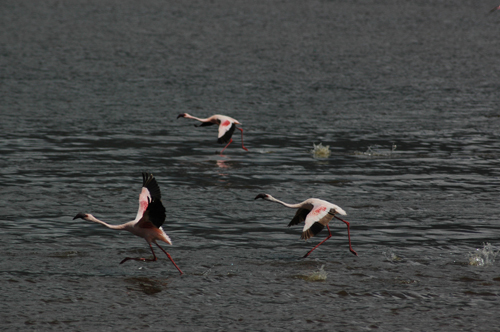
They are truly spectacular when they fly as the colurs stand out.


On previous trips we have also seen them at Lake Elementaita, the next lake south from Nakuru. The hill in the middle background is known as the Lord’s nose. The nasal shape does not show up well in this view, but the Lord name is a reference to Lord Delamere the famous, or infamous, English settler whose ranch, Soysambu, covered most of the land you can see beyond the lake, including the hill. Soysambu is now a conservancy and borders on Lake Nakuru National park effectively extending the area set aside for the purpose.


There are other lakes in the Rift Valley system, and of course the Rift divides into two arms. During our many trips with veterinary students to Uganda and the western arm, or Albertine Rift, we saw small numbers of flamingos in Queen Elizabeth NP, but not in the big lakes named in the 19th century for members of the British Royal family – they are Edward and George. We did seem them in the salt lake nearby, most frequently in Lake Katwe. The birds were never in huge numbers but perhaps because they saw so many humans mining the salt on a daily basis they were quite unconcerned about close approach. 

These pictures show a few of the saltpans that provided about half the village residents with their income. You can see a single bird at the very bottom right of this wide view of the pans. I can assure you that it has not been “Photoshopped” in. I even wonder if the photographer realized that she/he had snapped this single bird.

The briny water is trapped in pans about ten metres across and allowed to evaporate. As the salinity increases so the salt precipitates and can be harvested. You can see big piles of light or dark salt, some covered in plastic, stacked on the pan edges. The pans are individually owned and are traded for substantial sums of money or passed down in families. This is the only place in the world that I have ever visited where rain is simply not wanted. Indeed it is considered impolite to even suggest that the rainy season is approaching. Rain means less evaporation and the risk of spoilage or loss of a hard-won harvest.


These pictures were taken by me or one of the 79 students who joined me on those memorable trips, but I have no idea who. We shared thousands of photos every year, so thank you someone. I wrote about those Uganda teaching trips in The Trouble With Lions.


My wife and I had not expected to see flamingos a long way further south, so, in 1997 we were pleasantly surprised when we saw them at Walvis Bay, wading, feeding and stretching in the river estuary at low tide just south of this Namibian city. The one at left centre is graciously stretching his wings to give us a spectacular view. 


Tuesday, March 13, 2012

Rhino Poaching Update

There has been quite a lot of interest in the rhino poaching situation in the last three weeks. There was a recent NBC TV news report that I have linked to lowder down, and then the report in National Geographic magazine that really caught my eye for two reasons.

You can find the article, by staff writer Peter Gwin, on line here. If you only have access through the web you will miss some of Brent Stirton's remrakable photos. A double spread of a rhino suspended upside down under a helicopter is very striking, especially as the helicopter is out of shot. All you can see is the cable and a wide swatch of Africa. If you do not subscribe to the magazine, take a trip to your local library.

The first nice surprise was to see, on the editorial page, Peter Beard’s iconic 1968 photo of a black rhino coming straight for the camera. There are four men who seem to be standing on something behind the rhino. The man at the extreme left of the picture looks so much like me, with his bald head and face shape, that many folks are convinced it is me.

This is because Peter Beard was kind enough to allow me to use the picture on the front cover of my first book Wrestling with Rhinos: The Adventures of a Glasgow Vet in Kenya. (ECW Press 2002) Peter’s wife, and agent, Nejma has just told me that the man is Ken Randall, a friend of theirs.

The second excellent element was that the article not only told how modern poaching is done, but also gave an excellent update on the HOW of the use of rhino horn in Vietnam, not to mention the extraordinary prices now being paid. Not only is there a remarkable photo by Brent Stirton of a woman pseudo-named “Ms Thien” preparing a dose of “medication” but there is a link to a short video of that process.

I did write to the magazine’s editors. Of course there is not much chance of the letter being published, but I thought I’d share part of it with you.

"I write to congratulate writer Peter Gwin and photographer Brent Stirton on the excellent article about the resurgence of rhino wars in Africa. I have been involved with rhino since the late 1960s and treated my first two cases in Kenya’s Meru National Park during the late Peter Jenkins’s tenure as chief warden.

Although Gwin refers to the 2000-year history of rhino horn in TCM it might be interesting to give your readers some other elements of that history, which goes back quite a way. One of the most interesting comes from a 4th century Chinese pharmacist who wrote: “The horn is a safe guide to the presence of poison; when poisonous medicines of liquid form are stirred with the horn, a white foam will bubble up and no further test is necessary.”  This effervescing property may have saved the lives of many potentates. Among those who are known to have use cups made from rhino horn were England’s Queen Elizabeth I, France’s Louis XIV, and Rudolph II of Germany, who was the Holy Roman Emperor from 1552 to 1612.  All of these people lived in an age when poisoning was a popular way of getting rid of unwanted rivals and enemies.

In was glad to note that Gwin did not perpetuate one urban myth. Many print media have played upon the fact that sex sells papers, and have claimed that rhino horn is used as an aphrodisiac. I quote from the text of The Trouble With Lions: A Glasgow Vet in Africa:

“There are two small tribal groups who believe that horn has this property. In India’s state of Gujarat, men use it by applying some ground powder to the penis just before intercourse, and in the Nakasongola region of Uganda, just south of Murchison Falls National Park, it is believed by some that rhino horn ash helps stimulate sexual desire.  Perhaps the shape of the horn, and the prolonged courtship and copulation (up to an hour has been recorded) engaged in by rhinos, are what leads to the misconception (to coin a pun).  Douglas Adams of Hitchhiker’s Guide fame, with typical throwaway humour, suggested that the aphrodisiac myth might be simply related to the fact that rhino horn is a “big sticky-up hard thing.”

One other note of interest is that Peter Beard allowed me the use of his iconic rhino photo, the one you used alongside your editorial, for the cover of Wrestling With Rhinos. It was fun to see it again in the original."

That disturbing NBC TV report can be found here.

Tuesday, February 14, 2012

Lion Guardians Good news


Last December I was with my family in Kenya’s Maasai Mara and had a wonderful time. We saw all sorts of wild animals and of course my grand daughters thrilled to the sight of lions. I asked out guide, a young Maasai moran named Ben, if he had ever had to kill a lion. “Yes, three times” was his brief reply. I did not press further as he seemed somewhat embarrassed about it. He would have done it for one of two reasons.

In 2006, Leelah Hazzah, then a PhD candidate working for the Lion Guardian program on the Mbirikani group ranch beneath the majestic peaks of Mt. Kilimanjaro, wrote in her thesis that there are two basic reasons why Maasai hunt lions.  The best known is their ritualized Olimayio ceremony, when young men pass into manhood. The other is for revenge, and is called Olkiyioi.

It is a really nice change to be able to write a positive report about an African conservation issue. In The Trouble With Lions (TTWL) I expressed tentative hope that the Lion Guardians program in Kenya’s Maasailand would reverse the long trend of lion killing, by spear or poison, that has been going on for far too long. A hundred and more years ago, when lions ruled the roost and terrorized humans throughout sub-Saharan Africa the Masai, Nandi and other cattle herding tribes had little choice but to try and control the depredation wreaked upon their livestock. They did it with spears in ritualized hunts that “blooded”, sometimes literally, the young men whose initiation involved a lion hunt. They were the warriors sent out to fight the enemy.

The sort of outcome that occurred was recorded by Teddy Roosevelt’s cameraman in the very early part of the 20th century. A group of Nandi had surrounded a lion and speared it The attached picture, scanned from the book’s pages, show the results.

In TTWL I recorded the information gleaned by several scientists about the decline in lion numbers throughout Africa since about 1950, when there were about half a million on the continent. By 1975 there were about 200,000. By the end of 2006 there may have been 28,000.

Since those spearing events new ways to kill lions have emerged. Of course “white hunters” took their trophy toll with heavy rifles, but these were by no means the only methods. The most insidious are snares and poison. These two lions, poisoned with Furadan, a compound banned in the USA and Europe, were photographed by Amy Howard after the killers had stripped their manes. I have blogged before about Furadan and you can find those stories by going to the index at right.

A typical snaring may take a lot longer to kill a lion, or any other victim. This one had been snared in the Serengeti NP when veterinarian, friend and former student Dr. Patrick Garcia came across it and watched its death throes. 

The good news is that in parts of Maasailand the killing has stopped and young men are now actively engaged in lion conservation. You can read all about it, and a whole lot more, in the Lion Guardian’s annual report here, and I urge you to take a look at it, even at the risk of taking you away from my own page. Check out the 2011 report to see how things have changed. This is an important stuff!

Here is the picture taken by Leelah Hazzah of a moran named Mokoi using a telemetry receive to track one of the lions on the ranch.


Leelah, now more properly known as Dr. Hazzah, after receiving her PhD, is now the Lion Guardians Director, but of course the credit for initiating all the work goes to Dr. Laurence Frank of the University of California, Berkeley who has worked on large predators for over 40 years and is the Living With Lions Project Director.

As I said, a happy story. Long may it continue!
 

Friday, September 9, 2011

Talking books on TV

Link
For a change I'm uploading a video of a TV show I did with Saskatoon author and host Wes Funk who hosts a show about books and writing. It is called Lit Happens and is shown on the local Shaw TV station. Wes and I talk about two of my books. Mainly about The Trouble With Lions, but also about Of Moose and Men. I'm stil struggling with a possible subtitle of the latter. Right now I favour A Glasgow Vet's Journey With The Moose, The Whole Moose and Nearly Nothing but The Moose. Hope you enjoy the video. You can find it here on Youtube.

Book talk on TV

Link

For a change I'm uploading a video of a TV show I did with Saskatoon author and host Wes Funk who hosts a show about books and writing. It is called Lit Happens and is shown on the local TV station at Shaw. Wes and I talk about two of my books. Mainly about The Trouble With Lions, but also about Of Moose and Men. I'm stil struggling with a possible subtitle of the latter. Right now I favour A Glasgow Vet's Journey With The Moose, The Whole Moose and Nearly Nothing but The Moose. Hope you enjoy the video.

Friday, March 26, 2010

Lioness kills cub thief


Linkhttp://gorillacd.org/

As readers of this blog know well I am interested in the human x wildlife conflict, in all its forms, but particularly in Africa, my birth continent. In The Trouble With Lions I had chapters headed Lions In Trouble and Lions As Trouble. There is a third category that I had not thought of until today, when I received an email from the folks who run the Official Web site of the Virunga National Park, DR Congo, which most often posts material about the gorillas of that troubled region.

A soldier in Congo's Virunga National Park has been killed a lioness, after reportedly trying to steal 2 of her cubs. Another soldier was injured in the incident.

Surely a tragedy for the men’s families, but WHAT WERE THEY THINKING?

It occurs to me that there is a fair chance that these men came under the influence of an organized crime group. We know, from several reports, that organized crime in the wildlife field is on the upsurge world-wide. What price would some oriental billionaire with more money than he knows what to do with, and no semblance of a conscience, pay for a couple of ultimate status symbols? Of course the soldiers would have been offered a reward for their "work". A pittance for the crime boss, maybe a decent sum for the soldiers.

Does anyone have a suggestion for a chapter title that would cover this incident?

Monday, December 21, 2009

White Rhino Rescue


Linkhttp://www.wildlifeextra.com/go/news/pejeta-rhino.html#cr

In the book Last Chance To See written by the late Douglas Adams (he of the five books in the trilogy The Hitchhikers Guide To The Galaxy) and co-authored by Mark Cawardine, Adams described his visit in 1980 to the last refuge of the Northern White Rhino in what is now the Democratic Republic of Congo. At that time there may have been two dozen of the creatures left after a century of relentless slaughter, aka poaching. So relentless in fact that early in the 20th century the French organized and armed gangs of poachers for the express purpose of collecting rhino horn for sale. Then came the terrible times of Idi Amin in Uganda, and the end of all rhinos in that country.

This picture was taken in Kenya in the 1971 and shows Southern White Rhinos with their guard, but if I had not told you that this was the Southern, as opposed to the Northern, there is no way that you would have known - any more than I would if I had not been told. They look the same.

Four years ago, when I was in Kenya on a visit to my old stamping grounds around the town of Nanyuki, nestled on the western slopes of Mount Kenya, there was serious discussion of the possibility of bringing the last remnants (now only three or four animals) of the DRC group of rhinos to the Ol Pejeta Conservancy, where this picture was taken. That effort foundered on the rocks of local politics in the DRC’s Garamba National Park where the rhino hung on under some measure of protection.

There was one glimmer, a faint one, in that seven individuals of this now critically endangered rhino had been taken to the Czech Republic and kept at the Dvür Krålové zoo. In ten years only one calf, a female, was born. There were three more in San Diego, but they were not breeding at all. In 2009 there are now only eight northern white rhino in existence.

Now comes the latest, and probably last attempt to save the remnants. As reported on the BBC web siteof 20th Nov under the banner headline
Czech zoo sends rare Northern White rhinos to Kenya

The translocation is not without is detractors, but Rob Brett, who is a member of the IUCN rhino specialist group is quoted as saying
"Moving them now is a last-bid effort to save them and their gene pool from total extinction."

More details emerge in another posting and it is here where one learns about the team of folks who have been involved in this exercise, and perhaps why some folks are concerned. These concerns stem mainly from the fact that the Northerns are likely to breed with the Southerns that are already at the conservancy (if they breed at all). Of course their gene pool would immediately be diluted, but the prevailing view seems to be that the genes would be lost completely if no efforts were made.

Of course the hope is that the return of the two males and two females to a more natural habitat, and relative freedom of thousands of hectares of bush, will turn on their reproductive juices. It seems a faint hope until one remembers that the thousands of Southern White Rhinos scattered in parks and zoos around the world are all descendants of about ten animals left alive in South Africa in 1904.This animal was one of my patients in one of those refuges, Meru National Park in Kenya.

You can find more about this remarkable recovery, and about the long and ugly history of rhino slaughter and why people do it, inThe Trouble With Lions.

Sunday, November 8, 2009

Giraffes in Niger


Linkhttp://news.bbc.co.uk/2/hi/africa/8349712.stm, http://www.wcs.org/

Wildlife in Niger has been in serious trouble form poachers and hungry people for many years. One species that has been extirpated from the region is the scimitar-horned oryx, seen here in Texas and most of the world’s remaining members of this species now reside in North America. Indeed several exist on private game ranches. In the late 1980s I visited one such ranch in Texas where a philanthropic oil man had give over a large chunk of his land to their propagation. One of our party asked him “Why don’t you send some back to Niger?"

His reply – “Why would I? Everyone and his brother has an AK47. The animals would not last a month.”

So, the recent story from the BBC webs site about the resurgence of the West African giraffe in Niger is all the more remarkable.

As the reporter Martin Plaut writes
“From a herd of 50 animals, careful conservation supported by Niger's government has seen their numbers rise to around 200.”


Mind you this is still only a fraction of what once was an enormous number of these remarkable animals that roamed right across the region all the way to the Atlantic coast.

As I wrote in my blog of December 31, 2008 there are now five recognized species of giraffe. You can see four of them in that blog, but I have never seen the West African species, the rarest of all. My only chance to do so would have been in northern Cameroon in 1996, but I was fully engaged in an elephant collaring project with New York-based Wildlife Conservation Society. If you would like to read how very difficult this project was you can do in chapters 10 & 11 of The Trouble With Lions.

The good news in this BBC story is that the giraffes have been seen within 60 km of the country’s capital city Niamey and the government has banned all hunting in the hope that the animals will help with the tourist trade.

Friday, October 2, 2009

Canine Distemper in a new species


Linkhttp://www.sciencedirect.com/science?_ob=ArticleURL&_udi=B6TD6-4X9TTTY-6&_user=10&_rdoc=1&_fmt=&_orig=search&_sort=d&_docanchor=&view=c&_acct=C000050221&_version=1&_urlVersion=0&_userid=10&md5=d3ed97ecb6027210b92b683fe472e67d, http://wdin.blogspot.com/, http://asuka.wildlifedirect.org/2007/03/

Once again the Wildlife Disease Listserv and blog has provided an entry into a convoluted story of disease among wildlife, domestic animals and even people.

A recent report published in the journal Microbiology has further broadened the range of species that can contract and die from a nasty virus disease once thought to occur, as its name implies, in dogs. It is canine distemper. The title of the article, written by Zhaozeng Sun, Aixue Li and their colleagues, is Natural Infection with Canine Distemper Virus in Hand-feeding Rhesus Monkeys in China.

It has been known for many years that some other species can contract the virus, or its very close relatives, and it seems obvious that the virus itself is able to undergo slight changes that allow it to infect new hosts. In the last thirty years it has been seen in seals (hence phocine distemper), dolphins, and other species. In Africa it had devastating effects on the African Wild Dog populations and was reported in jackals and hyaenas. It would be no surprise to learn that it also killed other canids like bat-eared foxes, but they tend to fly a bit under the radar and do not have the charismatic appeal of the larger species – they only weigh about 3 kg. Then in 1994 an epidemic occurred in lions in the Serengeti, killing an estimated 30% of the population, something like 1000 animals, in two years!

As I wrote in The Trouble With Lions
“There is a dramatic, but grim, movie clip shown on the Glasgow Veterinary College web site, taken by modeler Professor Ray Holborn, of a lion in the Serengeti in the throes of a grand mal seizure, which is one of the classic signs of distemper”.
I have just spent a fruitless 30 minutes trying to find the video, but it seems to have been taken down.

In dogs some of the classic signs of distemper are fever, loss of appetite, respiratory symptoms and thickening of the footpad. Another name for the condition used to be “Hardpad” and at one time this was even thought to be a different disease. Distemper was once a major killer of inner-city dogs in Glasgow and we students used to go into slum areas and take part in free vaccination clinics. This is much the same as the clinics that now take place around national parks like the Serengeti and Masai Mara in Kenya and Tanzania. You can read more about this on the Wildlife Direct blog here.

Many dogs developed central nervous system signs and seizures were common before they went on to die. There is no mention of CNS signs in any species other than the lions, but deaths certainly occurred. That is exactly what took place in the Chinese Rhesus monkeys where twelve of twenty that were sick went on to die.

So, will distemper jump to humans? Maybe it has done so already, aeons ago, in the form of measles. We may be lucky, because the distemper and measles viruses are closely related. So much so that for many years measles vaccine was used to protect puppies. Another point. When measles vaccines programs fail, or folks take decision not to vaccinate children, the consequences can be terrible. Measles was once a major factor in many areas of the world where European invaders arrived and brought the disease to fully susceptible people.

Saturday, April 11, 2009

Book awards, The Trouble With Lions


Linkwww.bookpublishers.ab.ca, http://www.uap.ualberta.ca/, http://216.219.85.117/

Another book nomination – Yeah!
The Trouble With Lions has been nominated as a finalist in the Alberta Book Publishing 2009 Awards in the category of Trade Non-Fiction. The awards will take place at a Gala evening in Edmonton on May 8th. There are three other books in this category, so once again, it’s fingers crossed.

When I asked David Leach of the University of Victoria, who manages the Canadian Non-Fiction Collective's very active and useful Listserv to make a brief announcement about this he asked how I had managed to get Jane Goodall to write the foreword. Jane and I chatted at Saskatoon's Hotel Bessborough on one her visits and inevitably found that with our years spent in East Africa, and on wild animal work, we had many friends in common. We also have a shared passion about conservation, and Jane was happy to oblige when I asked her to write the piece.

Sunday, March 29, 2009

A Glasgow Vet in Africa: Furadan, birds, Kenya, lions and a new twist

A Glasgow Vet in Africa: Furadan, birds, Kenya, lions


Linkhttp://www.lionconservation.org/, http://www.peopleandwildlife.org.uk/, http://wildlifedirect.org/blogsList.php, http//:stopwildlifepoisoning.wildlifedirect.org/, http://wdin.blogspot.com/


A reader has asked a question on my blog of March 15th with the above title. Here is what I wrote in reply.

Thanks for your comment & interest. Out further west here in Saskatchewan we have just watched the same show on 60 minutes.

You are right, the herdsmen of Africa value their cattle very highly, and of course they are no different than a cattleman here in N. America. If a bear, wolf or cougar started to take out cattle the owner would be incensed. Witness the reaction of Wyoming ranchers after the wolves came from Canada a few years back.

As Laurence Frank said at the top of the show it is not just Kenya's lions that are in trouble. The opening paragraph of my book "The Trouble With Lions" read as follows:- "In 2005 veterinary students traveling with me in Uganda were horrified to learn that villagers in Queen Elizabeth National Park had poisoned two lions that they claimed had killed a cow. What the students learned first-hand was that the killing was merely that latest skirmish in one of the longest running wars on the planet." It is not just Kenya & Uganda. Anywhere in Africa where lions and other predators are a threat to livestock Furadan is a simple solution.

If you want to contribute towards compensation program for the Kenya situation, you can go directly to the web site of the Lion Conservation group at http://www.lionconservation.org/

As for the birds part of this, more tomorrow about crop pests & deliberate aereal poisoning.

Thursday, March 26, 2009

Book of the Year Award Nomination


Linkhttp://www.forewordmagazine.com/botya/

Exciting news. The Trouble With Lions has been nominated in the Travel Essays category by the New York-basedForeword Magazine. It is one of 15 finalists in this category, so there will be stiff competition, but hooray anyway. There were 668 books nominated in several categories.

Tuesday, March 10, 2009

Writing and bird photographs

Writing this from the cottage in Gilgil, Kenya where six years ago I started working in earnest on the first draft of the manuscript that would become The Trouble With Lions. I already knew, at that time, that this would be the title of the book, that the lion would simply be the symbol of what is happening to Africa’s wildlife, and that I would have stories about many of the areas of the continent where I had worked with wild animals.

What I had not known was that our hosts, Nigel & Muffet Trent had an active and effective bird feeding and watering station right outside the verandah of their house, and that I would only have to walk a bout 20 metres to sit there and be able to photograph the birds that came to feed or drink. These included cordon blues (this one is a male, identified by the red spot on his cheek), purple grenadiers, speckled pigeons and any number of bulbuls.


Yesterday we visited a new lodge that is sited right above Lake Elementaita, with a great view down over the water and across to the land that is now Soysambu Conservancy. The folks who own the lodge also offer balloon rides over the area. On the far side of the lake, and not visible trough the haze or at this distance, is the only known breeding colony of the Great White Pelican in East Africa.

There are two remarkable features of this colony. First, the young birds are pitch back in colour, and second the adults have move off to a neighbouring lake, either Naivasha or Nakuru, to find food. Being pelicans, they do this most efficiently when the heat of the day has started up a series of thermals, so one can see the birds circling in flocks as they gain height.

Wednesday, February 18, 2009

An injured lion in QEP

The last day in Queen Elizabeth NP was productive but exhausting. We started the day with a brief meeting with the Community Conservation Warden, Wilson Kagoro, and made arrangements for day trips for senior pupils from both Kasenyi Primary School and Equator Highway Primary School to have a day out. Forty children from each school will be picked up and brought to the park HQ where they will be fed, shown around, and given some conservation classes. The highlight of the trip will be the two-hour boat ride on the Kasinga channel, the same ride that we all took last Friday.

I dropped by Kasenyi Primary School to how the solar equipment was working. One DVD had already been shown to the kids, and Gorrit had prepared two meals with the solar oven. I asked her to pose outside her home with this useful piece of equiemt as I had managed to forget to take a pic the other day.

Then we set out to continue our research efforts with buffalo. This proved pretty frustrating and for four hours we were unable to get near enough any animals to dart one. However, the group traveling with me in the university Land Cruiser did see a very lame female lion with three half-grown cubs Both her left hind and right front legs were obviously hurting her and she would have had a hard time hunting, even with hundreds of kob around her. By the time we caught up with the rest of the team we had also found a sick buffalo.

We decided to try and examine the buffalo first, as the lioness was unlikely to move far. We did get one dart into her, but unfortunately it deflected of a wisp of grass and we were never able to get close enough again to do any more. Eventually we left her and returned to the lions.

It was not long before Dr. Ludwig Siefert had a dart in her and we were able to make a very detailed examination. This picture shows the small lesions on her gums and where she had recently lost a tooth in her lower jaw. She had obviously been in a fight.There were several bite wounds in her legs, and a claw on her rear leg had been torn off. The worst lesion was a deep penetrating bite mark low down on her right front leg. An hour later she had been weighed, her wounds had been cleaned up and she had been given a healthy dose of antibiotics. I took a bunch of pictures of the bite marks with my new cell phone, as well of a couple of short video clips of her being weighed, but I have not figured out how to download them on to this computer. Sorry ‘bout that, all I have is a pic of her getting a much needed does of fluids under the skin. An hour after that she was up and moving.

Next stop Lake Mburo National Park, but complete lack in Internet until about the 25th.

Wednesday, January 28, 2009

Monkeys and sunbirds in the garden


Linkwww.viewfindersltd.com

Have had very slow connections and cannot download pictures, so the mention of them here will have to be left to the imagination.

Safely arrived in Nairobi to be greeted by a heavy rain storm. The November rains failed, and with it an entire crop season, and it took no time for our taxi driver to tell about the latest corruption scandal, which involves the sale of maize to Sudan, the emptiness of maize silos here in Kenya and his opinion that the members of parliament involved in the scam should be dumped en masse. Will it happen? Not likely.

The rain lasted several hours, and over 25 mm fell in some places around Nairobi. Much welcome of course, but of no used to the crop sector as nobody will have planted and the proper rains are not expected until March.

Dropped off copies of The Trouble With Lions at five book shops and have lined up two more for tomorrow. We also visited Jean Hartley of ViewFinders Ltd, who acts for film crews in Kenya. She told us that she had acted for 78 such crews last year and already has 19 under way this year, and it is only January! While were with her, a lone colobus male sat in a tree in her garden and looked at us, while a troupe of very troublesome Sykes monkeys raided the sugar water feeders that she had hung up for the sunbirds. This green-headed sunbird, looking a bit like a character from The Muppets, was one I snapped a few years back. (What green-headed sunbird, I hear you ask)

Jean’s dogs tried to chase the monkeys, a futile effort of course and she worried about them as an aggressive male Sykes can make a mess of a large dog, and she has only Jack Russells. She took this picture of the colobus. (another non-download!) All this primate activity was taking place within a kilometer of Westlands, one of Nairobi’s busiest shopping areas.

Jean has also written a review of TTWL, but I have not seen that yet. Meanwhile we purchased copies of some of the classic Alan Root Films such as Castles in Clay that set the bar for wildlife films. We hope to show these to the children at Kasenyi as we endeavour to build up the conservation side of their education.

I will try & get the colobus and the bird on later, but don't hold your breath

Wednesday, January 21, 2009

Storytelling in London

Fun storytelling at London’s Royal Veterinary College last evening, but of course up against a much larger & more important world figure with Kenya connections. Despite that, about 40 students from the college turned out and we shared some fun, some serious conservation issues and then some pizza.

My theme was the use of the book title The Trouble With Lions as a symbol of wildlife in general. I was able to add one more symbolic to my collection when I was in Bali, which is far from any known lion range. These two statues are placed right at the gates of our hotel there, and the intriguing thing is their sarongs. These are not covers to protect drying cement, as I had at first thought, but are serious spiritual garments. Statues all over the island are similarly dressed and the black and white cheques are designed to keep the bad spirits out, and the good spirits in.

Apart from the students there were friends and family there as well. Then a few of went out for a pint and a pub supper. We did not find a Red Lion, but went instead to The Prince Albert on Royal College Street. This name will resonate with Saskatchewan readers as this is also the name of an important city in my home province. I had bangers and mash. Very English, pretty good. Filling.

Friday, January 16, 2009

Storytelling about Africa.

It’s been an interesting 36 hours.

I’ll go backwards.
Right now I am in Toronto Aiport, waiting for a flight to London as we head to Africa.

Last evening I was telling stories to the Western Canadian Association of Bovine Practitioners. The title of the session was Rhinos Cattle and Sex. The cattle part is what is new to these ages, and the pieces I cited came from both of my Africa books. I think that what created the most buzz was the footage of Ankole cattle entering a plunge dip.

Here it is. Old Africa hands know that this is for tick control, but folks who have not had to think much about tropical diseases, including most of the students we have taken to Uganda over the lat 8 years are amazed at the sight. Of course our hosts are just as amazed to think that we have no cattle dips in Canada, anywhere. I suppose that winter, snow, and severe cold have some advantages!

On Wednesday evening I told stores to the Calgary Academy of Veterinary Medicine in the Africa pavilion at the Calgary Zoo. My title for this group was The Trouble With Lions and other Animals in Africa. Footage was again a big hit, and I ran the edited piece that I have already got on You Tube that shows me capturing rhinos in the early 1970s with the team led by Tony Parkinson, my old tennis partner. There is no sound track - this footage was shot with a Super8 camera in the late 60s and early 70s.

I’m waiting for pictures on the 3rd gig, which was to the children in grades K thought 4 at the Chaparral school in Calgary.

‘nuff for now. I’ll be back with the story of the school soon.

Thursday, January 8, 2009

Anatolian Guard Dogs - follow-up

As I composed my previous blog about guard dogs and cheetahs in Namibia, and their presence in Kenya, I wrote an email to the folks at the Kilimanjaro Lion Projectto see if they had any news on this front. Amy Howard has just replied, and the answer is yes.

In a nice blog (which you can find here) titled None-lethal Predator Control veterinarian Asuka Takita has written about the program in Kenya’s Masai Mara.

I have lifted two of her pictures, as they nicely show the relationship between the dog and the livestock, and make the important visual point that the dogs need to be bonded with the stock as pups.

One quote says most of what matters
"In Namibia, ancient breed of Turkish livestock guardian dog, Anatolian Shepherd Dog, has been used since 1994 to reduce cheetah-livestock conflict by Cheetah Conservation Fund (CCF), defending livestock against baboons, jackals, caracals, cheetahs, leopards and even humans."

Good luck to all involved, from Asuka to all at the Kilimanjaro project, to the herders, who have so much at stake. Have a look at Asuka's blog

Tuesday, January 6, 2009

Cheetah conservation with guard dogs

Fascinating report on the BBC website at this URL about guard dogs & cheetah conservation.

In brief, Anatolian Kangal guard dogs are being used to protect flocks of sheep & goats. This picture is right on the site, but the photographer is not named. Pity.

The Anatolian Kangal is related to other livestock guardian dogs like the Great Pyrenees which shows the same guardian and bonding behaviour if raised with the stock from about the age of 8 weeks.

“We have had amazing results," Laurie Marker of the Cheetah Conservation Fund told the BBC. She added that Livestock loss has been reduced by over 80%. Obviously these results have a marked impact upon cheetah survival, as they are determined predators of small stock. They can kill many sheep in a single night, as I have documented in The Trouble With Lions.

In the ranch land south of Etosha National Park in Namibia (learn more here) they are considered a real pest by some livestock owners.

Laurie Marker, in a banner quote on the BBC site says
“If the farmers are losing livestock they will track every predator down. But if there are no livestock loss then harmony is developed."

The Cheetah Conservation Fund, which has representatives in several countries, also has a presence in Kenya where it is based in the Nakuru-Naivasha area.

I wonder if these dogs could be used to guard against other species – like lions. They might be useful as sentinels if kept with the flocks at night in bomas where they would raise a ruckus if a predator came close. Trouble is they would be very expensive to feed. They would also have to be thoroughly and regularly vaccinated. If ranging free they might just become lion dinner, especially if a pride goes on the hunt.

Tuesday, December 23, 2008

Lion Conservation Successes

It is a nice change to be able to report the good rather than the depressing about wildlife issues anywhere. Here is more good news from Kenya and the Lion Guardians of the Kilimanjaro region. Their annual report, written by Leela Hazzah, Antony Kasanga and Amy Howard is mostly upbeat and gives one hope. Much of what I am about to report is lifted, with copy and paste, direct from their report.

"Since the rains, the lion population has tripled on Mbirikani; we estimate that there are currently between 13‐16 lions on the ranch. Many of these lions are moving here from Amboseli National Park, and the group ranch surrounding it, and from the southern border of the ranch from neighboring Kuku Group Ranch"


Of course no one should imagine that the lions have decided on a cattle amnesty. This photo, taken by Anthony Kasanga shows Lion Guardian Kapande with a cow killed by a lion on the ranch. It is simply that through the Predator Compensation Fund (PCF) herdsmen can be compensated for cattle that are proven to be lion victims. Since the launch of PCF there has been a dramatic decrease in lion killing, while lion killing has continued unabated outside the ranch boundaries.

For instance on neighbouring ranches, where no PCF, or even a guardians program, exists, there have been a minimum of seven lions killed in the past year. Leelah and her team-mates are in the process of starting up the Lion Guardians program in these areas, in the hope of reducing lion killing.

Program members spend at least three days a week monitoring predators, ranging from lions to some of the smallest of all, like the genet. Currently there are eight collared lions being monitored by the Guardians.
These photos, taken my Amy Howard, show some aspects of the program.

One collared male lion, Ndelie, has recently been fitted with an Iridium GPS collar. This enables us, and the general public, to monitor his activities via the internet

Another new development has been that the court system has begun to deal seriously with people who kill lions. There have been three arrests this year that led to substantial fines. A man who poisoned two lions was fined the equivalent of US$ 1000, and two murrans caught in possession of lions claws intended for sale on the coast were fined USD $1250. The claws would possible have fetched as much as US$ 3000, so, as always, some rich buyer(s) are just as guilty.

This is obviously a very brief synopsis of a detailed nine-page report. Anyone who wants more can either email me and I can send a pdf copy, or get in touch directly with the folks in Kenya through their web site.