Showing posts with label moose. Show all posts

Sunday, November 4, 2012

Litfest 2012 in Edmonton

Last weekend I was lucky enough to be involved in Canada’s only purely non-fiction literary event. Litfest takes place each year in Edmonton and runs over ten days. Dozens of authors are involved and talks of varying length and styles were given in several venues.
-->

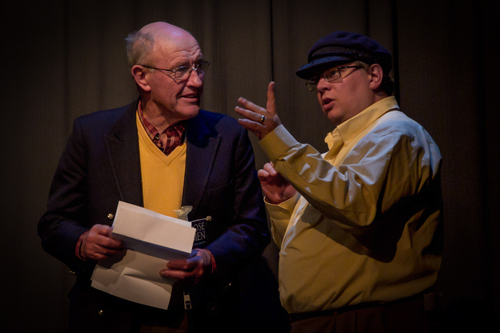
David Cheoros and Jerry (l) sorting out some admin details. (ph Kim Fong)
David Cheoros and his wonderful team organized everything to a “t”. My flights were booked and when I arrived in my hotel I was astonished to find an empty beer carton with a carefully labeled sticker attached. The sticker stated “beer in fridge.” Many volunteers ran me to and fro  - thanks to Pamela, Kathy and John.

Dr. Ole Nielsen at Litfest
My presentations started in the Strathcona County Council chambers in the community of Sherwood Park.  It was here that friend and former dean of the Western College of Veterinary Medicine, Dr. Ole Nielsen, introduced me. I was given 40 minutes, which is a long spot at a literary event, and so that rather than reading from my “Of Moose and Men” book I told some stories in the style of the ancient Cantastoria tellers who used picture boards and drawings to engage the audience. Of course the most modern form of this art is electronic and I used a PowerPoint presentation to share some of my experiences with this most remarkable animal. To pay homage to Ole I also started with the opening paragraph of the book, which is a telegram sent to him from Rwanda after he had offered me the job that launched me on my university career. It reads:

UNDERSTAND JOB OFFER SASKATOON STOP ON SAFARI IN RWANDA TRANSLOCATING ELEPHANTS STOP WILL MAKE CONTACT ASAP ON RETURN TO KENYA STOP HAIGH

In one segment of the presentation I told about how moose have been domesticated through the ages. There does not seem to be an old history of domestication in Eurasia, but we do now that the Aboriginal peoples of North America were using them in this way from at least the 1600s.

School bus, or fun outing in Russia.
They have been ridden, used to pull sleighs and buggies and kept as pets. The grainy B&W pic showing a sleigh full of small children being pulled by a cow moose caused much amusement. Was it a “school bus” or an outing for fun? I have no idea.

Tatiana Minaeva at milking time
In Russia there are at least two moose farms, and it was from Dr. Alexander Minaev that I learned about a farm at Kostroma where moose are routinely milked every day. He has a fascinating web site that shows many aspects of the operation and here are some pictures from that site. The milk goes to a local sanatorium for medical use, particularly for patients with stomach problems.

One account of a moose farm in Sweden has it that this is the source of the world’s most expensive cheese. I know that one audience member tweeted this little gem and before that day was over she received notice that it has been RT’d four times. I wonder if this was because the price, at last report, was a mere eleven hundred dollars per kilo. That is $1100! Any orders out there?

My next event was at a dinner in the Santa Maria Goretti Centre as one of four authors. This centre uses the same parking lot as Commonwealth Stadium, so it was a good thing that the CFL's Edmonton Eskimos were not playing at home that night. After a chicken meal served “family style” and some excellent wines sponsored by Naramata Bench Wines we all read or told sections from our books.

First up was Marcello Di Cintio who read a section about the Mexico / US fence from, his book Walls. As he said, the entire book, by its very nature, is pretty dark. For instance one of the walls he visited during his research was the one that divides Gaza from Israel. His fence piece told the story of a musician who ”played” the wall.

Telling about large antlers after dinner (ph Kim Fong)
Then I came on. I read a short piece about the confusion caused by the Scottish use of moose as opposed to mouse and Robbie Burns’s famous poem. I followed this with a reprise of my Montreal Story Slam about the role of antlers in during the rut of moose. I have posted this one on YouTube and if you haven’t seen it you might enjoy it.

After the dessert Carmen Aguirre read from her book Something Fierce: Memoirs of a Revolutionary Daughter. The story she tells is a harrowing one and as she read an account of her struggles against the Pinochet regime in Chile I was much moved.    

AndrewNikiforuk wound up the session with a piece from his book Empire of the Beetle. He chose an account of the role of bark beetles in forest ecology. Of course, as far as Canadians are concerned the pine beetle that has wreaked such havoc in British Columbia was the main theme. As he pointed out, the beetle has been the principal regenerator of forests from time immemorial, long before humans began to try and manage the resource.

Pamela, Candace, me and Andrew at the panel session. (ph Kim Fong)
The final event of the entire festival found me at a panel session in the Milner library in downtown Edmonton alongside Andrew Nikiforuk again and also Saskatoon’s and East End's own Candace SavageOur topic was Fauna. We each read short pieces from our work, Candace from her book A Geography of Blood. Then we had to try and field questions from our moderator, Pamela Anthony, and from the floor. We tried to answer some of the questions, but as Candace carefully dodged one impossible one I realize that we would need weeks, if not years, to make any kind of meaningful reply.

We all, panel and audience alike, realized that humans are the main driver of changes in both Canadian and global fauna. I did make a point from my African experiences. Why would a family living on a dollar a day be concerned about preserving the lions that kill their cattle or the elephants that devastate an entire year’s supply of staple foods such as maize or millet in a single night’s feeding? Thoughts of conservation are all very well for us in Canada, but these folks may have a different view, and who would blame them?

In the spirit of the whole event. Jerry and Pamela (ph Kim Fong)
All-in-all the festival was an amazing experience. Thanks to David and his team for all their hard work.

Tuesday, June 26, 2012

Urban Deer - Risks to Deer


In my last post I discussed the risks to humans when deer move into urban areas. They can become a pest and a risk to humans, but also a risk to themselves. 

When I mentioned traffic accidents I was referring to damage to people and their vehicles, but of course the deer are usually the losers in these encounters. It all depends upon the size of the deer. A mule deer fawn may not damage a car at all and is unlikely to survive the encounter.  A moose will likely do terrific damage to the car or truck and may survive, but is just as likely to be severely injured and suffer before someone puts it down.

A much more serious problem for the deer arises when well-meaning folks begin to offer supplementary feed to these creatures. Of course for the people there is likely a perceived “feel good” emotion to the action, which makes it very difficult to stop them doing it. After all we all like to feel good. It’s a sort of “Disney” effect.

Few if any such folks realize that they are upsetting the natural order of things in several ways. These fall under the headings of habituation, prolonging the breeding season, inappropriate diet and increased disease potential.

Habituation
If deer, particularly the females, deliver their young in a certain area they are likely to see this as a “home” area and deliver in the same place year after year. Their fawns or calves, raised in that area, are quite likely to repeat the whole thing, but not of course in exactly the same garden or park. They will disperse a little when their mothers reject them when new youngsters appear each year and so the “occupy town” effect spreads little by little. The deer become habituated and pretty soon a “herd” of them are searching for food, mates and a predator-free place to live. Just about the only predator they have to face is the motor vehicle.

It is not just the females that fancy town life. The males also enjoy the relative safety, easily found food (more of this below) and of course, for the brief (4-6 week) period of the rut they have access to lots of females. This is where one of the major problems begins to appear.

Late breeding and birth seasons
In natural systems the males and females disperse after the rut. Indeed they may have completely different home ranges, miles apart in some cases. If the males have become habituated and the females do not have anywhere different to go the two sexes are likely to encounter one another on a regular basis, maybe more than once a day. Some of the females, especially the younger ones that are not yet big enough, may not have been bred or may not have conceived during the regular rutting time. In either case they may come into heat again and again, which inevitably brings the males into contact again. Those pheromones wafting on the breeze are powerful aphrodisiacs.

The net result is that the males hang around, perhaps for the chance to breed, or maybe just for the grub. This unnatural situation is stressful for both sexes.

In the males the stress manifest itself in prolonged retention of antlers. In normal environments the antlers fall off naturally when testosterone level decline. However, other hormones, particularly steroids, can mimic the effect of testosterone when it comes to antler cycles.  Once natural steroid levels decline and the antlers drop the males are infertile.

If the breeding season is prolonged then of course the calving or fawning season is extended. That can be very bad news for the late-born fawns.
 
 (Note here that I’m referring to deer with seasonal breeding patterns. Tropical deer like these chital or axis deer in India dance to a different drummer). There are eight does in the picture.Can you spot them all?


Of course the more late fawns that are born and survive until next year (some do) the more the breeding season is extended. It is a self-perpetuating phenomenon that can get worse over time.

Across Canada and indeed all temperate zones of the world, winter is a determining factor in the life history of deer. It may be the bone-chilling dry cold of the prairies and steppes, or the wet windy blasts of coastal regions of Europe or North America, but wherever it is some sort of protective mechanism is essential. For deer, the mechanism is to be born early and gain lots of weight and strength during the long summer days.

There is evidence that the dam’s milk may have lost some nutritional value when calves arrive late. Whether this is a seasonal effect or simply the fact that the spring and early summer forage has lost quality when those latecomers arrive is not clear.

It is not only the milk quality that is affected. Just as for the dam, the length of time before those green shoots become golden red or yellow to brown autumn leaves is reduced. As the leaves age they lose their nutritional value. All in all the fawn or calf simply lacks the opportunity to gain weight in preparation for the hard times ahead.

Late-born deer may not have developed the fat reserves or body size to withstand those winter conditions. This applies to deer of all sizes. Late-born moose calves, only six weeks behind schedule, seldom survive the winter. I once watched a late-born mule deer fawns fade and die over a few days outside our home in Saskatoon. At necropsy it had no fat reserves anywhere in its body, not even in its bone marrow.

Inappropriate diet
The country mouse and the town mouse cannot get along. One of the reason for that is that they are not used to one another’s feeding regimes. The same sort of thing applies to deer, except that for the urban deer there is none of the natural feeds available. Wild deer are real cafeteria eaters. They may browse or graze on upwards of 150 different plants over the course of a year. If they end up in town the array of feed is greatly reduced. Many of the plants with which they have evolved over tens of thousands or millions of year are simply not available.

They may end up eating poor quality, low energy, high carbohydrate feeds, especially if well-meaning people feed them bread and other “tidbits” like bread, apples, grass, alfalfa, and grains. Just like the Morgan Spurlock, the director and star of the movie “Supersize Me” they end up nutritionally impoverished.

Such diets lead to an ugly end. The deer can and do end up with grain overload, disruption of the rumen, diarrhea or impaction. Handling exacerbates the problem and they cannot be medicated or fed back to health.

All this leads to an end stage of severe metabolic problems, hypothermia, hypoglycemia, exhaustion and death.
Yellow Azalea - image from poisonous plants website


The diets are not only impoverished, but the deer also run the risk of eating poisonous plants, some of which are grown in people’s gardens.

Azalea oleander, and yew are examples among many that may surprise you.


Diseases
The increased density, poor diet and overall debility expose the deer to a range of diseases that they would normally shrug off. Many of the deer show up with poor to extremely thing body condition, poor hair coats (even almost bald) and greenish soft to liquid diarrhea.

Mule deer with lice
One example of this situation has been the arrival of exotic lice that parasitize the coastal black-tailed deer of Oregon, Washington State and Vancouver Island. This picture was taken from the Washington State information sheet on lice. Thousands of lice have been found on a single deer and not surprisingly the coats are in terrible shape.

The bottom line?
Curb your inner Bambi fixation. By encouraging deer into urban settings and feeding them remember that fawns will starve to death and many deer will die.  

THIS IS AN ANIMAL WELFARE ISSUE


Sunday, June 24, 2012

Urban Deer - Risks to Humans


Have just returned from a great trip out to very western most part of Canada. We got as far as Tofino on British Columbia’s Vancouver Island after visiting friends along the way. I also did a talk on various things related to wildlife for the Victoria Academy of Veterinary Medicine. Most present were small animal practitioners, but there were a few wildlife rehab folks there as well. I may have surprised some of the attendees by suggesting that the feeding of urban deer is simply a bad thing.

Of course it is bad for the humans in several ways.

Perhaps the mildest ”bad” is that the deer eat people’s gardens. Not just veggies, but also ornamental flowers. Most of our friends on the island have erected deer-proof fences and on the offshore Saltspring Island I think everyone has done the same.

Another concern is the potential for Lyme disease to crop up in humans. Here is an authoritative site about it. The deer do not carry the disease itself, but they do carry the ticks that spread it. The more deer, potentially the more ticks. There were ten reported cases of this nasty condition in humans in British Columbia in 2011.

Traffic accidents are of course a major hazard. There are YouTube videos to show it. 

Habituated or tame deer can be very dangerous. The females are especially so when they have very young fawns.  In this clip shown on TV news, a doe attacks a pet dog in the Victoria suburb of Sannich. Imagine if that had been a toddler.

Dr. Jay Rolfe, whom I had not seen since his graduation from the Western College of Veterinary Medicine about 25 years ago, related how a doe had emerged from hiding and flattened a young 18-year old male. In the city of Fairbanks, Alaska, a cow moose attacked and killed a pedestrian.  Newly calved wapiti are very aggressive and are a real hazard in Jasper National park. They seem to view dogs with great dislike and will attack them. I am convinced that small children (say under ten) are seen as potential predators.

If does are potential bad news rutting stags or bulls of any member of the deer family become incredibly dangerous during the rut. Each fall there are reports of so-called tame deer, usually white-tailed deer, changing almost overnight from “stroke-my-nose-please, I-love-it” to crazy killers hell-bent of destruction. One client of mine was treed for several hours by such a buck after it hit him from behind. He was lucky to escape up a nearby poplar with torn jeans and some dramatic bruises. 

As the person who posted this YouTube video wrote:
This is video of the elk rut in Estes Park, CO in the fall of 2009. The elk are in a frenzy, and don't care about people around! 
If that shows how things can get wild with non-imprinted cervids, this story shows how things may turn out.

I wrote this in Of Moose and Men.

My own scary experience with an enraged “tame” bull occurred with three hundred kilos of mind-bent, testosterone-crazed, but luckily de-antlered wapiti. He was part of a research group that I had been working with for several months. I used to visit them almost daily but had missed seeing them over the first weekend in September. On the Monday morning I entered the pen without taking due note of the changes that had happened. The bull came straight for me and pinned me against one of the uprights in a corner of the yard. As long as I stood fairly still he simply leaned on me, albeit with some force, pressing my back against the post so that I could feel each of my vertebrae creating a dent in the wood. If I tried to move he leaned a bit more—quite a bit more. I wondered if I was ever going to get out of this mess, but luckily I was with one of my students, who was outside the pen, and so I called out to him to help me. He had the presence of mind to grab a handy length of two-by-four, lean around the nearby gatepost, and give the bull a good thump on the rump. Happily the bull turned to face this new threat, giving me a chance to break the world’s standing high-jump record over the three-metre fence.

The student was Jay Rolfe, but I had failed to catch up with him before publication of the book and felt I could not use his name without his permission.  He certainly saved me from some serious injury and may have saved my life.

This sharp testosterone peak is central to the whole business of the rut and in this graph that I developed almost 30 years ago from work I did on wapiti (North American elk) I show how quickly it happens.
 
In wapiti the jump takes place about the beginning of September. In other species the date changes, but not the event. If you look closely at the scale you will see that this is a log scale. There would not be room on this page to show the actual rise in real numbers. It is about 1000 fold!

It is not just tame animals that will become aggressive. On the eleventh tee of the beautiful Lobstick golf course in Prince Albert National park a bull wapiti once took over the ground. Wise golfers used ”local rules” and teed up a hundred or so yards down the fairway. I don’t know if the scores for the shortened hole improved, but I doubt it. Golfers would have had heightened excitement levels after a meeting like that. The steadiness needed to play god golf might have been suspended.

I shall explore how the development of an urban deer culture, and especially the feeding of urban deer is an animal welfare issue in my next post.

Monday, January 2, 2012

Of Moose and Men - final edits

Of Moose and Men- final edits.
It's the second day of the New Year and a spectacular sunrise to greet us. Also the day that I have completed my final edit of the new book Of Moose and Men. The subtitle has been chosen and appears as A Wildlife Vet’s Pursuit of the World’s Largest Deer. I’ve been working off an “advanced reading copy” which lacks the colour plates and an index, but they will come, along with appropriate quotes and so on. I can share a couple of things. The first is my opening quote, that comes from a speech made by Sit James Barrie at the St. Andrews University convocation in 1922. He said:
“It is not real work unless you would rather be doing something else.”
The second is some of the material about the taming, not quite domestication, of moose through the ages. This comes near the end of the book after I have discussed many of my own experiences with them, and a bunch of other stuff about their lives, their antlers (and the role of these in moose sex) and the carnage they cause on the roads. The first written records of tamed moose in North America come from the early 1600s when French priests reported that there were moose in captivity in New France, but it seems highly likely that Aboriginal people had tamed them long before that because those same priests and later European explorers commented on how easy moose were to train, and many authors and raconteurs mention how remarkably tame a moose can become.
This photo, by Ernest Brown, will be in the book courtesy of the Provincial Archives of Alberta. It is simply titled “Moose in harness.” Unfortunately the photographer provided only a brief caption to the image: “Moose Yoked.” No other information about the location or history of this photo has been found. In 1770 Samuel Hearne, who was the first European to reach the Arctic Ocean by a mainland route across North America, noted that moose “are also the easiest to tame and domesticate of any of the deer kind.” He went further in describing the details. “I have repeatedly seen them at Churchill as tame as sheep, and even more so; for they would follow their keeper any distance from home, and at his call return with him, without the least trouble, or even offering to deviate from the path.” The deviation, or lack of it, is not constant. In 1910 a man named D.E. Lantz, who worked for the U.S. Biological Survey, gave a pithy account of this when he wrote the following about a pair of moose that had been trained to pull a buggy, “which they did with great steadiness and swiftness, subject, however, to the inconvenience that, when they once took it into their heads to cool themselves in a neighbouring river or lake, no effort could prevent them.” Also in 1910, author, explorer, and naturalist Ernest Thompson Seton wrote that that moose were “much more tractable and valuable than reindeer . . . they are docile, easily trained, exceedingly swift, and, being natural trotters, are well suited for light travel.” There are several even earlier accounts of tamed moose, especially ones that were shipped to Europe, to men like England’s King George III and to dukes who could no doubt afford the considerable costs involved. Many of these animals, however, died soon after arrival or even while on board ship. The year 1770 crops up again in this context because the first bull moose to make it alive to England was sent that year by Guy Carleton, Governor General of Canada, to the Second Duke of Richmond, who later imported two more. The duke must have acted quickly after the animal arrived in order to engage an artist, because that first one is the subject of a work, also dated 1770, by one of the great animal painters of all time: George Stubbs, best known for his wonderful pictures of horses.
The photo of this famous painting, which will appear in the colour section of the book, was kindly shared by the folks at the The Hunterian Museum, University of Glasgow, my alma mater. The animal had only his first set of antlers, and those at bottom left were included to show what a mature set would look like. © The Hunterian, University of Glasgow 2011 There are fewer records or claims of moose being used as saddle animals and some of these may be more fancy than fact. Among others these accounts include descriptions of attempts to use moose for postal delivery and as cavalry mounts in Sweden. An urban myth has it that either King Karl XI of Sweden, or his successor Karl XII, even went so far as to invade Russia with moose-mounted hussars in the late 17th or very early 18th century. This story seemed to be too good to be true and the dangers of the Internet soon showed themselves as some entries appeared to confirm it, while others made no mention. I did some digging and received this email from my colleague and friend Dr. Bengt Roken.
There is no documentation to be found in the historic literature about moose used by the ancient military. Not even their use for postal deliveries is true. During the 19th century a number of moose calves were reared and got tame and some of them could pull a sledge or carry a rider. One farmer, Darelli, published his experiences with a pair of hand-reared moose and speculated about the possible use of trained moose as superior to horses in the cavalry. From his speculations most of the tales about moose cavalries have evolved.
Hope these tidbits tickle your fancy.

Monday, October 10, 2011

Of Moose and Men

I now have the front cover for my new book to share with everyone. It is due out in the spring – probably May 1.

You might ask how I got this picture. The story is told in full in the book, but here is a summary. The animal had been immobilized (obviously) and in order to get accurate data I had designed a sling made of old webbing material that had once been used to make visual i.d. collars for moose. We borrowed a scale from the vet college and using this technique we were able to gather data on weights of over 40 moose and tabulate them according to sex and age. Using a variety of body measurements we were able to get reasonably accurate data that would give others, who lacked a scale, a good indication of the weight of the moose by simply measuring head length, spinal length, heart girth and so on. From those data they could use an equation we developed to give a reasonable estimate of the animal’s weight.

Another way of viewing this is to link to my Youtube video. This was shot in the snow, and the book cover was not set at that time, so I selected a dramtic one that was unforunately too grainy to use in print as it came from a Super 8 footage clip.Here is the link.

Friday, September 9, 2011

Talking books on TV

Link
For a change I'm uploading a video of a TV show I did with Saskatoon author and host Wes Funk who hosts a show about books and writing. It is called Lit Happens and is shown on the local Shaw TV station. Wes and I talk about two of my books. Mainly about The Trouble With Lions, but also about Of Moose and Men. I'm stil struggling with a possible subtitle of the latter. Right now I favour A Glasgow Vet's Journey With The Moose, The Whole Moose and Nearly Nothing but The Moose. Hope you enjoy the video. You can find it here on Youtube.

Tuesday, August 30, 2011

Of Moose and Men and Tony Bubenik

I thought I would share with you a little of the material from my new book Of Moose and Men. The subtitle is not yet firm, but may well end up as something like The Moose, The Whole Moose, and Nearly Nothing But the Moose.

One character whom I met several times through the years, and who was highly regarded among deer biologists around the world was Tony Bubenik. I fist met him in Prince Alberta in 1978, and then several subsequent times, including when he stayed in our home.

He was never backward in coming forward with new ideas or extending discussions. Not all his ideas proved to be correct, but he was the first to acknowledge it when they did not pan out, and to the end of his life at age eighty-two he kept abreast of developments and technology.

His output included something over three hundred articles and contributions in numerous books. He was also fluent in six or seven languages (accounts differ, probably because of differing definitions of fluency) and wrote in thirteen.
To top it all off, Tony was an accomplished artist, and we have two large watercolour crayon works of his. This one shows a scene which he witnessed when walking in the bush. He told me that the look of surprise on the animal's face was exactly what he saw. The sketches that illustrate the story I have below were also his, made from Super8 movie clips shot by his biologist wife Mary.

Tony’s early life was not easy. He first suffered persecution from the Nazis in his native Czechoslovakia (as it was then) and then dealt with the Communist takeover after World War II, when he was forced to work as a labourer. He came to Canada in 1970 and was soon recognized as one of the most innovative thinkers in the field of deer biology.

Because he was fascinated by the role of antlers in deer society Tony carried out a series of experiments related to the pre-flight displays that occur just before and during the rutting season. He loaned me a copy of Mary’s footage and his son George kindly allowed me to use the sketches for the book.

For the moose study he built a dummy head to which he could attach antlers of various sizes. Even with only two legs, as the sketches showed from these and other experiments, the wild animals reacted to them. He found a bull that had taken up residence near a pond in Ontario and proceeded with his study.
First, he put on a tiny set of antlers that matched those of a sixteen-month-old spiker and walked out from behind his hiding place when the wild bull appeared. The movie shows the bull lifting his head briefly from the water, taking one glance at the intruder, who was showing the correct behaviour in moving lateral to and not facing the dominant animal, and ignoring him. This was much as expected.

Next, as his experiment escalated, Tony exchanged the spikes for a set of super antlers, far bigger than those of the resident. This time, when the bull saw him, he again took a look, but he did not hang around. He simply retired from the scene and ghosted into the spruce trees.

Then Tony showed his true scientific inquisitiveness. He put on the last set of antlers, a set that he had constructed to match those of his subject as nearly as possible. This time he was neither ignored nor avoided.

As Tony’s drawing from the film clip shows, the bull came round the side of the pond and began the ritualized threat that precedes a serious fight among bull moose of equal rank. He dropped his head so that the massive palms would show to maximum effect and rocked his head from side to side, showing off his “stuff.” He walked forward with his forelegs spread wide and locked as if they were stilts, like Frankenstein figures in early horror films.

Not surprisingly Mary’s filming technique suffered a bit at this point as she began to retreat behind a tree. Tony dropped the dummy head, having no wish to take his proof to its inevitable conclusion.

The dummies were so convincing that, as Tony wrote:
“On two occasions moose cows offered themselves for copulation even though a short while earlier they were courted by a bull of lower rank antlers.”


Sunday, August 14, 2011

Moose sounds - moans and grunts

Link
In the past week I have learned a whole lot more about moose calls. I had known that during the rut bulls make a noise that has been variously described as a grunt, a hiccup and even, somewhat bizarrely, as sounding like “a human being in the throes of seasickness.” This last description was made by Frederick Selous, the famous hunter of African big game who came to Canada in the early 1900s.
I wonder if this bull, painted by the late Tony Bubenik, was grunting.


I also knew that cow moose make a moaning call during the rut and had believed it to be a protest to courting bulls, especially youngsters.

Then a BBC Nature story written by Ella Davies appeared about a second reason for the moan. Davies had interviewed Dr Terry Bowyer, who used to work in Alaska before moving to Idaho State University. What Bowyer showed, after many hours of observation, was that the moan has a second surprising purpose. His paper was recently published on line in the journal Behavioural Ecology and Sociobiology. He and his team showed that the moan is used as a tool to attract bigger bulls if a small male approaches. When that happens females moan more and this triggers aggression in larger males.
In fact, As Terry said in the interview
“Male aggression was more common when females gave protest moans than when they did not, indicating that this vocalization incited male-male aggression. Protest moans allow females to exert some female choice in a mating system where males restrict choice of mates through male-male combat.”

In this regard it echoes shades of human behaviour and clearly shows that there is a considerable element of female choice during the rut. When I chatted to Dr. Bowyer he told me that one of his colleagues, who read the manuscript, said to him, “This is not unique to moose, I have seen it in bars in Wisconsin.” I replied,” Not just Wisconsin, I saw it during my student days in Glasgow.” Of course we both acknowledged that this comparison is an oversimplification. As Terry said in that same BBC interview,
“Human females have far more opportunities for mate choice than do female moose because of differences in mating systems.”

The grunt of the rutting bull and the moan of the cow are not the only sounds that moose make.

As we sat over a beer during our recent writer’s retreat at the Sage Hill Writing Experience naturalist and long-time moose watcher Roy Ness of Whitehorse told me of two encounters with moose during which he heard more than just the moans of a cow.
In mid-September 1983, at the height of the rut, “I was in what's locally called the Teslin Burn,” he said.
“I was camped at the end of Grayling Lake, south of Teslin Lake, an area of regrowth that had the highest moose density in the Yukon.”
As he sat on a three-metre tall knoll at the end of the lake in the gathering autumn dusk he listened as a cow accompanied by her calf came to the shore from quite a distance away."

As I read Roy’s subsequent emailed graphic description of the next ninety minutes I got goose bumps.
“I was sitting there as it got dark and I heard the cow call. It started high and went down the register for about 10 seconds, closely repeated several times, each shorter than the last, until it ended in a couple of short grunts. She would call every five or ten minutes, each time getting closer and each time getting answering grunts from a bull at the far end of the lake.”

There was no moon that night and by the time the animals arrived in the meadow just below the knoll only the stars gave any light. It must have been magic.
“Even though they were only a few meters away,” he wrote, “I could barely discern their shapes. She continued to call for about an hour while her calf seemed to be playing—fits of running about then standing still for a while.”

I called him and as we chatted about his experience he told me that the cow suddenly became aware of him, although there was no wind to speak of. At that point “she let out the loudest sound I've ever heard escape the lungs of any animal. It was a lion’s roar with a deep loud belch mixed in. I nearly jumped out of my clothes.”
The cow took off at a great rate, down the meadow and through the willows, crashing though the bushes and letting out the same call as she went.
I wonder if the cow and bull ever got together, as happened in this picture taken in Prince Alberta National Park by Gerhard Stuewe.

This alarm call is made by both sexes.

On another occasion, in early June Roy watched a cow and her small calf feeding in some willows. “I could not see them a lot of the time,” he said during our conversation, “and they certainly could not see each other all the time. However, they both let out a series of high-pitched calls, almost like squeaks, as they stayed in touch. I couldn’t tell which was the calf, and which the mother.”

Vince Crichton from Manitoba is Canada’s senior moose biologist and has witnessed and videotaped a play fight encounter between two young bulls during which they both made sounds that closely resembled the moan of the cow during the rut. He told me “ If I had not seen them and heard their moaning I would have said it was cows – quite amazing – have video of this and I was about 20 feet from them.”

Sunday, July 17, 2011

Of Moose and Men

Link
UNDERSTAND JOB OFFER SASKATOON STOP ON SAFARI IN RWANDA TRANSLOCATING ELEPHANTS STOP WILL MAKE CONTACT ASAP ON RETURN TO KENYA STOP HAIGH.


It was 1975, and I was working in Rwanda on an elephant project. The team had taken a brief break and come to Kigali, the capital, in mid-April 1975 and had not long come off the phone with my wife Jo, who was at our home in Kenya. After the normal greetings she said, “A man called Nielsen called from Saskatoon in Canada. They have offered you the job at the vet college.”

She read out the long number, which I tried to memorize, and then I realized that with the nine-hour time difference it would be 4 a.m. in Saskatoon. Not a good time to call. Conversely, by the time Nielsen would be in his office it would be 1 a.m. in Kigali, and I would not be able to use a phone, as the post office would be closed. In those pre-Internet, pre-fax days, a telegram was the only solution to my problem. And I was intent on getting my response to him as quickly as I could.

In the half-dark of a crowded post office jam-packed with Rwandans and three other “Europeans” (as any white person was called), I struggled to compose the telegram.
Eventually I got to the front of the queue, where I found that I could hardly see the clerk behind the grime-covered glass sheet. I bent down and spoke through the grate.
“I’d like to send this cable to Canada,” I said to him, only to receive a blank stare. I had forgotten that I was in a francophone country. I switched to French, which was also a mistake, as I ran out of vocabulary after the initial, “Je veux.” I changed gears again to Swahili, which allowed us to understand one another.

Dr. Nielsen was offering me a post as a zoo and wildlife veterinarian at the University of Saskatchewan’s Western College of Veterinary Medicine. I had applied several months earlier and been waiting to hear for some time.

It was this opportunity that has led to my 36 years in Canada and the writing of Of Moose and Men. Moose are the first free-ranging species on which I carried out research work and they have fascinated me ever since. Here is the first moose that I ever worked on and his new collar. The book is now in the editing stage with publisher ECW Pressof Toronto, so I’m moving on to the next phase. Tomorrow, Monday I head to Saskatchewan’s Quapelle Valley and the Sage Hill Writing Experience (see more here) to start work on anew project that I’m calling, for now, From Polar Bears to Porcupines. Let’s see if that title holds up after 10 days of work, but meanwhile, here is one of the pictures I would likely include.

I'm not sure how good the Internet contact will be at the retreat, but if it works I will certainly keep you posted.

Monday, July 11, 2011

Of Moose and Men

Link
Just signed a contract with Jack David of ECW Press for my new book and things are moving ahead towards a spring launch. Very exciting!

The title is fixed at Of Moose and Men. The subtitle is still under discussion. Watch this space!

Here is a brief outline of what it is about.

The book provides a wealth of information about moose from all corners of the world. It covers not only my personal experiences with both tame and wild moose but also an overview of moose biology, including their specialized diet and the relationship between sex and antlers, where size really does matter. It also covers the history of moose on earth and the marked fluctuations in populations that have occurred over time. There are chapters on moose diseases (not too technical), moose and traffic, moose as a resource, and the use of live moose in several ways that range from transport to clothing, as dairy animals and as pets.


Here is a section from my acknowledgements that shows the sort of coverage that I did in researching it.

In order to do as thorough job as possible, one of my self-imposed tasks was to try and gain an understanding of the status of moose in the early twenty-first century, and to that end I contacted biologists from just about every range country, US state, and Canadian province where moose exist. I read as many volumes as I could of the Proceedings of the North American Moose Workshop, not just the publications from the workshops I was lucky enough to attend. These workshop proceedings morphed into the journal Alces, whose front-cover mandate reads: “A Journal Devoted to The Biology and Management of Moose.” I owe the contributors and editors sincere thanks for their hard work. I also consulted several books that contained useful information. When those attempts failed, I went, with some care, to the Internet. In the end I was able to obtain information on fifty-five regions—including five separate ones in Russia, which I think is excusable because there are nine time zones involved.

This is not the place to list all those who gave me valuable information, but they are of course listed in the acknowledgements.

Of Moose and Men

Link
Just signed a contract with Jack David of ECW Press for my new book and things are moving ahead towards a spring launch. Very exciting!

The title is fixed at Of Moose and Men. The subtitle is still under discussion. Watch this space!

Here is a brief outline of what it is about.

The book provides a wealth of information about moose from all corners of the world. It covers not only my personal experiences with both tame and wild moose but also an overview of moose biology, including their specialized diet and the relationship between sex and antlers, where size really does matter. It also covers the history of moose on earth and the marked fluctuations in populations that have occurred over time. There are chapters on moose diseases (not too technical), moose and traffic, moose as a resource, and the use of live moose in several ways that range from transport to clothing, as dairy animals and as pets.

Here is a section from my acknowledgements that shows the sort of coverage that I did in researching it.

In order to do as thorough job as possible, one of my self-imposed tasks was to try and gain an understanding of the status of moose in the early twenty-first century, and to that end I contacted biologists from just about every range country, US state, and Canadian province where moose exist. I read as many volumes as I could of the Proceedings of the North American Moose Workshop, not just the publications from the workshops I was lucky enough to attend. These workshop proceedings morphed into the journal Alces, whose front-cover mandate reads: “A Journal Devoted to The Biology and Management of Moose.” I owe the contributors and editors sincere thanks for their hard work. I also consulted several books that contained useful information. When those attempts failed, I went, with some care, to the Internet. In the end I was able to obtain information on fifty-five regions—including five separate ones in Russia, which I think is excusable because there are nine time zones involved.

This is not the place to list all those who gave me valuable information, but they are of course listed in the acknowledgements.

Tuesday, June 21, 2011

Humour in Storytelling

Link
I’m posting this as a storyteller and member of the national storytellers association http://www.sc-cc.com/ rather than any one of my other alter egos. Last Sunday I was one of nine members of the Saskatoon Storytellers Guild (we are on Facebook) who joined moderator and workshop leader Kevin Mackenzie (find him here)in a 3-hour session on humour. After a relaxation exercise we all told brief anecdotes about a memory of something in an early part of our lives, or in my case, in my grandson's five-year old life.

This was about the time that he caught his first fish. We were camped by Namekus Lake in Prince Albert National Park and were out in our canoes. Mathew had cast his own line while his dad, Charles, paddled along about twenty metres from me as we worked our way a hundred metres or so out from the shore. Suddenly I heard Charlie say, “Son, you’ve got one on.” Pretty soon the fish was alongside the canoe as the lad acted on the advice to keep his rod tip up and wind away on the reel.

As Charles brought the pickerel (walleye) into the boat the boy exclaimed, “So that what this is all about.”

We turned back towards camp in order to show the rest to the family the spoils of the excursion and Charles said, “Would you like to put your line back in again?”

He sort of sighed and said, “No Dad, my nerves are having party, I don’t think I could handle it.”

We all shared similar little vignettes and then got to the meat of the workshop. This was to watch Elna Baker perform a set at what was called the Rejection Show, a stand-up comic storytelling session in New York. It’s must-see for anyone, just as a great piece of humour. As an exercise it is amazing.Kevin had himself been at a workshop given by Doug Stevenson and from that session he developed a list of twelve techniques that work in humour.

There may be more, but these are the ones we tried to identify. Self effacement; hyperbole (which can be over or understatement); juxtaposition of illogical ideas; creating a context and then breaking it; the use of similes, which can be ridiculous; metaphors (which are like similes☺; tongue ties; triple or “rule of three”; idioms; false assumptions, double entendre (which does not need to be naughty); and puns. We had no trouble finding ten of the twelve.

Our last exercise was to work in pairs and try the techniques in our own stories. I used a brief extract from my new book Of Moose and Men from a chapter titled Sex and Antlers in which I demonstrate that size really does matter. This picture comes from the book.

My work partner, who also works as a face artist, clown and a country newspaper reporter, was Danica Lorer who told me story in which she advised that one should never give one’s seven-year old the car keys. You can find out more about her here

It was a well-spent afternoon.

I have deliberately not given you think link to Elna’s piece up to this point, because you would have moved away and then lost your train of thought as you laughed. Now is the time, here is the URL. You can also look her up on Google and find other pieces. Enjoy!

Saturday, June 4, 2011

New book

Link

I’ve been “off air” for just over a year as I worked hard on my new manuscript and found that I could not devote enough time to it and do a decent job with my blogging. The manuscript is now in the hands of a publisher and so I cannot do anything with it for now, so I’m going to try & get back on track. Meanwhile fingers crossed.

Here is the cover that I propose, but of course that may change. It is a single frame converted to digital from a Super8 movie that I shot in the late 1970s, so is a bit grainy.

The image also appears as part of a Youtube video that I posted a few weeks ago. You can find it on my web site under the video link or go straight to it. Here is the link
http://www.youtube.com/watch?v=Qugw7JA1cJw

I will continue to post about conservation issues, with an emphasis on Africa, but there are other things that catch my eye.

Wednesday, December 9, 2009

Murder by elk (moose)?


Linkhttp://stju.blogspot.com/2009/12/swedish-man-cleared-of-murder-after.html

An unusual report has come out of Sweden and appeared on the BBC website (here) on 28th November and on a blog called JUSTICE", FROM THE CRAZY TO THE DEEPLY DISTURBING" (here). The BBC headline reads,
“Sweden woman's 'murder' committed by elk not husband”
.
I have been trying to find out more about it since the as the report has some intriguing holes in it. Of course the first thing to clear up is that the word elk means something different in Europe than it does in North America. It is a bit difficult to figure our why the elk of North America, known as Wapiti, ever became to be called en elk, which is what the moose is known as across the pond and right round the globe as far as the Bering Strait. Elch, Alg, and others are the names in languages other than English. Idle speculation on my part makes me wonder if one of the early settlers, maybe even someone on the Mayflower, was either short-sighted or had cataracts. If he or she saw a large brown deer-like beast it might have been dubbed an elk.

Anyhoo, that aside, the story is a sad one. A man named Ingemar Westlund says he was "dragged through a nightmare" after being arrested on suspicion of the murder of his wife. He found the body of his wife Agneta, aged 63 in September 2008 and was immediately arrested by police and held in custody for 10 days.

In the initial investigation, police did not take into account the possibility of a killer elk, assuming that the animal hairs on Mrs. Westlund’s coat were from her dog. It was only when the police realized that 68 year-old Mr. Westlund was not strong enough to have inflicted the damage to his wife that they went to forensics. Scientists at Umeå University sorted out the hair types and identifed the saliva. At that point it must have been assumed that she had been attacked when taking their dog for a walk in the forest. The charges were later dropped.

One of the weirder elements of this story appears as a quote on the BBC site
“Swedish Radio International says the animals can become aggressive after eating fermented fallen apples in gardens.”

There are more detail on the “Justice” blog where it states that:
“Drunken elks attacked an old people’s home four years ago, and had to be driven back by police and hunters… Typically weighing up to half a tonne, elk are best avoided when they are tipsy. They have entered department stores, got stuck in lifts, attacked skiers and barged into kitchens.”


If the “murderer” was a bull then there is a much stronger likelihood that apples had little to do with the event.

The deer scientist in me at once raises a red flag. The sad event occurred in September. September is the month when the rut starts in moose in the Northern Hemisphere and as the month goes along the rut gets more intense.

That intensity is driven by a huge spike in testosterone (T4) in the blood. I am not aware of any exact studies of T4 levels in moose, but in elk (the wapiti version) they are well known. As you can see from this graph, which I made almost 30 years ago during a research project of the rut in wapiti, T4 concentrations increase about 100 fold in the space of two weeks. The scale on the graph does not give a true picture as it had to be altered to fit on a page or screen.

Aggression is then the watch-word and humans are targets if they get too close to the sex-crazed creature. One of my colleagues, who will remain nameless, descried a particularly randy male student (who also flies incognito) as a life-support system for an erection. A rutting male deer really does fit that description.

I have talked to moose hunters who have been attacked. They were all terrified and were mighty thankful to have guns. Poor Mrs. Westlund would have had no chance.

Even if the moose was a female and Mrs. Westlund had got too close, she would have been completely outmatched. Moose cows, especially if defending a calf, are powerful and would attack a dog much as they do a wolf, using the front feet to strike and pound. Imagine 400 kg or more of enraged moose, bull or cow, up against a woman and a dog. No contest.

Another sad element. Mr. Westlund was shunned by his neighbours. “When I and my children bade farewell to Agneta at her funeral in front of 300 mourners, I was suspected of murdering her — can you imagine what that means?” he said. He is now seeking compensation.