March 20 is World
Storytelling day and around the globe tellers will gather and share. Not just
the 20th, but on dates near it. In Saskatchewan
the Saskatchewan Aboriginal Literacy Network Inc. and the Saskatchewan Indian Cultural Centre
help coordinate events around the province and I was able to get to several such affairs in and around Saskatoon. This fabulous piece, titled Circles Close was designed and crafted by Leah Dorion was used as major drawing card by the SALN. You can see an array of her work at her website.
help coordinate events around the province and I was able to get to several such affairs in and around Saskatoon. This fabulous piece, titled Circles Close was designed and crafted by Leah Dorion was used as major drawing card by the SALN. You can see an array of her work at her website.
I have already written about the Saturday night get-together at the
Wanuskewin Heritage Park.
A major event, designed primarily for school children, was actually two
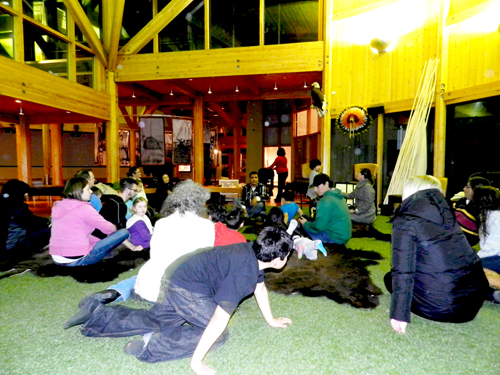
events, two weeks apart, at the SICC’s White Buffalo Youth Lodge. I was able
to get to part of both days and meet up with Barry Akenakew and Darryl
Chamakese, who were both so helpful in sharing stories and letting me use
them in Of Moose and Men. I was more or less lost in the crowd of
several hundred children from schools all over the city, but I did have a
chance to meet and listen to new-to-me tellers and heard new stories.

John Spyglass had four sessions, two on the 15th, and two more on the 29th. He is an experienced teller and delights in using his large collection of artifacts to build his stories. With pupils from the smallest grades he used a mixture of reading, games and “dressing up” to keep the children enthralled for some eighty minutes – quite an achievement for this age group.
One thing he did was classic. About 45 minutes in, when the children might have become restive, he suddenly switched and got all the kids (and the teachers) going with versions of “Incy Wincy Spider” (aka itsy bitsy spider). Of course they started with the standard one, but John then took it all to new levels by having us perform the rhyme in various voices, angry, sad, funny, quiet, loud and so on.
 On either side of the rhyme he showed us
many different pieces of traditional art. A beautifully decorated cradleboard
and moss bag had a big doll inside it and one of the children must have had a
memorable moment when she was selected to wear it. Other children donned headdresses
and various garments.
On either side of the rhyme he showed us
many different pieces of traditional art. A beautifully decorated cradleboard
and moss bag had a big doll inside it and one of the children must have had a
memorable moment when she was selected to wear it. Other children donned headdresses
and various garments.

In the session on leap day John’s audience were older – from grade nine. The room was packed and John changed up his performance to fit the group. Partly because we hardly had room to move and partly because of the ages of the audience he only demonstrated the various items. Here he is holding a buffalo headdress as he explains its significance.

I leap-frogged between various
sessions but made sure that I heard Barry
Ahenakew’s wonderful tale of the buffalo child in full. Like many (maybe
most?) good stories this one can go on for a long time, but Barry crafted it to
fit the time available. Of course I am not going to even try to re-create
Barry’s telling, with is voice changes, actions and mood swings, but basically
the story revolves around the challenges faced by a young boy who grows up
among buffalo (bison) but returns to his human village to marry and have
children. He goes back and forth between the two societies, shape-shifting all
the while. For the ending, you will have to find a way of hearing the story from
Barry.
 Darryl was not so much a teller during these two days as he was a
facilitator, but I did manage to capture a quick snap of him and Barry, with
crowd of children behind them at the end of the morning session.
Darryl was not so much a teller during these two days as he was a
facilitator, but I did manage to capture a quick snap of him and Barry, with
crowd of children behind them at the end of the morning session.
I was only able to take in one other event. Elaine Greyeyes, daughter of renowned storyteller, the late Freda Ahenakew gave us an account of
her mother’s legacy. Freda compiled, edited and wrote twenty books of Cree
stories. As Elaine said, her mother was
preserving the culture in an important way.
We both feel that the writing down of these stories is vital. At a time
when so may old cultures are falling under the hammer of lost language, modern
toys (smart phones and the like) and a general wish of the younger generation
to “modernize” the ancient stories, be they from Africa, Canada or any other
culture, can only be preserved in the writing.
One Cree elder told me that by writing the stories one kills them. Most of
the people I have met, and all those I have mentioned in this post, agree that
they are not so much killed as placed into suspended animation. When re-told
they are resurrected. Indeed that may often be adapted ot the audience,
something that is often a vital part of the storytelling craft.