Showing posts with label giraffe. Show all posts

Tuesday, November 27, 2012

Stories of Africa, and telling them


I was recently invited to do a guest blog by Karen Chace. In it I discussed the use of images during storytelling sessions and my hypothesis that they may have a very ancient origin that goes back as far as the artists who made petroglyphs and pictographs. Some of the art work is of stunning quality, and as good an example of that as any lies in the extraordinary Chauvet caves of southern France, a subject I have blogged about before .

Giraffe, eland and freinds at Twyfelfontein
Of course these are not the only examples of cave art. I have chosen this one, a photo taken at Twyfelfontein in Namibia because of what comes below.

You can easily link to that guest blog here.

I posted the link to several of my contact pages and it has generated a lively discussion on one of the LinkedIn ones. a members only group one can join StoryTellers - The Oral History Group.
A general conclusion is emerging that there are many ways to tell stories and we should open our minds to them.

I mentioned that I use both oral and visual telling techniques, sometimes in one presentation. For those who use PowerPoint (the latest evolutionary form of cave art) this is simply done in the middle of a talk by hitting the “B” key (I'm a Mac guy, don't know about PCs). The screen goes blank and one can then step up and let the audience focus solely on the teller. Hit the “B “ again and one is back to the picture.

Here is a brief example from a recent school tour. Using no pictures I opened with a bit about myself and how my first memory was of a giraffe’s legs heading away through the trees. Then I told the children about my return to Kenya after vet school in Glasgow and how the very first animals I saw were three giraffes peering at me from inside Nairobi National Park.

Next up was a description of how, three days after arriving as an intern at the Kenya vet school I had to treat a giraffe with footrot. This term is self-descriptive, and needs no gory technical explanation. However, some of my audiences have been in rural schools and many of the kids knew exactly what I was talking about. Of course this gave me the chance to link to their own experiences of watching a vet or parent medicate a cow with the condition.

This let me describe the problem of injecting a giraffe and let me use this phrase: “Of course there were as many giraffe in Glasgow (where I graduated from vet school) as there are in "Homeville" (name the community I'm in). I then climbed the imaginary walls of the chute where the giraffe was standing to inject him high above my head. (Actions: climb, stretch, grunt, inject)

With the three giraffe images now established I switched to the old folk tale about how the giraffe became so tall.  It involves a conversation with an owl, a long walk, a witch doctor, a magic potion and the failure of giraffe’s friend the none-too-intelligent rhino, to arrive on time at dawn to get his own helping of the potion.

Of course this set up later folk story about another stupid rhino, again told after the “B” has been touched.

After that fun account I ran the projector again and showed the kids an entirely silent movie clip that I made myself in the early 1970s of rhino capture. It runs about 4 minutes and as it has no script I made the odd remark, telling the tale of how and why we did the work. I can't add it here, but if you haven’t seen it, it lies embedded under the video tag on my website. The kids were enthralled.

Mum waits in case the little guy needs help. He didn't
To wind up this post I have added a few pictures that I showed the children. These ones were of the Aaaah, or Ooooh variety and needed few words. They are examples of things that the kids may not have seen or can enjoy for the images' own sake.

The shy little girl with her Teddy Bear, knitted by ladies of a group who call themselves "Teddies for Tragedies" is probably receiving her first ever gift. She is one of 147 kids in an AIDS orphanage school we linked with and supported.

I showed the baby rhino being bottle fed after the capture movie. A winner!

 
This is a humorous one, again needing no script.  As one teacher said to me after the talk, "Anything with bums or poop stories will be a winner."

If it itches, scratch it.


Thursday, March 29, 2012

Giraffes in Kenya


Now that our daughter Karen has had time to select from the mass of photos taken during our 3-week trip to Kenya in late November and early December I can share some with you.  These are all of giraffes, and feature the three species found in various parts of the country.


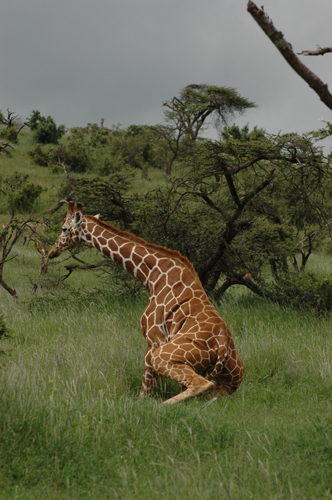
First up, the beautiful Reticulated giraffe (my favourite), found only in the north-eastern part of the country. These ones were photographed on Borana, where the cover picture of my entire website was taken a few years ago.


This series from Borana showing an animal getting to its feet was not taken by me, but either by Karen or her husband Robert.


Might as well have a feed now that I'm up


We had three cameras on the go the whole time and the other photos below are more difficult to assign.

We saw this bull seeming to take shade under a big thorn tree in Nakuru National Park


He is a Rothschild’s giraffe. How can you tell? There are two features. First, the Rothschild is the only one in Kenya that has no varied marking below the hock or carpus (aka, and mistakenly, known as the front knee). Second and only present in the bull, there are five horns.  The three in front, two larger and either side of the ears, and one knobby one dead centre. The other two can only be seen from the rear, and are smaller that the side ones. Take a look and you will see them. 


These Rothschild’s were also in Nakuru NP, and two of the bulls were competing in the necking ritual. Quite a contest.

 
Rothschild’s giraffes were once restricted to the extreme west of Kenya and the last remnant population was translocated to Nakuru about 30 years ago from Solai, not far from Kitale and the Uganda border. There are Rothschild’s in Uganda, most abundant in Murchison Falls NP.


Then we saw Maasai giraffe in the Maasai Mara where we spent two delightful nights at the Porini  camp of Gamewatchers. (Porini is a Swahili word mean “in the bush”, “in the wilderness” etc).

I love the way this fellow's mane falred as he ran to catch up with is herd-mates

I had saved an extra giraffe treat for the family on our last day. We went to the Giraffe sanctuary near Nairobi and there saw a few Rothschild’s giraffes that had been there since 1979. You can see more about them at their website here. Some of the giraffe are so tame that they will take food out of the mouths of willing tourists - Karen included.

However, the guide warned us that if you stand too close, and have no food to offer, the impatient would-be feeder might well bludgeon you.

Sunday, November 8, 2009

Giraffes in Niger


Linkhttp://news.bbc.co.uk/2/hi/africa/8349712.stm, http://www.wcs.org/

Wildlife in Niger has been in serious trouble form poachers and hungry people for many years. One species that has been extirpated from the region is the scimitar-horned oryx, seen here in Texas and most of the world’s remaining members of this species now reside in North America. Indeed several exist on private game ranches. In the late 1980s I visited one such ranch in Texas where a philanthropic oil man had give over a large chunk of his land to their propagation. One of our party asked him “Why don’t you send some back to Niger?"

His reply – “Why would I? Everyone and his brother has an AK47. The animals would not last a month.”

So, the recent story from the BBC webs site about the resurgence of the West African giraffe in Niger is all the more remarkable.

As the reporter Martin Plaut writes
“From a herd of 50 animals, careful conservation supported by Niger's government has seen their numbers rise to around 200.”


Mind you this is still only a fraction of what once was an enormous number of these remarkable animals that roamed right across the region all the way to the Atlantic coast.

As I wrote in my blog of December 31, 2008 there are now five recognized species of giraffe. You can see four of them in that blog, but I have never seen the West African species, the rarest of all. My only chance to do so would have been in northern Cameroon in 1996, but I was fully engaged in an elephant collaring project with New York-based Wildlife Conservation Society. If you would like to read how very difficult this project was you can do in chapters 10 & 11 of The Trouble With Lions.

The good news in this BBC story is that the giraffes have been seen within 60 km of the country’s capital city Niamey and the government has banned all hunting in the hope that the animals will help with the tourist trade.

Sunday, April 26, 2009

Masai Mara Wildlife Populations


Linkhttp://news.bbc.co.uk/2/hi/africa/8008700.stm, http://www.physorg.com/news159599572.html

A report on the BBC website (here) shows once more how wildlife populations in Africa continue to decline in the face of human population expansions. With annual increases in the human populations continuing to be over 3%, and in some cases even over 4% this is not a big surprise. When you put those numbers on to a spread sheet you soon learn that the number of people will double roughly every twenty years. The increase in human settlement has a direct effect jupon the wild animals
Of course these people need a place to live and so the number of dwellings increases, and also the number of cattle, as cattle are the main currency for the tribes in the area and even more, for the Maasai, they are the reasons to live.

Here a herd of wildebeest in the foreground is living almost cheek by jowl with cattle that are linked to the Maasia manyatta in the middle of the picture.

Hunting, although illegal inside the reserve, is another factor. It is conducted for food and profit as the bushmeat trade lends significant income for some families.

A study telling the story and conducted by a team from the International Livestock Research Institute (ILRI) has recently been published in the May 2009 issue of the British Journal of Zoology.
"The situation we documented paints a bleak picture and requires urgent and decisive action if we want to save this treasure from disaster,"
said Joseph Ogutu, the lead author of the study and a statistical ecologist at ILRI.

“Numbers of giraffe, warthog, impala, topi and hartebeest fell by 50% or more between 1979 and 2002.”

"The numbers of lions are going down. The cheetah numbers are declining. The wild dogs in the Mara system have become extinct."

By 2002, numbers of giraffe in the reserve had fallen to 20% of their 1979 levels, the bulk of those losses occurring before 1989. Topi and hartebeest in the reserve fell to less than half their 1979 levels, and almost disappeared in some of the neighbouring ranchlands where they once grazed. Impala fell by 70% in the Mara itself, while warthog fell by more than 80%, although their numbers appeared steady since 1989.

Is there any chance that human population increases will flatten out? Not much, when all the elements are factored in. The Pope has again condemned the use of condoms, and for many people large families are simply a fact of life. The doubling effect is relentless and the pressures on the ecosystem will continue.

Friday, March 20, 2009

Meru National Park

Meru National Park in Kenya has long been one of our very favourite places. It was here that I treated my first two rhino cases, which almost certainly led to a 40-odd year career in wildlife medicine. The chapter titled The Four-Gallon Enema in Wrestling With Rhinos describes one of those cases.

Since then the park had had its ups and downs, as I described in The Trouble With Lions, but it still a beautiful place to visit. This year we were not disappointed and saw more of the graceful, shy, lesser kudu than we have ever seen before. They are a miniature version of the greater kudu that is the emblem of the South African National Parks system, and also occurs in Kenya. The first of these two photos shows a greater kudu bull at Borana, a private ranch with a beautiful up-market lodge. We saw the bull in the second photo in Meru just a couple of days ago and this is a female just about to disappear into some bushes.
We also saw a lesser kudu calf alongside a reticulated giraffe as they watched us from across the Bwatherongi river.

Meru NP also has a wide variety of bird species, among the most spectacular of which are rollers, both European (this one twisting his neck to look up) and lilac-breasted. Yellow-necked spur-fowl are abundant, but one does not see them much after 8.00 am or before 6.00 pm when they emerge from the grass to gather gravel on the roads. I tried to get a pic on this blog,but my connection had a brain fart, so I'm using a friend's computer. I'll get one up later.

Wednesday, March 4, 2009

Semliki and Shoebills


Linkwww.wildplacesafrica.com

From Murchison it was a brutal 10 hour drive to Semliki, only 150 km by water (achievable in 3 hours or so in a speed boat) but more like 280 km by road, only 50 km on tar, the rest on ruts, ridges, rocks and occasional smooth murram. Felt like we had been through a particularly bad massage, or maybe 10 rounds with a latter day Muhammad Ali.

We had booked in the Semliki Safari Lodge, and it is really beautiful. Each room is entirely independent, and none are visible from one another. Comfort, great food, beautiful setting overlooking the Wassa river valley, and both black & white colobus and casqued hornbills to greet us.

The only other guests were Peter & Elka Moeller, friends of Ludwig Siefert, with whom we have just been working. Peter had just retired after many years in Uganda and he too has a passion for things wild, having founded a German NGO called Foerderkreis fuer Ugandas Tierwelt (Foundation For Uganda’s Wildlife) after the disasters of the Amin and then the Obote years.. He has been a filmmaker (for German TV) a builder, and was involved in the translocation of eland from Lake Mburo and Rothschild giraffe from Lake Nakuru NP in Kenya to Kidepo Valley NP in north-eastern Uganda.

The highlight of this trip was undoubtedly the boat trip to the papyrus swamp on Lake Albert. On the way we passed a large fishing village and watched as two boatmen rowed their canoe-like craft out from a sheltered cove. A close look at the picture seems to show that they are rowing stern first, but all such boats were propelled in the same way. The oars are simply flat boards that have been shaped a bit at the handle end.

Our hosts, Mark and Kristin Vibbert had not told us that the chances of seeing a Shoebill stork were good. We saw three, close up and personal, and one of them moved to grab something in the water, but we never saw what is was.

One of the films that Peter Moeller made was about these extraordinary birds, which live only in papyrus swamps and stand waiting for movement of things under the floating vegetation. They then grab at the movement and if it is a fish they kill it with the sharp hook at the end of the upper bill.

There were many other water birds along the swamp edges. This purple heron, that had been lurking in a patch of floating weed surprised us as it left in a hurry and a pair of fish eagles regaled us with their evocative cries.

R & R in Murchison Falls NP

Students away safely on Friday evening and due for some R&R in Amsterdam. Hope we did not work them too hard. I don’t think so & I received a moving and kindly though-of book of paragraphs written by each one of them saying how the experience had affected them. Not for sharing here, but something for me & Jo to treasure.

As they were landing in Holland Jo, Geraldine (her sister) and I headed out on a week’s R&R of our own. Our vehicle was a Land Cruiser belonging to my colleague Dr. JB Nizeyi and driven by professional driver/guide Dauda, which took all the pressure off us, me especially, as I have no driving to do for a whole week.

Our first stop was Murchison Falls NP, and this where we spent 2 nights, saw many species that we had not seen on other parks, had a great ride on the Nile in the tour boat, and enjoyed the rest.

Highlights included close-encounters with pair of Abyssinian Ground Hornbills, shown here, with the male having both red & blue bare skin over cere and neck, the female only blue. These turkey-sized birds are almost never seen flying, but stalk purposefully through the grass looking for food over large home ranges.

We also saw lots of Uganda kob, Rothschild’s giraffe, buffalo, warthogs and hundred’s if not thousands of Abdim’s storks, which were scattered everywhere, also foraging when not circling on the thermals. I almost forgot to mention two other mammals, one common, one less so. Oribi, a dainty antelope with a distinctive black spot behind the eye, are the common ones. Leopard the others. Our most unusual sighting was of a very close association between these two when the cat crossed the track in front of us carrying a partly devoured example of the antelope.

As we circled on one of the many tracks we came across this old bull elephant having a good scratch against the trunk of a Bourassas palm. It must have felt good!

Wednesday, December 31, 2008

Giraffe taxonomy

For years there has been a usually friendly debate among taxonomists and biological scientists who fall into one of two camps. These are the “lumpers” and the “splitters”. I have always been a fence-sitter on this, as I do not know enough about the pure science to make a meaningful contribution. A recent report that reached me through the newsletter of the International Giraffe Working Group (IGWG) may lay the debate to rest, at least as far as giraffes are concerned. This beautiful image, which appears here in the on-line journal BMC Biology is not a fanciful depiction of a multi-coloured palm leaf, but shows how six different groups of giraffes can be divided at the species level through the wonders of DNA technology. Many of the species separated as long as a million years ago. The ten-author study was led by David Brown, from the University of California, Los Angeles.


There are some obvious differences in appearance among the species, the most striking of which is the chocolate-coloured and clearly delineated coat pattern of the reticulated giraffe from Kenya’s north-east, which here in the first picture, taken at Borana. For those who wonder, the mountain at the back is Mt. Kenya. As for Borana, you can find out more about the idyllic lodge and setting here.

A closer view of these striking beasts show four of them in close association. Two are “necking” a competitive activity which ecologist Richard Estes describes in these terms (the) “Movement and counter movement appear rhythmical and synchronized, imparting the sinuous grace of a stylized dance”.

There are two other species of which I have my own photos. This one shows a group of Rothschild's giraffe, in Uganda’s Murchison Fall NP.

This photo of Rothschild giraffes taking the midday shade under a Fever Tree, was taken in Lake Nakuru NP, to which the founding herd had been translocated from western Kenya when the land they lived on had been developed for farming. Lake Nakuru is outside their traditional range, but the herd has been used as a source for subsequent translocations, notably back to Uganda, where numbers have been in decline ever since the ravages of Idi Amin and his armies.

And then there is the Masai giraffe, which is the first kind that I saw as I left Nairobi Airport (before it was named after Kenya's first president) in 1965, three days after graduating from veterinary school in Scotland and 16 years after leaving the country of my birth. I saw this group below the Ngong Hills, just outside Nairobi a few months later. Sadly there are not may there now, as poaching pressure with gun and snare has been relentless.

The speciation may not stop at six. Author David Brown and his colleagues in their paper in the BMC online journal state that
"The discovery of potential giraffe species may not be over. The Thornicroft's giraffes are a morphologically distinct population of giraffes endemic to the Luangwa Valley in Zambia, and a key link between the African continent’s north and south populations. The population is biologically isolated from other giraffe populations and as such is ecologically and potentially genetically unique."

In common with much else in the wildlife world, all over the globe, the numbers of giraffe are declining, in concert with expanding human populations. As Brown and his colleagues state
"There has been an estimated drop of 30% decade to less than 100,000 giraffes remaining on the continent."

Nowhere is this more apparent than in West Africa, where bushmeat hunting activity is rampant. Here is what Brown and his co-authors have on this part of the story.
"Within the peralta group of West-Central African there are only about 200 giraffes remaining in all of West Africa west of Cameroon where until the mid-20th century there were perhaps thousands"
.
There are several other fascinating articles in the IGWG newsletter that is edited by Dr. Julian Fennessy, so for those as captivated by these magnificent animals as am I, I suggest that you make contact with him. I cannot give you his email address here - that would be inappropriate, but he may choose to add it in the comments section to this posting.