Showing posts with label hyaena. Show all posts

Wednesday, July 16, 2008

Storytelling. A cowardly prince and a rhino.


Have just started to come down off a high after attending a second storytelling conference, followed by a three-day workshop & class run by Jennifer Cayley and Jan Andrews.

The conference, the annual gathering of the Storytellers of Canada-Conteurs du Canada (SC-CC) followed only two weeks after the other storytelling gathering in Saskatoon that I reported on in my blog of June 22nd was organized in Saskatoon by the team led by Kathy Bennett, Judith Benninger and Bonnie Logan, with other members of our local guild helping out in various ways.

There were many high points during the conference, too many to relate here, but Judith’s last-minute filling-in for an absent concert star on the Saturday night was, for me, quite special, because she dipped in to her huge repertoire of African folk tales and told us about a cowardly prince who first rode on the back of a hyaena, then a hung-over lion (believe me, this was important to the story), grunting in terror both times, thus winning the heart of a princess in the next kingdom and the permission of her father for a wedding. The prince ended up routing an invading army as he rode, (the grunt in fright again) on the back of a huge horse. He was followed by his warriors, who copied the noise, assuming it was his war cry, as he pulled up trees in an effort to stop the animal’s mad dash towards the enemy, who collectively took one look at this amazing sight and fled. Of course they all lived happily ever after – it would not have been a folklore tale otherwise. In reducing this story from its original 15 minutes to 4 sentences I have lost the atmosphere, but even writing it out in full would not convey the proper feeling - especially the grunts.

The workshop that followed, also dubbed a master class, had only eight students, so we had lots of chances, over the three days of the sessions to learn techniques of voice pitch control, range, and the visualization of scenarios. The other “students” were all experienced storytellers who used traditional folk tales from a variety of cultures.

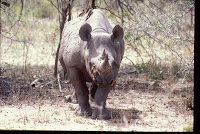
I try to tie African animal folk tales into life experiences and I started the story out with my first attempt to capture Black rhino, moving into the story of how rhino used a porcupine quill to repair his skin after being beaten up by elephant, which explains his territorial behaviour and his untidy skin. You can find it here in the form that I used for writing it as a piece for reading. Although it had interesting content the group quietly suggested that it could take a lot more scene-setting and personal involvement. Six hours of writing and re-writing, late at night and early in the morning, gave a whole new structure to the story. When I re-told it at the end of the gathering I had added quite a few elements and Ottawa storyteller Lucie Roy voiced a thought that “The first time you told it, it was an interesting anecdote. While this time you were telling a story.” This time the rhino really did have wrinkly skin. Another thing that soon became obvious was that writing for telling is a different skill than writing for reading. I still have to explore that side of things, as there are so many wonderful traditional tales that I can link to real-life experiences. Among them, why hippos live in water, how the zebra got his stripes, how the leopard got his spots and a favourite, how the tortoise’s shell became criss-crossed.

Storytelling. A cowardly prince and a rhino.


http://www.jerryhaigh.com/books/wrestling_with_rhinos/images/rhino_folk_tale.pdf


Have just started to come down off a high after attending a second storytelling conference, followed by a three-day workshop & class run by Jennifer Cayley and Jan Andrews.

The conference, the annual gathering of the Storytellers of Canada-Conteurs du Canada (SC-CC) followed only two weeks after the other storytelling gathering in Saskatoon that I reported on in my blog of June 22nd was organized in Saskatoon by the team led by Kathy Bennett, Judith Benninger and Bonnie Logan, with other members of our local guild helping out in various ways.

There were many high points during the conference, too many to relate here, but Judith’s last-minute filling-in for an absent concert star on the Saturday night was, for me, quite special, because she dipped in to her huge repertoire of African folk tales and told us about a cowardly prince who first rode on the back of a hyaena, then a hung-over lion (believe me, this was important to the story), grunting in terror both times, thus winning the heart of a princess in the next kingdom and the permission of her father for a wedding. The prince ended up routing an invading army as he rode, (the grunt in fright again) on the back of a huge horse. He was followed by his warriors, who copied the noise, assuming it was his war cry, as he pulled up trees in an effort to stop the animal’s mad dash towards the enemy, who collectively took one look at this amazing sight and fled. Of course they all lived happily ever after – it would not have been a folklore tale otherwise. In reducing this story from its original 15 minutes to 4 sentences I have lost the atmosphere, but even writing it out in full would not convey the proper feeling - especially the grunts.

The workshop that followed, also dubbed a master class, had only eight students, so we had lots of chances, over the three days of the sessions to learn techniques of voice pitch control, range, and the visualization of scenarios. The other “students” were all experienced storytellers who used traditional folk tales from a variety of cultures.

I try to tie African animal folk tales into life experiences and I started out with my first attempt to at capture of Black rhino, moving into the story of how rhino used a porcupine quill to repair his skin after being beaten up by elephant, which explains his territorial behaviour and his untidy skin. You can find it here in the form that I used for writing it as a piece for reading. Although it had interesting content the group quietly suggested that it could take a lot more scene-setting and personal involvement. Six hours of writing and re-writing, late at night and early in the morning, gave a whole new structure to the story. When I re-told it at the end of the gathering I had added quite a few elements and Ottawa storyteller Lucie Roy voiced a thought that “The first time you told it, it was an interesting anecdote. While this time you were telling a story.” This time the rhino really did have wrinkly skin. Another thing that soon became obvious was that writing for telling is a different skill than writing for reading. I still have to explore that side of things, as there are so many wonderful traditional tales that I can link to real-life experiences. Among them, why hippos live in water, how the zebra got his stripes, how the leopard got his spots and a favourite, how the tortoise’s shell became criss-crossed.
Wednesday, June 18, 2008

Furadan again

Each week the Canadian Broadcasting Corporation puts out several excellent shows that fit into the “Investigative Journalism” box. Recently (May 26th) the host of one of those shows, Rick MacInnes-Rae, did an in-depth report on environmental issues from Cambodia and Russia’s Lake Baikal. I have added below the email letter I sent to the comment box on the show’s email address. Not long afterwards Rick contacted me to find out how to pronounce my name so that he could read the piece on air. Of course he edited it a bit, as all good hosts are likely to do. I have asked if I can make a copy of the email as an audio clip, but have not yet heard back from Rick or the copyright folks at CBC. If they do give the go-ahead I will add it to this blog. (By the way, the name is pronounced like the famous Dimple Haig scotch)

Meanwhile if anyone wants to hear the show they can get at it though the CBC web site. The full 50 odd minutes of each show lie under Dispatches, June 16, 2008 -- Mumbai, India, Montreal, Iraq, Managua, Nicaragua, Woodland Hills, California 
or Dispatches, May 19, 2008, Cambodia, Siberia, Oxford, Beirut, and Washington.

I missed the May 26th show that has a cryptic précis that goes “Pygmy elephants versus palm oil.” I’ll pick that one up as it would seem to fit the theme.

So here is my letter in response the Cambodia & Baikal reports of May 19.

Rick,
It was good to hear this evening that Dispatches continues to tell people about wildlife and conservation issues all over the world. The stories from Cambodia and Lake Baikal are part of that genre, and it is important that you folks continue that line.

Another story that might interest you and your listeners is the use of the agricultural pesticide carbofuran, sold in East Africa as Furadan, which as been wreaking havoc on wildlife populations. The chemical is not only effective as an insecticide, and no doubt proves useful in crops ranging from cotton to maize, but it is also a deadly poison, in minute amounts, for large mammals and birds. I have been taking Canadian veterinary students to Uganda for several years, where we link up with students and faculty from the Makerere University’s Department of Wildlife and Animal Resource Management and study the complicated matrix of the human x livestock x wildlife interface. We have witnessed first-hand how lions in Queen Elizabeth National Park have been poisoned in revenge killings. It is not only lions. An entire clan of hyaenas was wiped out late last year, and vultures have virtually disappeared from the park. Where we saw hundreds in 2007, we saw only one in February this year. The cattle herders in the park have become adept at hiding their use of the poison and are alleged to now be using it preemptively. If a small calf is killed by being given a dose of Furadan orally, and then left to die in the open, any predator feeding on the carcass will also succumb. A recent example of this occurred in Kenya’s famous Maasai Mara when a poisoned hippo (a crop raider?) was partially consumed by lions. Four of them developed signs of poisoning, and two of them died.

There are lots more factors around this subject, but I hope that this note will stimulate you sufficiently to pick up on a possible story and highlight an increasing threat to conservation in Africa.

Another great investigative journalism show, well worth a listen whenever you get the chance, is the CBC's As it Happens. Go for it.