Showing posts with label Karl Amman. Show all posts

Saturday, February 8, 2014

Bushmeat and the African Trade to Europe

Last week I was in Peru and met an experienced airline steward who has flown with major airlines for many years into, and more to the point, out of several West African capitals. We got chatting about the bushmeat situation, something I have written about in books and on blogs for several years.
 
One of Amman's many pictures of the bushmeat trade

Of course writers with bigger followings, like the remarkable Karl Amman have written and photographed bushmeat and poaching stories to a wide audience. He also graciously allowed me to use some of his images in my book The Trouble With Lions .

The late Anna Mertz, who worked as an engineer in West Africa for many years reported on the horror show of truck loads of dead and badly injured antelopes appearing almost in food markets in Ghana long before the bushmeat trade issue reached a wider global audience.

My steward acquaintance told me that loads of bushmeat continue to come out of Africa bound for the UK with every flight. It is packed in passenger luggage, and the security officers who check bags before departure have no interest in, and probably no jurisdiction over it.  They are concerned with weapons.

The airplane staff can do little about it either. They do try to curtail the excess baggage situation, but even that is a hopeless task, as the routine response from Nigerian passengers is that a white-skinned staff member is picking on a black person. Inevitably some of the bags leak their contents and many planes end up with bloodstains and bad smells.

In Kenya Ann Olivecrona told me how she chanced to witness a bushmeat import at London’s Heathrow airport. As I wrote in 2008:

“in May 2004 she witnessed an amazing interchange involving bushmeat at London’s Heathrow airport. Her plane happened to arrive at more or less the same time as a flight from Lagos. During the time that she watched the procession, customs officials stopped every one of the Nigerian passengers and asked for the huge suitcases to be opened. Almost all were packed with smoked bushmeat.”

The bushmeat trade poses serious risks at both ends.

In Africa it is leading the rapid depletion of wildlife populations. Many species are involved. While primates are the most evocative for most people, the most popular species is the cane rat of the genus Thryonomys, known locally as cutting grass. They can weigh as much as 10 kg in the wild and in most West Africa countries efforts have been made to rear them for the meat market.  

Credit: Aurélia Zizo/Wikipedia

Here is a picture from the Wiki of one such rat, a male Greater Cane Rat (Thryonomys swinderianus) in a breeding station in Owendo, Gabon. 

Many tribes in the region have long held certain species taboo. Not any more. Anything goes.  One example is the African buffalo, long deemed off limits to one clan in Ghana. In October 2001 Ghanaian journalist Vivian Baah wrote a series of articles under the title “Guess What’s Cooking for Dinner?” in the Evening News of Accra. She related how in parts of Ghana:

“among the Ekona clan of the Ashanti's, it is a taboo to kill the Ekuo (buffalo). But these days, the members of this clan themselves are the worst offenders. Having turned their backs on the taboo, they now butcher the Ekuo with cheeky ease.”
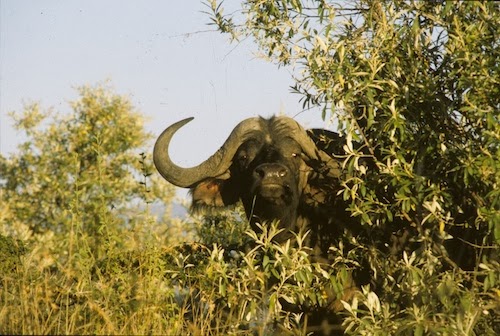
Cape buffalo - aka Ekuo in Ghana

Of course this process will inevitably lead to the law of diminishing returns. Species will simply disappear or become rare.

In Europe there are serious disease risks. Much of the continent has an endemic foot-and-mouth disease status. If the disease gets into UK, for instance, it will cause billions of dollars worth of economic damage. All it needs is for some improperly preserved meat to carry the virus to destination. A little bad luck or carelessness and the explosion would take place. If this seems unlikely one only has to look at my home province of Saskatchewan, where, in 1952, illegally imported smoked meat from Poland led to the last outbreak of FMD.

Fruit bats roositng in Uganda


It is not just livestock diseases. Ebola and the closely related and equally deadly Marburg virus can infect humans who handle primate and fruit bat carcasses (fruit bats are a popular bushmeat item).

 HIV/Aids came to humans via chimpanzees and sooty mangabeys. No doubt there are other examples.

In a TTWL chapter titled Bushmeat and Bureaucrats I tried to make the point that thousands of words on paper would achieve nothing much. One example of such verbiage came from the European parliament. A tome from that body that took four years to reach “Provisional Edition” status came out in 2004.

Bureaucrats the world over are famous for producing complex, usually lengthy documents about almost any subject one can think of. The more pen pushers involved the more complex the end product. Only this human sub-species could have come up with the title “EuropeanParliament resolution on Petition 461/2000 concerning the protection andconservation of Great Apes and other species endangered by the illegal trade inbushmeat (2003/2078(INI).” 

The material has ten “Having regards to” clauses, fifteen appearances of “Whereas,” and twenty-one “Urges” and the like, a few with sub-clauses. There are no teeth to the document, just urges.

It is obvious, from my airline steward’s account, that the teeth are either absent or false.


Wednesday, August 21, 2013

Rhino Horn and Bling


-->In my post of 17th August I referred to a fine piece of undercover detective work carried out by Karl Amman. It is titled Hanoi Connection, The Rhino Horn Mafia. In this 26 minute video he shows how the rhino horn trade has exploded and gone mainstream in Hanoi. So much so that there are large quantities of false horn now available on the market as demand has grown. 
I had thought that this was driven by the TCM market, with the added extra component of an alleged used for dealing with hangovers and so-called rhino horn parties at which the stuff is ground on specially designed plates, suspended in fluid and drunk.

Of course this moves the use of the horn into the conspicuous consumption field, and Karl has very recently taken his investigation a lot further. 

Rhino horn is now used as bling. 

His full story is up on his website and will also appear in the East Africna Wildlife Society's flagship magazine Swara. For lovers of wildlife stories, and an edgy apporoach to today's issues, you could not do better than subscribe. Here are a couple of Karl's pictures from the bling story.

A horn shop in Hanoi at left and a
 transaction underway at right


I decided to find out a bit more about bling and of course the first place to look was on Google. I knew it is a word that has only come into the lexicon in recent times. I had not realized how recent. One source states that it is of Jamaican origin and was first used by the Silvertones in their December 2002 song Bling Bling Christmas.

It is such a good word that it is now in common use throughout the English-speaking world. Various definitions are offered. A simple one is Flash and sparkle; glamour. Another puts it this way: The word "bling" refers to any unnecessary accumulation of metal or jewellery which impresses the simple-minded.

I fell to thinking about bling in a wider context. Of course there are plenty of recent references to things like fancy engagement rings and so on, but the truth is that humans were using bling long before it became a word. 

Witness the widespread used of animal parts by people all over the world for who knows how long.

Joy Adamson’s fascinating 1967 book The Peoples of Kenya has dozens of her photos and paintings showing tribesmen dressed in an extraordinary array of skins, feathers, bones and horns. Many of the original works have been shown in Nairobi’s National Museum, once known as the Coryndon Museum.

Ostrich feathers were not only worn by Kenyan and other African warriors. They became a fashion statement for western women and ostrich famers of the late 19th and very early 20th centuries profited mightily. Then came the motorcar. Most cars were open to the elements and the industry took a hit. 

In my copy of the 1982 The Elk of North America is a picture of a beautiful young girl of the Dakota Sioux Nation nation who is wearing a ceremonial dress covered in approximately 1700 canine teeth (aka bugle teeth) of a wapiti.

Some of the tribesmen of Papua New Guinea are famous for wearing all sorts of bling. Perhaps the most well-known are the bones through their nasal septa and the Koteka or penis sheath worn by many, mainly highland, tribes. 

Last weekend my wife and I watched a PBS movie made by Ken Burns. It is titled The National Parks: America's Best Idea and tells a remarkable story. The bling issue arose there as well, in a way I knew nothing about. A hundred and ten years ago egrets in the Florida Everglades were shot in unimaginable numbers - 5 million a year. All the feathers, and some whole birds, were used to decorate women's hats! 
"Wanda in wild feathers." A photo from the early 1900s

Almost 95% of the species were wiped out and the feathers for the hats had to be obtained during the nesting season.

The movie’s narrator recounts how a naturalist, going for a stroll in New York, saw 542 feathered hats with material from 40 different species.

Numerous attempts were made to halt the slaughter and an Audubon Society campaign failed. Only when a government congressman named John F Lacey got something done did things improve! 

Plus ça change, plus c'est la même chose.

Is the use of rhino horn bracelet worn opposite a $15,000 Rolex watch (and costing about as much) just the latest manifestation of an ancient human trait?


Saturday, August 17, 2013

Rhino horn's long tradtion in TCM


I have been writing about the war between humans and wildlife, and specifically the rhino wars for at least ten years.
 

With 536 rhinos killed in South Africa by the end of July, it seems highly likely that the death toll for the year will surpass 2012′s shocking 668 and may even reach 1,000. At this point the kill may exceed the number of calves born.

It is very clear that whatever policing efforts are made, and however much pressure is brought to bear by almost anyone, the consumption of rhino horn in the Orient for medicinal purposes is not going to stop. It has been going on for centuries and some populations of rhino have collapsed because of it.

There were rhino in many parts of southern China until at least the 15th century. They are long gone, all victims of the insatiable consumption of TCM products. Black rhino numbers have plummeted since I worked on them in the 1960s and 1970s. Where there were once as many as 20,000 members of this species in Kenya there are perhaps 600 today. Africa’s total 2013 black rhino population is thought to be about 6,000. 

It is not just China and Vietnam. In The Trouble With Lions I cited one example, among many of this attitude. I quoted a 1993 TRAFFIC (Trade Records Analysis of Flora and Fauna in Commerce) report by Judy Mills in which she wrote that 60% of Korean doctors believe that horn is an effective medication and 79% say that it is essential for a wide variety of ailments.

On top of that 20-year old report has come the claim of its efficacy in the treatment of some forms of cancer, it’s effectiveness for hangovers (suggested to be a “Ferrari” effect) and very recently the claim that it is an aphrodisiac. This last was only ever a factor in India’s state of Gujarat and a small tribe in Uganda. It was misrepresented in western media (sex sells!) and I would bet that the same snake-oil salesman who dreamed up the cancer thing found yet another way to market his product in the Orient.

There has been a tremendous upsurge in control methods in several parts of Africa, especially in South Africa, where some 75% of rhinos are located. Most of these are in the Kruger National Park, and it is along the park’s long and porous border with Mozambique that many of the poachers operate, slipping back into their home country with impunity. There have been recent suggestions by enforcement agencies that so-called “hot pursuit” may be permitted, but it will require the agreement of the two countries to make it happen.

The bottom line – nobody is ever going to completely stop the rhino horn trade with enforcement. As people get richer the demand will increase.

This is surely in part because of cultural biases that may not be well understood by Westerners.

A telling new documentary filmed and produced by Karl Amman takes a look at the issue. It is 26 minutes long, but well worth the time.


The attitude of many, perhaps a large majority, of Chinese people and others in Southeast Asia is that animals were put on earth for the use of humans. 
Tiger parts and deer antler velvet on sale in a Chinese pharmacy

Why then would anyone in that part of the world be bothered if rhino (and many other species) are killed, eaten and used in other ways. Witness the relentless killing of tigers documented by John Vaillant in his book Tiger.  


On a stopover in Beijing in 2008 I happened upon a copy of the English edition of the China Daily News and was astonished to read of one tiger farm where some 500 of the animals are bred for TCM use. Digging further led me to a 1994 article in the Vancouver sun on this same topic. Lion bones are now an export item from hunt farms in South Africa.

Of course the Chinese are not the only people who believe that we humans have the right to use animals in any way we choose. There is a mistranslation in the bible’s book of Genesis. In 1989 Michael W. Fox put the record straight.

"While in the book of Genesis we read that man has God-given dominion over the rest of creation, the original meaning of the word dominion is not to have power over and exploit all of life for our own ends.  The original meaning of dominion comes from the Hebrew root verb 'yorade', which means literally to come down to, to live in sympathy, respect and harmony with other creatures."
Michael W. Fox —, Steps Toward a Humane, Sustainable Agriculture, 1989 [HSUS MS, p 8].

It is not as if the use of animal parts is confined to oriental people. In his book Tiger Bone & Rhino Horn Richard Ellis has done an extraordinary amount of research and recounts some of the text of one Thomas Culpeper’s 17th century catalogue in Culpeper's Complete Herbal: A Book of Natural Remedies for Ancient Ills.  He lists over 150 animals parts that apothecaries (the pharmacists of their day) had to stock. Among the most bizarre to 21st century eyes were:
“The fat, grease, or suet of a duck, goose, eel, boar, heron, thymallows (if you know where to get it) and over twenty other creatures including a vulture (if you can catch them).” I Googled thymallows as I have no idea what that might be. The site took me back to Culpeper and I am none the wiser.

Culpeper also lists “the horn of an elk, a hart, a rhinoceros, and unicorn, the skull of a man killed by a violent death…

If for no other reason than curiosity the Culpeper’s list, and others about how to make up prescriptions, are worth a read.

The point is that western medicine was no different in concept that that of the orient just a few hundred years ago. In fact the separation was very recent, and is by no means complete.

Western Medicine only began to leap in a different direction after penicillin began to be available for general use.  The first time it was used clinically was in 1938. A few years before that the sulfonamides were developed and specific serums might help fight an infection - as long as the doctors chose the right serum. Before then doctors had to rely on a variety of remedies that owed as much to faith as to science. An interesting take on the changes in our medical practices, by no mean all to the good, is given by Atul Gawander in a New Yorker blog of May 2011.

For the rhino horn issue Members of the South African Game Ranching community are touting another option. This is to legalize the trade.  There is serious discussion in the South African parliament about this matter.

On July 3rd this year Edna Molewa, South Africa’s Minister of Water and Environmental Affairs told reported that her country “cannot continue to be held hostage by the syndicates slaughtering our rhinos…The establishment of a well-regulated international trade” could help curb rhino poaching, she said.

More on this controversial subject in my next post.


Thursday, September 20, 2012

Conservation, chimps and rhinos


I have been a member of the East African Wildlife Society for over forty years. In the early days they published a magazine called Africana. Some time in the early 1970s there was a rift in the organization. For a while both Africana and a new magazine, called Swara  (which is Swahili for antelope) ran side-by-side, but then Africana, of which I still had a few copies until we recently moved house, disappeared.

The latest issue of Swara is a reflection of what is happening to wildlife across Africa. There are eight articles under the general heading of Conservation and four Spotlight pieces. Two of those four are also about conservation.

Two of the conservation articles report in-depth examinations of the trade in wildlife and wildlife products. One of these, by professional photographer, author and long-time conservationist and bushmeat activist Karl Amman covers the latest development in oft-studied SE Asia, particularly as regards rhino horn. The other deals with things that have gone on in Morocco for ages but have not been much reported upon.

All the authors bemoan the massive decline in wildlife numbers, and by wildlife I don't just mean animals. Forest have been under threat for may years, mostly due to the fact that the populations of these countries are expanding at unsustainable rates and people want land to cultivate their crops. The Mau forest, on the western side of the Great Rift Valley in Kenya is but a remnant, and now the Kijabe forest has taken a beating.

Karl Amman also has an opinion piece that follows right on the usual editorial and administration material and gives something of a taste of things to come. He does not mince words. Even the title tells the tale: Conservationists should carry condoms, ‑ not GPSs. I have written similar sentiments in the past, but the meat of Amman’s article was a shock. In it he tells of the illegal and growing trade of live baby chimps into China and to a lesser extent to the Middle East. He reports “some 130 chimps and 10 gorillas were smuggled out of Guinea [West Africa] during the last three years.” As he writes further “That’s a horrific number, considering how many adults were most likely killed to generate the orphans for trade.” It would be at least ten adults per orphan. As there are a reported 95 dollar billionaires in China, and over a million millionaires, money is no barrier.

It is obvious that Amman is not impressed with the CITES (Convention on International Trade in Endangered Species) staff involved. He criticizes them for completely ignoring the China connection and even ignoring the written offer of a Kenya-based chimpanzee sanctuary to house them in new facilities.

In his book What I tell You Three Times is True Ian Parker, who knows more about ivory and elephants than almost anyone considers CITES to have become “a top-heavy bureaucracy that is held up by its own inertia;” he describes it as “an orgy of silliness.” Sad, but based on these and other reports, probably true.

Amman makes an interesting point. He compares the effective campaign to interest the media in the rhino horn trade and the increase in smuggling to SE Asia. I have written about this on a few occasions and the Swara editors have been a part of this effort. In the same July-Sept 2012 issue as Amman’s piece they provide a table showing the increase in poaching of rhino in South Africa. In the year 2000 only 7 rhino were poached, none in the Kruger NP. By 2011 the number had risen to 448, of which 252 went from the Kruger. The 2012 figures to June show a continued increase. As Amman points out, even in the face of these events rhino numbers are on the increase.

To quote him again, Amman states, “the ape conservation community could learn a lot from the rhino community in terms of lobbying, campaigning and activism.”

Try and find a Guinea Ape Traffick story on primate blog sites. Not easy. I found three.

This was the third item on the Google list during my search today. It is by Jeremy Hance but it is headlined Cute Animal Pictures of the Day. I see nothing cute at all. Just desperately sad. 

This picture of a young chimp, that I took in 1997 in Cameroon, is a more realistic reflection, but it won’t win any “cuddly” prizes. He was in the grim cage 24/7 in the forecourt of a hotel near the coastal town of Limbe.

You will find Amman’s story (in a slightly different version) here where you can read about his thesis on the need for condoms.

Amman’s final paragraph, both in the magazine and on-line begins “The fact is that when it comes to wildlife conservation the animals are not the problem. The humans are.”

How true.

Saturday, June 18, 2011

Elephants as bushmeat

Link
In a BBC science and nature report of June 15th author Victoria Gill recounts how the forest elephants of Africa face extinction. Her piece is titled Elephants Face Same Extinction Fate as Woolly Mammoth and you can find it here.

Quoting Professor Adrian Lister of the UK's Natural History Museum she relates how wooly mammoths that once roamed in their millions in the UK and across northern Europe and North America were squeezed into smaller and smaller areas. Professor Lister says that forest elephants are suffering from the same "double whammy" that claimed the woolly mammoths - habitat loss and hunting.
"Today both of those sides of the pinch are caused by humans."

Gill suggests that history may be repeating itself. This is because as the dense rain forests of central Africa are being opened up raided by logging companies who supply the needs and greed of wealthy people from Europe, North America and the Orient.

I took this picture in Cameroon in 1997. The truck was one of six that I saw in a two–hour drive from the coast to our work station when I was involved in an elephant research project with the Wildlife Conservation Society team in the mid-1990s.I have told the full story in The Trouble With Lions: A Glasgow Vet in Africa. Each load was worth about $100,000 to the suppliers. Of course the trees were being felled by men who did the grunt work and needed to eat.

The logging led to habitat loss in several ways. First, and most obvious, was the destruction of many hardwood trees. Second, the damage to the surrounding bush as heavy machinery smashed everything in its path. Third, and least obvious was the curtailment of elephant movement, which has become worse over time as the number of roads has increased and the number of elephants has declined.

The team leader in Cameroon was Buddy Powell who had started to examine how elephants affect their environment and spread trees around when they eat the fruit and then pass the seeds that germinate in another area of the forest.The plant diversity is amazing and when I asked Buddy about numbers he told me that there were likely as many as 300 species of plant in a ten metre radius of where we stood. As the elephant’s range is restricted and their numbers dwindle so the plant diversity will decrease.

Gill only touches on a part of the problem when she writes about the ivory trade. Although she is right when she says that the
“trade - fuelled by civil unrest and organised crime in some central African countries - supports the poaching.”
What she has missed is the other vital element.

In the January to March issues of Swara, the magazine arm of the East African Wildlife Society Dr. Dan Stiles has documented a bigger problem. His title says a lot: First Ivory, now meat: Elephants face second threat to survival. Unfortunately the article does not seem to be on line, but the magazine’s editor does state that the full report will be published this year by IUCN.

What it boils down to is that the loggers need to eat and that is the central problem for all the species that dwell in the forests.

During our walks though the forest I would hear a shotgun blast about once an hour and it was no surprise to see spent shells like this one planted on a bush.

I encountered a roadside bushmeat stall where a variety of species were for sale. They included birds, cane rats, monkeys and duikers.

Karl Amman, the Kenya-based wildlife photographer who permitted me to use some of his pictures in my book The Trouble With Lions has documented the bushmeat trade in startling detail. You can find many more pictures at his website.

Although the bushmeat hunters take anything they can Stiles quotes Amman stating that
“Elephant meat is worth much more than ivory.”

So much so, that this remarkable picture on the BBC site shows a shop somewhere in Africa where ammunition for elephant hunting is graphically advertised on the outside wall.

So, as all species, animal and plant, in the forests of central Africa are hammered, the elephant, which gives the greatest return on investment is taking a big hit.