Showing posts with label Namibia. Show all posts

Thursday, January 3, 2013

Rhino poaching and possible solutions


Rhino killing in Africa continues more or less unabated. 

The “official” figure for 2012 is 633 rhinos poached, the majority in South Africa’s flagship Kruger National Park. This is likely to be a low-ball number. One source dated in mid-December has suggested 699. I would not be a bit surprised if the true number was well over 700.

Then of course comes the question of how many of these victims were pregnant females. 
This poignant picture, sent by Dr. CR “Bossie” Boshoff to all members of a wildlife vet listserv shows a tiny foetus found in the uterus of one such animal. 
 
 
Here is another pair of photos, these ones from Dr. Lin-Mari de Klerk-Lorist the State Veterinary office in the Kruger. 

The lactating cow was already pregnant, and her accompanying 2.5 year-old calf was killed. Three animals down in one nasty raid!


There are reports that about 600 people have been arrested in connection with this crime, but how many of them will actually be found guilty, or receive sentences that will send the preventive message?

The recent sentence of 40 years given to  Chumlong  Lemtongthai  might have some effect, but it might not. Life sentences and the death penalty have not stopped murders.

As I have written before, paltry sentences have been quite useless in Kenya and I still wonder how many links in the money chain there are so that the actual real cash goes to some high-placed politician or a person with those sorts of contacts. When the price of horn exceeds the price of gold by a factor of two, temptation is enormous. 

Forty years ago, as Ian Parker wrote in his book What I Tell You Three Times is True, the president’s wife was a major player in the export of ivory. Nobody was going to be able to stop that.

The critical thing to remember is that so far any and all attempts to stop the poaching have more or less failed, at least in parts of Africa. It would seem that an alternative strategy and thinking process is needed. If not an alternative, at least an effective parallel one.

On Dec 16 Robert Godec, the United States ambassador to Kenya, wrote a 134 word op-ed piece in Kenya’s Daily Nation  newspaper titled “We need to work together to save Africa’s threatened wildlife from greedy poachers.”

His most crucial sentences were as follows:
“And most importantly, we need to persuade individuals to stop buying ivory, rhino horn, and other products that require the slaughter of wildlife.

In short, we need to galvanise bold, comprehensive, worldwide action against poaching. We need to stop the organised and criminal slaughter of wildlife.”

In the Oct-Dec issue of Swara  the magazine arm of the East African Wildlife Society there are two articles on the subject of rhino poaching. The first is an opinion piece by Kenneth K. Coe, who styles himself as an Asian American. He is chairman of the Nature Conservancy's volunteer Africa council.   He makes the point that we are wasting our time if we try to change thousands of years of TCM culture. We are also wasting our time if we target the heart of the rhino horn user by appealing to a sort of inner "love" of rhinos. The real approach, he suggests, is to get at the brain of the users by telling them that they are being scammed or "defrauded by rumor-mongering criminals and others on the take.'" His key paragraph starts like this:

This is the message that needs to circulate in Asia. "You are being conned! Who do you think is spreading the cancer cure rumour? It's the rhino horn dealers! Such a rumour is slap in the face to TCM, a 3,000 year old art of healing.

Another way of putting this is that buyers are being sold useless goods by what used to be called snake oil salesmen. They were vilified and run out of town by the (usually) white-hatted sheriff in many a spaghetti western. Let’s get that vilification onto the television, radio and print media in Vietnam, where the cancer cure nonsense seems to be strongest.

In another highly relevant article in the same issue, Esmond Martin and Lucy Vigne have a piece titled Strategies To Decrease Rhino Poaching In Africa: Our Personal View. These two have tracked and followed the rhino and ivory story for three decades. They provide a comprehensive figure of rhino poaching, covering the period 2007 to 2011, of at least 1370 animals. Add the 2012 figures and we are two thousand and counting!

In their article Martin and Vigne compare the protection of rhino in the Indian sub-continent with the apparent failures in some parts of Africa.

The bottom line is that where the poaching is less rampant there is a more coordinated effort by government. Villagers on the fringes of the Indian parks are helped with all sorts of agricultural enterprises and far more money is spent per km2 than in Africa. In a couple of parks there are two field staff per square kilometre. Of course this leads to far more buy-in by villagers and if poachers are arrested and tried the local judiciary “usually gives sentences of several years in prison that act as an adequate deterrent.”

In a few African countries (Namibia, Swaziland) there has been much less poaching, which can probably be ascribed to much lower human densities than in South Africa as well as lower rhino numbers, stiff sentences for those found guilty,  and greater buy-in by local communities. One of the problems that plagues the Kruger efforts is the huge size of the park (at 20,000 km2 it is about the same area as Wales or about four times the size of Prince Edward Island) and the much lower density of staff (one person per 33 km2). On top of that there is a more-or-less open border with Mozambique all along the eastern boundary of the park. As Martin and Vigne report “There have been a number of arrests of poachers, but overall intelligence and cooperation with official across the border has been inadequate, and Mozambique’s penalties for wildlife crimes are ineffectual.”

It's an interesting read, accompanied by several telling pictures, including ones of fake rhino horns for sale in China.

Thursday, April 19, 2012

Big Bustards


There are at least eight species of bustard (yes you read that correctly) in Africa and if you include the korhaans from southern Africa and its neighbours then the numbers climb to about a dozen. The largest of all is the kori bustard (Ardeotis kori) , which is certainly the largest bird on the continent capable of flight.

The males weigh in at about 13.5 kg, but may be heavier, even up to 20 kg. The largest specimens may top a metre in height. The females are somewhat smaller. I have seen them, usually as singletons, in many areas of Kenya and Uganda, as well as further south in Namibia, Botswana and South Africa. 

I saw these three together at Borana, which lies to the north of Mount Kenya. (Number 3 is in the background and the focus is fuzzy, but it is there!

They are grassland birds and only seem to fly occasionally. They seem to prefer to walk and as they do so one can see them searching for food. You can find a short Youtube video from Tanzania’s Ngrongoro crater that shows a pair of them.

My late father, who was a keen wing shot, described his efforts to bag one during World War II told me that it was very difficult to get them on the wing but on the one occasion that he did so, and got it, there was enough meat to feed the entire officer’s mess. 

There is another very large bustard that ranges across Europe and into temperate Asia. It is known as the great bustard (Otis tarda) and there seems to be a lack of agreement among scientists as to which is the two is the larger.

Like other species they once occupied much wider ranges and we know that the Great Bustard occurred on England’s Salisbury Plain is historical times, having been extirpated in about 1832. An active program in the UK led to their reintroduction in 2004. One can visit the release site, details here. You can see footage of these huge birds at the centre by linking here. Perhaps the most striking thing about the film is the remarkable display by the males, during which the head almost disappears in a mass of white feathers that puff up from the throat. At the same time the tail fans out, again revealing a mass of white. All this is to attract females. I have only witnessed a bustard display once, in Kenya, but unfortunately I did not have a movie camera, so I cannot share it with you.

Wherever the great bustard of Eurasia hangs on, from Portugal eastwards, it only does so in small numbers, often in protected areas.  Much of the decline has been due to changes in agriculture and human development, not only houses, but roads and other infrastructure.

Great bustards also feature on stamps. The 1994 Hungarian 1.50 florint stamp showed a single bird and there was a 1.10 koruna stamp issued in Slovakia in 2011 depicted two great bustards. I found this image on a stamp website here.

Saturday, April 7, 2012

Flamingos, salty water and salt mining in Africa


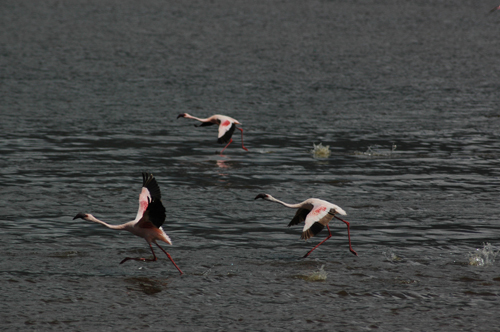
Another collection of pictures from Africa. This time it’s birds and more particularly, flamingos. With two exceptions they come from Kenya. The last two are from Uganda and Namibia. Even the Kenya ones are not all from the same spot.

It is, or was, Lake Nakuru that was always famous for the masses of these striking birds. Indeed it was said that there were, at times, over a million of them on the lake. That has changed dramatically. I took this picture over 40 years ago, and there appear to be more birds than water.  

On our visit there in December we saw very few, maybe a couple of dozen at most. 


We did see thousands, standing, feeding and flying at Lake Baringo, the next-most northerly lake in the chain that appears in the Rift Valley. The storm clouds had gathered in dark masses about the eastern wall of the Rift as we stood and marveled at the sight. The photos at Baringo were taken by one of thre three of us with cameras. Our daughter Karen, her husband Robert, or me.


These pictures do nicely show the difference in both size and bill colour between the Lesser and Greater species. On the left they are all Lessers. The fully dark beak with its small dark pink spot near the tip shows clearly On the right a single Greater, with his pink bill and dark tip stands out. The lesser also has a pinker hue to the body feathers.  How obliging of them to stand so still for the camera.

Feeling the cold?


I’m not sure if this one was feeling the cold, but he/she does seem to have a scarf around the neck.


Sart your engines!

Near the finsih line


They are truly spectacular when they fly as the colurs stand out.


On previous trips we have also seen them at Lake Elementaita, the next lake south from Nakuru. The hill in the middle background is known as the Lord’s nose. The nasal shape does not show up well in this view, but the Lord name is a reference to Lord Delamere the famous, or infamous, English settler whose ranch, Soysambu, covered most of the land you can see beyond the lake, including the hill. Soysambu is now a conservancy and borders on Lake Nakuru National park effectively extending the area set aside for the purpose.


There are other lakes in the Rift Valley system, and of course the Rift divides into two arms. During our many trips with veterinary students to Uganda and the western arm, or Albertine Rift, we saw small numbers of flamingos in Queen Elizabeth NP, but not in the big lakes named in the 19th century for members of the British Royal family – they are Edward and George. We did seem them in the salt lake nearby, most frequently in Lake Katwe. The birds were never in huge numbers but perhaps because they saw so many humans mining the salt on a daily basis they were quite unconcerned about close approach. 

These pictures show a few of the saltpans that provided about half the village residents with their income. You can see a single bird at the very bottom right of this wide view of the pans. I can assure you that it has not been “Photoshopped” in. I even wonder if the photographer realized that she/he had snapped this single bird.

The briny water is trapped in pans about ten metres across and allowed to evaporate. As the salinity increases so the salt precipitates and can be harvested. You can see big piles of light or dark salt, some covered in plastic, stacked on the pan edges. The pans are individually owned and are traded for substantial sums of money or passed down in families. This is the only place in the world that I have ever visited where rain is simply not wanted. Indeed it is considered impolite to even suggest that the rainy season is approaching. Rain means less evaporation and the risk of spoilage or loss of a hard-won harvest.


These pictures were taken by me or one of the 79 students who joined me on those memorable trips, but I have no idea who. We shared thousands of photos every year, so thank you someone. I wrote about those Uganda teaching trips in The Trouble With Lions.


My wife and I had not expected to see flamingos a long way further south, so, in 1997 we were pleasantly surprised when we saw them at Walvis Bay, wading, feeding and stretching in the river estuary at low tide just south of this Namibian city. The one at left centre is graciously stretching his wings to give us a spectacular view. 


Wednesday, January 18, 2012

More on Rhino Horn and Poaching

My blog of Nov 29 about rhino poaching was written before I went with my family to Kenya. While there, and since I got back, more disturbing news has been reported.

The use of rhino horn as part of Traditional Chinese Medicine is ancient, nobody knows how ancient, and as I have blogged before the situation continues to be a nightmare for conservationists. I used one example of many in The Trouble With Lions when I quoted Judy Mills who, in a TRAFFIC report found that 60 percent of South Korea’s doctors believe that rhino horn is an effective medicine and 79 percent believe it to be essential for a wide variety of ailments.

Yet another South-East Asian country seems to have joined the “hunt” for rhino in South Africa. For some reason the finger-nail-like substance has gained an entirely false reputation as a cure for cancer. Vietnamese hunters, have arrived in South Africa and in one report titled mules hunting rhino -check it out- are seen to be active, with a video report by Dan Rather even appearing on the planetsave.com website.

Recent African twists in the ugly saga come from three countries. First, two places in Kenya, where Mugie Ranch, on the Laikipia plains west of Mount Kenya have given up their attempts to keep black rhino because of the steady decline of their original number of about 30 head as poachers took them out one at a time. The Kenya Wildlife Service moved in a translocated them all (apart from the one they lost during the drugging). In some ways sadder was the poaching of a single hand-raised rhino at Sweetwaters Conservancy. I last saw him three years ago when I could scratch his neck as he contentedly chewed on a stick of sugar cane. Now some callous sod has taken him out.

Are these two still there? - I took the photo in South Africa about 15 years ago.

Then there is Namibia, where officials in the Ministry of Environment and Tourism, and where has been apparently granted a Vietnamese man a hunting permit for the trophy hunt of a rhino on the Otjiwa Safari Lodge.

The same article in the Namibian Sun quoted the Deputy Minister of Environment and Tourism, Uahekua Herunga, as saying that the government should also look into “legalizing” a trade in rhino horn. Presumably he is suggesting some sort of “farming” for horn. What next?

In many ways more chilling than either of the things going in these two countries is the news from South Africa. I have mentioned before that one of my former students told me about two vets who have been implicated in poaching. Now I’ve learned more about them. In an article published on line they are named as Karel Toet and Manie du Plessis (and their wives) They are suspected of involvement with a rhino horn syndicate headed by Out of Africa Adventurous Safari’s Dawie Groenewald. The veterinarians (and other “Groenewald gang” members) will face charges of assault, fraud, corruption, malicious damage to property, illegal possession of firearms and ammunition, and contravention of the National Environmental Biodiversity Act when they return to court in April 2012.

If you think that is bad news and a slap in the face for wildlife vets, there is more. One of South Africa’s most prominent wildlife vets is Dr. Douw Grobler. He is a former head of the game capture unit in the Kruger National Park and was arraigned in Pretoria North Magistrates Court. No charges were laid but he is suspected of supplying veterinary drugs to a controversial game farmer and hunter named Hugo Ras, who has several previous convitions related to nature conservation transgressions and was arrested last August.

The case was postponed to February 28th and Grobler was released on R5,000 (USD $618) bail. You can read the full story here.

Of course Grobler may have been falsely accused, but the picture is not pretty and certainly puts all wildlife vets in Africa under a spotlight.

Wednesday, June 15, 2011

Snares and poachers

Link
In my post of June 10 I wrote about the real situation in Kenya’s Masai Mara and the decline in wildlife numbers. I also referred to poaching and the numbers of poachers caught on a regular basis. Poaching is so widespread in Africa that one hardly knows where to start, but I did refer to the experiences of one park warden in the Serengeti. This was Myles Turner, who was there for 16 years and documented his work in his fascinating 1987 book titled My Serengeti Years: The Memoirs of an African Game Warden. I suggested that his book might just as easily have been subtitled The Poaching Wars.

One of the major tools for poachers is the snare. Here are a few examples of ones I have seen in various places. In Namibia’s Etosha National Park there is even a sort of “rouges gallery” in the park offices where this display case shows various types of snare that have been found over the years.

When I worked on an elephant project in Rwanda in the 1970s we found that 27% of the animals had injuries related to snares. There was one that had a cable deeply embedded in the creatures leg, while several animals had lost part or all of their trunks because they are ever curious and made the mistake of picking up snares meant for buffalo and the like.

When I was with veterinary students in Uganda’s Queen Elizabeth National Park we never failed to see animals damaged by snares, or find snares, usually at waterholes. We were able to free this warthog after immobilizing him, but I do wonder how he got on.

We found a collection of wire snares including the nasty tin can lid type that is designed to ride up an animal’s leg if it is unfortunate enough to stand upon the thing. Just have a look at the picture and imagine what will happen.

It is easy enough to condemn the poachers, but the issue is not that simple. "Poacher" is a term used by landowners to describe people who might otherwise be known as hunters. If you have no source of protein, virtually no income, and a family to feed, and a wild animal hangs out near your home, what are you to do? This is not the same as the commercial, crime syndicate type of poaching that has led to the decimation of rhino and tiger populations, to mention but two of hundreds of species.

The news about a major highway that will cut through the heart of the Serengeti has been simmering for quite a while, but now seems to have surfaced in major print media. More on this when I drop by again.