Showing posts with label Storytelling. Show all posts

Tuesday, June 17, 2014

A Storytelling Gig


I have just been sent a poster that describes a gig I have upcoming in Halfax Nova Scotia. This event will be in supprt of the Hope For Wildlife Society and I plan to share a few stories from my days in Africa, not just from the time I lived there, but a few research activities and more recent trips with students. This is the poster as it appears on the Storyteller of Canda - Conteurs du Canada website.

Here are a few of the pictures I may use.

My 1st wildlife patient was a giraffe
 

My 2nd wildlife patient was a white rhino


My 3rd wildlife patient. A constipated rhino

Bottle feedig a baby rhino
An alarmed rhino
Part of a hippo folk tale


Another part of that hippo folk tale
An elephant project in Rwanda

 
Equator Primary School, Uganda. A registered AIDS orhpanage.

Saturday, November 2, 2013

Stories about Moose and a Wildlife Vet in Africa in British Columbia


We have just finished up another storytelling and book tour. Eight libraries, one sporting goods store and a wind-up at the University of Northern British Columbia. All  in 7 days. I tried to find a map to show all the communities, but could not quite manage it. 

This one shows 8 of the 10 spots. I added Granisle and Fraser Lake and each place has an italicized number, showing the order of the events.

We started in McBride where the folks enjoy decorating anything you can think of, including their fire hydrants. Why not?  Our total distance on the road, including the leg from home was just over 4500 km.

Fraser Lake, after the session. Thanks
Miake Ellott and me outside the Houston store
Just as in our trip to Yukon I offered one of two sets of stories, with pictures. Either A Wildlife Vet in Africa or Of Moose and Men Around the World. This time there was a split. The folks in Granisle, (at the very top left-hand corner of the map) and Houston went with the moose set. Everyone else chose Africa. In only one case, for the students at UNBC, did I know ahead of time which one it would be.

The odd tea break was an essential element

We had a great reunion Williams Lake with one of the students who joined Jo and me in Uganda. Dr. Ross Hawkes practices there and we reminisced a bout a whole bunch of things after the talk. 

Ross (the redhead 2nd from left back row) classmates & Ugandan students 2007
It was Ross and his class-mate Kevin Oomah who came up with the novel, some would say crazy, idea of subjecting themselves to a full bikini-wax hair strip of the hair above their waists in order to raise money for the schools that we have supported in Uganda over the years. In 50 minutes their generous “donation” generated $1800 !  I had not known, until Ross delved into his files, that there was video evidence of this event. If he and Kevin will allow it I would like to show that in a future post.

Most of our audiences were adult, but in Quesnel we had a surprise. A group of home-schooled children and their parents showed up. They were the only audience – the session was set for 10.00 am and it would have been tough for adults to get away from work. This meant that I had to change on the fly and luckily this was not too difficult. After telling them a little about my background, I began with stories about my own experiences with giraffes, which gave me the entry into the folk story about why giraffes are so tall. 


A couple more folk stories, with the little ones involved and with grins, and we had a happy crowd. I ended with a food-chain account of why hippos are so important for the health of the great lakes of Africa. This one resonated with one of the older boys who happens to be studying the food-chain right now! 

After the Quesnel set we needed a lunch break. Luckily we found a local bakery, and had soup like your mother made it. Yum!

Philippe Henry's snap of the audience before the start
The largest crowd was at Prince George’s University of Northern British Columbia, where student Gabrielle Aubertin and faculty member Philippe Henry had done a fine job of getting the news out. I told stories about work with rhinos, lions, elephants and a run-in with safari ants. The stories were for an adult audience, but included two folk tales. The first was about why wild dog’s wife got very sick and why they now hunt in packs, the second about the hippos again. I used two famous quotes. 


The first from one R. Maugham in 1914, which one might think was being recycled for the attitude of some towards wolves a hundred years on. Here it is:

"Let us consider for a moment that abomination - that blot upon the many interesting wild things - the murderous Wild Dog.  It will be an excellent day for African game and its preservation when means can be devised for its complete extermination."

The other from David MacDonald of Oxford University which sums up my own thinking.

“To nominate one sight as the most beautiful I have seen might, in a world filled with natural marvels, be considered disingenuous. Yet, of images jostling for supremacy in my memory, it is hard to better the bounding forms of African wild dogs, skiffing like golden pebbles across a sea of sunburnt grass at dusk.”

I was delighted with the reactions from the folks, which came on FB. 
Gabrielle wrote “Thank you for the great talk, I have only received positive comments, so I think everyone enjoyed it. How could they not. I thought it was a great mix of facts to stimulate the scientist brain, of beautiful images that would make anyone dream of having career like your and it was also funny!"

Philippe wrote:  I kept getting comments in the hallway yesterday: beautifully told stories with real value for the conservation of our living world, thanks again for taking the long trip here:)


Monday, October 14, 2013

A Storytelling Tour in Yukon

-->
My wife Joanne and I have just completed a wonderful storytelling trip to Canada’s Yukon. The trip was not only a storytelling adventure, but a book tour, but I did not read anything. It was all done with pictures and stories about those pictures. As folks who have heard me storytelling will know I  often use the most modern form of Cantastoria, the ancient art of telling with images. You can see more about this and other telling techniques here


A short walk to the springs. There they are, a swim if you wish
We covered 7700 km, saw some beautiful scenery and visited six libraries in far-flung communities. On the way north we stopped in British Columbia’s Dawson Creek and I told stories there as well. A stop at Liard Springs gave us a welcome break on the long drive.


A bend in the river and a welcome stop for a picnic lunch not far from Faro in Yukon
A tiny gap in the clouds as we drove back from Burwash Landing, where we told to 45 folks of a total  popualiton of 95!
At each venue I gave the audience a choice of some stories about our time in Africa or ones about moose. Everyone chose A Wildlife Vet in Africa. I guess there are lots of moose in Yukon. At two venues I was asked to tell one brief moose story at the end of the set. Why not?

Mairi Macrae of the Yukon Library system who organized the tour with meticulous attention to detail wrote this in an email at the end of the adventure.
Out of this world! We had a great audience of 48 at Jerry Haigh’s African presentation. It was incredible to see in photos and film the work that he was doing in the 60’s on up until the present with all kinds of large mammals. The audience was enthralled and I don’t think anyone had seen or heard stories like that. Jerry (and his doctor wife Jo) have had the privilege of living a very interesting and exotic life. On top of that, he is a great storyteller and a passionate speaker. Very interesting Q & A as you can imagine. Definitely of all the programs we have during my time here, this was one of the best.

During my tellings I did do something I have not previously tried. To introduce myself I told the folks a bit about our (Jo’s and my) family history and how we have fallen pretty close to the apple tree in terms of our adventures. Here is that introductory piece.


Something I have never related before struck a chord with me and so I began to investigate it further. As you have seen Jo’s parents were married in a so-called Glove Wedding. Abraham, her electrical engineer dad, was in India building that country’s first radio factories, starting in Calcutta. He had been sent out by his employers, the Philips Company of Eindhoven in 1932, and had left his fiancé, Tine, behind in Amsterdam. 

The official ceremony took place in Holland. Abraham’s brother Jaap stood in for him and Tine was duly and officially married. She soon shipped out for India

Naturally I knew that this glove wedding had taken place, but I wanted to find out more about the process.

Of course I tried Google. All I got was an endless stream of advertising sites for the sale of wedding gloves. I guess they are a really big deal in several senses of the term. I tried various combinations of search word, but it was not until I typed Dutch Glove Wedding that I made some progress
There was just one hit, from an Australian newspaper article published on the 31st of May 1919.  It came from page 7 of the Barrier Miner (Broken Hill, NSW : 1888 – 1954) and was barely intelligible as it had been electronically translated. Many words were garbled, but with patience I was able to decipher it. Here is that version.

THE "GLOVE" MARRIAGE
Not long ago a Boer in Pretoria was married to a girl in Amsterdam, the ceremony constituting what the Dutch call ''handschoen" or glove marriage.
In spite of the fact that a distance of 6000 miles separated the bride in the Netherlands and the bridegroom the Transvaal they were, just as effectually married under the Dutch law, as if both had been present in the same church

The bridegroom sent to his friend or best man in Amsterdam a power of attorney to represent him as his proxy at the ceremony, and at the same time forwarded his glove, which, at the proper moment when the two were made one, was held by both the bride and the proxy. The wedding was duly registered at Amsterdam and at Pretoria, where the bridegroom filed an affidavit with the proper magistrate.

This curious form of marriage is a purely Dutch institution, the custom having originated, it is said, in the old times o£ Dutch-Batavian rule.

Now my interest was even more peaked. I knew, or thought I knew that Batavia was the name used for Jakarta of the Dutch East Indies in Holland’s colonial days when they tried to run the valuable spice trade. I decided to check and so, back to Google. 

I was in for a surprise. There are, according to Wikipedia, nine communities in the USA called by the name. However, the name goes back at least 2000 years. It was “a land inhabited by the Batavian people during the Roman Empire, today part of the Netherlands” I wonder if those US towns were founded by Dutchmen. 

The Barrier Miner reporter had underestimated his distances slightly. Amsterdam to the Transvaal is about 13,000 km by road (if you even get there these days, which I doubt). The bride would have no doubt gone to Cape Town by ship, and then overland, which would have involved a couple of thousand more. That would have been some 9000 miles

Tine only had to go about 9000 km, or 5,600 miles. I’m going to do some more digging as I do wonder if any other Glove Weddings to India (Brits Indie as it was known in those days to distinguish it from Indonesia) ever took place

Anyway, we can be certain that Jo’s apple has indeed fallen right at the foot of her parents’ tree.

Tuesday, November 27, 2012

Stories of Africa, and telling them


I was recently invited to do a guest blog by Karen Chace. In it I discussed the use of images during storytelling sessions and my hypothesis that they may have a very ancient origin that goes back as far as the artists who made petroglyphs and pictographs. Some of the art work is of stunning quality, and as good an example of that as any lies in the extraordinary Chauvet caves of southern France, a subject I have blogged about before .

Giraffe, eland and freinds at Twyfelfontein
Of course these are not the only examples of cave art. I have chosen this one, a photo taken at Twyfelfontein in Namibia because of what comes below.

You can easily link to that guest blog here.

I posted the link to several of my contact pages and it has generated a lively discussion on one of the LinkedIn ones. a members only group one can join StoryTellers - The Oral History Group.
A general conclusion is emerging that there are many ways to tell stories and we should open our minds to them.

I mentioned that I use both oral and visual telling techniques, sometimes in one presentation. For those who use PowerPoint (the latest evolutionary form of cave art) this is simply done in the middle of a talk by hitting the “B” key (I'm a Mac guy, don't know about PCs). The screen goes blank and one can then step up and let the audience focus solely on the teller. Hit the “B “ again and one is back to the picture.

Here is a brief example from a recent school tour. Using no pictures I opened with a bit about myself and how my first memory was of a giraffe’s legs heading away through the trees. Then I told the children about my return to Kenya after vet school in Glasgow and how the very first animals I saw were three giraffes peering at me from inside Nairobi National Park.

Next up was a description of how, three days after arriving as an intern at the Kenya vet school I had to treat a giraffe with footrot. This term is self-descriptive, and needs no gory technical explanation. However, some of my audiences have been in rural schools and many of the kids knew exactly what I was talking about. Of course this gave me the chance to link to their own experiences of watching a vet or parent medicate a cow with the condition.

This let me describe the problem of injecting a giraffe and let me use this phrase: “Of course there were as many giraffe in Glasgow (where I graduated from vet school) as there are in "Homeville" (name the community I'm in). I then climbed the imaginary walls of the chute where the giraffe was standing to inject him high above my head. (Actions: climb, stretch, grunt, inject)

With the three giraffe images now established I switched to the old folk tale about how the giraffe became so tall.  It involves a conversation with an owl, a long walk, a witch doctor, a magic potion and the failure of giraffe’s friend the none-too-intelligent rhino, to arrive on time at dawn to get his own helping of the potion.

Of course this set up later folk story about another stupid rhino, again told after the “B” has been touched.

After that fun account I ran the projector again and showed the kids an entirely silent movie clip that I made myself in the early 1970s of rhino capture. It runs about 4 minutes and as it has no script I made the odd remark, telling the tale of how and why we did the work. I can't add it here, but if you haven’t seen it, it lies embedded under the video tag on my website. The kids were enthralled.

Mum waits in case the little guy needs help. He didn't
To wind up this post I have added a few pictures that I showed the children. These ones were of the Aaaah, or Ooooh variety and needed few words. They are examples of things that the kids may not have seen or can enjoy for the images' own sake.

The shy little girl with her Teddy Bear, knitted by ladies of a group who call themselves "Teddies for Tragedies" is probably receiving her first ever gift. She is one of 147 kids in an AIDS orphanage school we linked with and supported.

I showed the baby rhino being bottle fed after the capture movie. A winner!

 
This is a humorous one, again needing no script.  As one teacher said to me after the talk, "Anything with bums or poop stories will be a winner."

If it itches, scratch it.


Friday, August 10, 2012

A Story About Bats

-->
Just finished the annual gathering of the Storytellers of Canada – Conteurs du Canada which took place in Montreal this year. Four days of great stories, workshops, meeting old friends and making new acquaintances.

One thing I am always on the lookout for at the sale counter is books of African stories and I found four of them. By chance the first one I opened, published by Beacon Press of Boston in 1962, is called Umbundu: Folk Tales from Angola. It was translated and collected by Merlin Ennis and had a story in it that linked directly to my last post about bats in Uganda.

The story is called Fruit Bat and Sun. I have edited it slightly. It explains quite nicely why it is that bats spend their daylight hours in dark places and ties in with my last post about Ebola.

§§§§§§§§§§§§§§§

When the only child of Sun was sick, Sun went to the house of Elder Fruit Bat, and said to him, “Save my child for me.” Fruit bat went and soon cured the child.

Not long after this marvelous cure Elder Fruit Bat’s child got sick and so of course he went at once to Sun’s house and said, “Now my child is sick. Will you please come and save him for me in your turn.”

Sun replied “Come tomorrow very early and seek me. Don’t be late for once the day has started I never turn back.”

So, Fruit Bat came good an early, but not early enough for Sun, who said “Didn’t you listen to me? I said come early because I never turn back. Come again tomorrow but make sure you arrive while the ground is still black.”

Next day, when he arrived Sun said “You are late.”

Fruit Bat again turned for home, but when he arrived he found that his child was dead. Of course he was very sad and he swore an oath that he would never again speak to or see Sun.

From that day forward he has never once seen Sun, for, as he says, “He has done me a wrong.”
§§§§§§§§§§§§§§§§§§

So, now we know.


Friday, March 2, 2012

Wanuskewin Stories

In Saskatchewan February is Aboriginal Storytelling month.


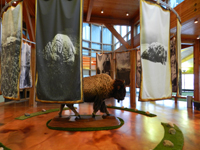
On Saturday the 25th a small but enthusiastic crowd braved a nasty storm to get themselves to the Wanuskewin Heritage Park (found here)This is the striking entrance to the building.


As one enters the main section another buffalo, surrounded by hangings, stands out.


We all had the chance to wander round the gallery and admire the fascinating collection of materials dedicated to the horse. There was a full-sized horse front and centre, and some forty paintings, many by Allan Sapp, of scenes depicting the use of the horse in (relatively) modern times. The most striking items were five beautifully decorated elk hides, each one depicting scenes of some brutality, with horse-mounted cavalry and aboriginal peoples at war. It was not until I leaned over and took a close look at the work under the glass covers that I realized that every item in the entire series, containing hundreds of figures in excruciating detail, down to pistols, head dresses and the caps of the cavalry, was created with beads, thousand of tiny beads.  It would have been great to be able to show you a picture of at least one of the hides, but of course galleries do not allow one to take them, and I could not get hold of one electronically. If I get the chance I will post again, as they are truly stunning.

Andrew McDonald, the marketing and sales manager of the centre, had organized the evening’s events and it was he who told me, in an email, that these beaded elk hides were given to the Wanuskewin Heritage Park by George Pekwawa for the Mistatim Exhibit. The hides depict the Battle of Little Bighorn, where Chief Sitting Bull defeated General Custer. It is thought that descendants of Sitting Bull, who fought in the battle, created the works. Following the battle Sitting Bull found asylum here in Saskatchewan where he stayed at Ft Walsh. The hides are thought to be based on a series of drawings that Chief Red Cloud was later commissioned for.

Before the main event we had a chance to sample Chef Kevin Merasty's delicious berry crumble, mostly Saskatoon berries, as you might expect, and everyone who had braved the winds had a bowl of his creation and a dollop of ice cream. Hot chocolate optional. Not too shabby!

 
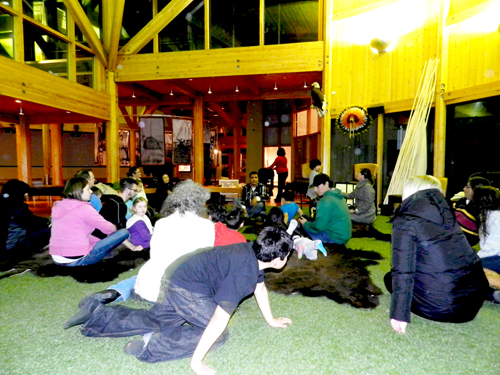
Lamarr Oksasikewiyin of the Traditional Native Games Organization (found here) led off the activities, focusing on the children who had come out on a stormy night. He first got everyone involved in one of the oldest indoor games, which most of us learned at a very early age. Here you can see one of the parents about to pass on her start to the string game. 


Lamarr then began with children’s games that were originally designed as preparation for the vital art of hunting or for learning patience in the harsh dark days of winter. He told us that the storm was a hidden blessing as it was on nights like this that games and storytelling became important because it mirrors the winter camp and times in the tipi. He had the youngsters playing a game we all recognized. Today we can purchase a fancy version called pick-up sticks. The old version involved willow twigs, and Lamarr selected a marker that was the key to unlocking the fallen sticks. The kids were quickly involved.


Then he called for volunteers, who promptly stood and started to try and hit a ten centimetre toy bison with a weighted turkey feather from a range of about two paces. Of course the two paces varied with the size of the child. It is not as easy as it sounds. You can see the bison (pale brown, hanging on a string) right of centre about 1/3 of the way from the top, level with the top of the window. No wonder there were no hits.


While the other adults visited the gallery I stayed to watch the puppet show being put on by Cheryl Hoftyzer. I've been trying to post a short clip here for the last 45 minutes, but the Blogger program is having a hissy fit. It is defintely home movie stuff as the lighting was not the best, so perhaps it doesn't matter. Cheryl ran the puppets as we learned the entrancing the story of the beaver and his tail with its moral issues about pride.

Alex Ahenakew gave us part of his family history after explaining the importance of the smudge. As he performed this ancient ceremony his grandson joined him and then a little girl who could not have been more than about two, left her father’s lap in the story circle, crossed the floor and went over to lean into the smoke spiral. She has obviously been shown the ropes. Alex wound up with a delightful explanation of his maternal grandfather’s name, which is Atimoyoo, or in English, dog’s tail. It involved shape shifting and the acquisition of a beautiful horse.

Darryl Chamakese, seen here in the checked shirt beyond his audience is the Cree language developer at of the Saskatchewan Indian Cultural Centre (found here). It was he who gave me two fascinating stories for my book Of Moose and Men (publishers web info here). Darryl did a wonderful job with one of the many Wesakechak stories, this one about the time that the hero of that long-running saga fooled a bunch of waterfowl into giving up their lives for his meal, only to be outwitted by that cunning carnivore, the fox. Of course in the end Wesakechak got his revenge and forever changed the coat colour of the wily beast.

Finally Lisa Wilson gave us a brief reading from her history of the Gabriel Dumont Institute. You can find out more about the institute here.

Then it was time to head home. Luckily the storm had abated, but we did hear that further south it had been severe enough to lead to closure of some highways. A good evening to be indoors with like-minded people and out of the cold.

Wednesday, February 22, 2012

Saskatoon Storytelling


Friday night is storytelling night in Saskatoon. Or at least the 3rd Friday of every month. That is when storytellers gather for an informal session that usually runs about two and a half hours. The core, the driving force, behind the group (we call ourselves the Saskatoon Storytellers Guild) are a small group of half-a-dozen or so professional tellers who have been involved for a long time.  Many of us are members of the Storytellers of Canada, Conteurs duCanada. Chris Lindgren keeps the books and runs the group email list. Other regulars who tell in libraries and schools are Kathy Bennett, Judith Benninger, Russ Frith, Bonnie Logan, and Garry Tisdale. Balladeer Paddy Tutty brings her dulcimer and contributes. Sometimes other professionals also manage to be in the city on the right day. Last week it was Kevin Mackenzie from Regina who joined us. Occasionally teller, musician and actor Joseph Naytowhow is in the city and drops by, much to the delight of all. The there are a few who might be classed as semi-professional. Wayne and Shirley Handley probably fit this bill as do I. There is woodwork to do, grand children to visit, fish to catch and writing to finish, or maybe start. 

Then there are the more-or-less regulars who come out to enjoy an evening of stories and share experiences. We are usually a group of about twenty who gather at 7.30 of an evening. Our venue of late has been the Unitarian Centre on 2nd street, which is a friendly spot with comfortable chairs.

Each time we meet one of us acts as “host.” This is not an arduous task as it just means that the host has to choose a theme for the evening and make sure that the tea and coffee supplies arrive at the same time as the people. 
Here Kevin and Christine share a moment during the break. The coffee and tea supplies are at the back.  Those who can do so bring some sort of goodies, for the break. Home-made muffins, oatmeal cookies, some sort of chocolate delight. It’s all good.

Last week Rhonda was our host. She chose an open-ended theme of birds or flight and as usual the theme stories were the first to be told in the story circle as brief anecdotes. In storytelling tradition some sort of object is passed around the circle and is held by the teller. It shows who has the floor. It is often a stick, but can be a hat or a stone. That’s up to the host. Rhonda chose to use a sculpture of a small duck—probably a teal.

Highly appropriate, and here she is at the right of the circle starting the proceedings off.

All nineteen of us gave a short account of some sort of bird, or near-bird encounter. It was fun to listen to the variety of stories that emerged. We had naturally had stories from Canada, but also from Kenya, Ecuador and France. The Canadian ones included accounts of humming birds in Tofino, LBJs (unidentified Little Brown Jobs) south of Moose Jaw, a successful killdeer nest on a driveway and the disadvantages of winning a duckling in a raffle. For those who have never had such luck, it is definitely a two-edged sword. 
  
As teller Bonnie put it, a duckling’s output is somehow greater than its intake, which can be a disadvantage if the pet is sitting on your head. The wooden teal in Bonnie’s hands is definitely not the pet one.

Rob told us how he and his family went birding at North America’s oldest bird sanctuary at Last Mountain Lake but instead watched as 1900 head of cattle crossed the road, mustered by just three cowboys. It took a long time and not much bird watching occurred. We heard about an escaped budgie that eventually came back, and a blue and gold macaw that cleaned its handler’s ears near the Arc de Triomphe. Kevin must have thought he was at a liar’s contest. His anecdote started out as being more-or-less believable, but soon morphed into a fantasmagoric account of a swan’s broken wing, surgery, a famous film star, a sauna bath and an unusual tissue transplant for the patient with the wing of a rare Central American duck. Of course he has to wring the duck’s neck to steal the wing. He had us all in stitches.

The session after the break is always for prepared stories that can be on any theme. They always range across the full gamut and at least one is likely to involve the third son of an impoverished family succeeding when his brothers have failed. In this case it was not only the third son but he had to complete three seemingly impossible tasks. Of course he got the girl–what else would you expect?  There were folk tales, a Maasai animal story, stories from a time before time and stories with a moral.

A typical storytelling evening, and a good time was had by all. We don’t know if everyone will live happily ever after.

Tuesday, February 21, 2012

Maasai Stories

In December I was with my family in Kenya’s Maasai Mara. We stayed at Game Watchers delightful Porini Camp in the Selenkay Conservancy and of course saw a range of neat things. Our grand daughters had a truly grand time, as did our daughter and her husband and it was a delight to share with them some of the things we so love about Kenya.

Our tour guide as we drove around was a young Maasai named Ben ole Tongoyo, who has already passed his Kenya Professional Safari Guides Association silver level tour guide test and is working towards the highest level of certificate – a gold. He was very knowledgeable about many things, but it was nice to be able to share a few things that he had not picked up on.

One was the business of why hippos mark their territory by shaking their tails as they defecate. This behaviour is only done by dominant males and I showed the girls, and Ben, a spot where a hippo has marked his exit trail to deter would-be challengers.

The business of tail wagging has led to the wonderful story, that I told Ben and the family, about the desperate desire of all hippos to live in the water and escape the sun’s burning rays. After their king’s repeated conversations with Ngai (the great god who lives in the mountains), they were allowed to do so, but only during daylight hours and under strict conditions. I’m sure you know it, so I won’t repeat it.

What I will share are the skeletons of three stories that Ben gifted me as we swapped animal stories about creatures he knew well. He is not a storyteller as such, but he gave me enough to build upon. As far as I know none of these stories has ever been published.

The first was about a time a long time ago when Maasai women had cows which were wildebeest. It does show some attitudes that would not be considered PC in today’s culture, but it is an ancient story. Basically the women failed to care for their charges because of the heavy and persistent rains. After many days of neglect the cows wandered off and went on along trek, returning once a year to check things out, but never again being domesticated. Instead the women had concentrate of their other tasks, hauling wood and caring for the children. Here you can see the Maasai manyatta beyond the trees and the scattered wildebeest in the foreground. Are they waiting for attention?

The second story was about the theft of ostrich chicks by lion and how none of the animals would stand up for the upset parents until ground squirrel showed them all up.

I’m working that one up with pictures right now. Might try and publish it. 


The third one was how tortoise escaped his impending execution. All the other animals hated and feared him and had decided by a vote to get rid of him once and for all . That too needs a work-up.

As we departed I left my copy of the Jonathan Kingdon Field Guide to African Mammals with Ben. Let’s hope it helps him in his efforts towards that gold certificate.

Monday, January 9, 2012

Chauvet Cave movie - Cave of Forgotten Dreams

Link
On Saturday we went to the movies. We had chosen to go and see the story of France’s Chauvet caves, discovered in 1994 by three men. There are several web pages about these extraordinary findings, and one can find the fantastic drawings on some of them. The movie, directed by Werner Herzog, is called Cave of Forgotten Dreams and for those who don’t know about them these caves are absolutely extraordinary. The art work has been dated to be in the region of twenty-five to thirty-two thousand years old. This is at least twice as old as any other ever found, the other famous ones being the Lascaux caves, also in France. Of the many images, two in particular have caught my imagination.

There are two rhinos fighting, their horns crossed like a couple of fencers squaring up.
My own work with rhinos has shown me direct evidence of these behemoths fighting, especially when in the grip of sexual foreplay. The whole process can last up to an hour before any kind of mounting. Both of my cases were in white rhino, animals that had been brought up form South Africa in the late 1960s. Of course at that time we had to state that they came from Lesotho because Kenya and South Africa were not diplomatically linked, Apartheid being the political climate in the latter. The first case was a cow that had been picked up a bull, on the end of his horn, and slammed into a big pepper tree. I was district veterinary officer in the town of Meru, east of Mount Kenya and when Peter Jenkins, the chief park warden in Meru National Park called me I headed out as soon as I could.

I really had no idea what was wrong and decided on a shotgun treatment, a big dose of antibiotic and multivitamins. The challenge was how to get them into her. In the end I simply drove a long needle into the muscles on the backside and was astonished when she stood there eating the hay that her minders had given her.

Rhino are not the brightest start on the planet and it was only about half way through the treatment that she noticed my attentions. She began to walk away, and so my injections ended up being given “on the run” My efforts did no good and when she died two days later Peter told me that she had a broken rib and a ruptured liver. It is amazing that she lived as long as she did., but the astonishing thing to look back upon is the power in the bull’s neck. The cow must have weighed close to 1500 kg!

A year later I had to treat another cow that had also been attacked during foreplay. In this case the damage was limted to her hind end, but was so severe that she had not been able to pass stool or urine for 3 days. After evacuating her rectum I administered a 4-gallon enema - and have evidence of the event in the photo that my wife took. This time the treatment, which also included antibiotics, was a success.
The other image is the multi-legged bison. The artist drew eight legs, some of them paler than the others, and in forward positions with bent joints. Everyone, including me, thinks that the images are made to look as if the bison is running.

I have taken this an extra step in my imagination. If you, as a child of about six or eight, are in the cave with your dad and suddenly hear the sound of running bison in the background, followed almost at once by the sight of a flare being waved in front of the animal on cave wall, the legs will come in and out of focus, just as if the animal is running. Are you holding on tight to your dad’s knee?

There are lots of other stunning images and the movie producers have done a good job of telling the story. The last set of pictures are not inside the caves, but are a spooky postscript about a nearby nuclear plant. I won’t tell you any more. Go and see the movie.