Linkhttp://www.sherborne.org/, http://www.turing.org.uk/turing/, http://www.livescience.com/, http://www.uap.ualberta.ca/
One of my favourite pastimes is storytelling. When we visit my granddaughters one of the first stories they ask for is
How The Zebra Got His Stripes and here is a condensed (very condensed) version.
A long time ago, when zebra was pure white, a brave young zebra decide the challenge baboon for access to water, which the latter had claimed for his own. After a long and terrible fight baboon began to get the upper hand and pushed zebra into a fire. The pain was so severe that the zebra jumped up and lashed out, kicking the baboon clear across the river where he landed on some rocks. The upshot, the zebra was scarred for all time, but the baboon ended up with a bare backside after damaging itself upon landing.
It is no surprise that folklore about other animals, particularly leopards and serval cats, tell how they got their markings after ending up involved with fire.


Here are a couple of pictures that you might enjoy. The smaller serval cat was a bottle-raised animal that lived in
Kenya's Meru National Park around the home of chief Warden
Peter Jenkins and his family in the late 1960s. I have stories about Peter in both of my books.
Another fun component of storytelling is trying to find ways of linking these ancient and entertaining interpretations of the things that people saw around them to modern scientific explanations of how things work and for me it has always been a challenge to do that with these “burn” stories.
Like the mythical American cavalry of the old Hollywood Westerns, or the more modern arrival of the marines (
satirized so brilliantly by Tom Lehrer) science has come to the rescue.
In a posting of April 7th headlined
Study Reveals How Creatures Get Spots vs. StripesLiveScience managing editor
Jeanna Bryner takes us into
recent information about fruit flies and their markings, and links us back to her own
older post about leopards and their spots.
“Biologists have long wondered how leopards and other mammals acquired their distinct and uniform coat patterns. In 1952, British mathematician
Alan Turing developed an equation to explain how simple chemical reactions produce the spots, stripes, and swirls that decorate a variety of mammals.”
By a strange coincidence I have a weak link with Turing, as he was at the
same school as me (although of an earlier generation). He has been dubbed by many in the field "
the father of modern computing" and is known to have had a huge influence upon the ENIGMA machine that let the Allies break to German codes of WWII.

Here is a photo of Turing that I found on line. I could have chosen any one of hundreds, as a Google search for them got me to 49 pages. A second family link to Turing ties in with the fact that my daughter is heavily involved with computing, artificial intelligence and the world of robots. For the folks in her world Turing is an icon.
Anyway, back to leopards, zebras and the spot/stripe question.
Turing's mathematical model could not account for the evolution of markings as the leopard matures from spotted cub to rosette-dappled adult.
As a Bryner relates a team of scientists from
Taiwan’s National Chung-Hsing University in Taichung and
England’s Oxford University “modified Turing's model and ran it through computers, concluding that substances called “morphogens”, chemicals secreted by pigment cells in the coat, diffused through the coat and led to the development of the distinctive patterns seen in adults.”
A really positive clue came from more recent work with a species of fruit fly, which are much easier, cheaper and safer to study than big cats. In this case the wing spots, which are the natural pattern, were converted into stripes by means of gene manipulation and understanding of the location of the morphogen-linked gene. "
We can make custom flies," said Sean Carroll, a molecular biologist at the
University of Wisconsin-Madison, and the senior author of the report published this week in
Nature and referred to by Bryner.
Of course none of this explains the weird story of the quagga, an almost mythical beast that actually existed in the most southern regions of
South Africa and was exterminated in the late 1800s. The quagga was a form of zebra that only had stripes on the front half of its body, the rear half being self-coloured.

The last known one died in an Amsterdam zoo in 1883.
When I was in
South Africa in the early 90s there were several groups exploring the possibility of doing a sort of
Jurassic Park experiment to try and re-create the quagga from DNA in old hides. I later heard that they had abandoned the effort when they discovered that it was just a type of zebra.
In another
LiveScience posting titled
How A Zebra Lost Its Stripes an analysis by a team of German and US scientists show that the quagga diverged from plains zebra in
Africa during the last Ice Age. It then developed the colour markings that made it look as if it might have come from a Dr. Doolittle story.
Or maybe it was another white zebra that got into a fight with a baboon but only got burnt on the front half of its body. It's just a question of what you choose to believe.


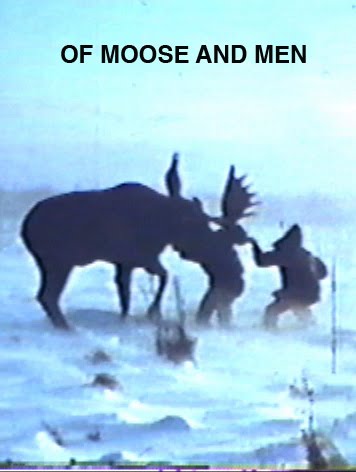 In my new book Of Moose and Men I have quoted statistics from Sweden about vehicle x moose accidents. They have long been a major problem and in 2010 there were 7227 reported to police. What, you may ask, has this got to do with the Serengeti?
 Here are a couple of pictures that you might enjoy. The smaller serval cat was a bottle-raised animal that lived in Kenya's Meru National Park around the home of chief Warden Peter Jenkins and his family in the late 1960s. I have stories about Peter in both of my books.
 Here is a photo of Turing that I found on line. I could have chosen any one of hundreds, as a Google search for them got me to 49 pages. A second family link to Turing ties in with the fact that my daughter is heavily involved with computing, artificial intelligence and the world of robots. For the folks in her world Turing is an icon.
  The last known one died in an Amsterdam zoo in 1883.
