Showing posts with label bushmeat. Show all posts

Saturday, February 8, 2014

Bushmeat and the African Trade to Europe

Last week I was in Peru and met an experienced airline steward who has flown with major airlines for many years into, and more to the point, out of several West African capitals. We got chatting about the bushmeat situation, something I have written about in books and on blogs for several years.
 
One of Amman's many pictures of the bushmeat trade

Of course writers with bigger followings, like the remarkable Karl Amman have written and photographed bushmeat and poaching stories to a wide audience. He also graciously allowed me to use some of his images in my book The Trouble With Lions .

The late Anna Mertz, who worked as an engineer in West Africa for many years reported on the horror show of truck loads of dead and badly injured antelopes appearing almost in food markets in Ghana long before the bushmeat trade issue reached a wider global audience.

My steward acquaintance told me that loads of bushmeat continue to come out of Africa bound for the UK with every flight. It is packed in passenger luggage, and the security officers who check bags before departure have no interest in, and probably no jurisdiction over it.  They are concerned with weapons.

The airplane staff can do little about it either. They do try to curtail the excess baggage situation, but even that is a hopeless task, as the routine response from Nigerian passengers is that a white-skinned staff member is picking on a black person. Inevitably some of the bags leak their contents and many planes end up with bloodstains and bad smells.

In Kenya Ann Olivecrona told me how she chanced to witness a bushmeat import at London’s Heathrow airport. As I wrote in 2008:

“in May 2004 she witnessed an amazing interchange involving bushmeat at London’s Heathrow airport. Her plane happened to arrive at more or less the same time as a flight from Lagos. During the time that she watched the procession, customs officials stopped every one of the Nigerian passengers and asked for the huge suitcases to be opened. Almost all were packed with smoked bushmeat.”

The bushmeat trade poses serious risks at both ends.

In Africa it is leading the rapid depletion of wildlife populations. Many species are involved. While primates are the most evocative for most people, the most popular species is the cane rat of the genus Thryonomys, known locally as cutting grass. They can weigh as much as 10 kg in the wild and in most West Africa countries efforts have been made to rear them for the meat market.  

Credit: Aurélia Zizo/Wikipedia

Here is a picture from the Wiki of one such rat, a male Greater Cane Rat (Thryonomys swinderianus) in a breeding station in Owendo, Gabon

Many tribes in the region have long held certain species taboo. Not any more. Anything goes.  One example is the African buffalo, long deemed off limits to one clan in Ghana. In October 2001 Ghanaian journalist Vivian Baah wrote a series of articles under the title “Guess What’s Cooking for Dinner?” in the Evening News of Accra. She related how in parts of Ghana:

“among the Ekona clan of the Ashanti's, it is a taboo to kill the Ekuo (buffalo). But these days, the members of this clan themselves are the worst offenders. Having turned their backs on the taboo, they now butcher the Ekuo with cheeky ease.”
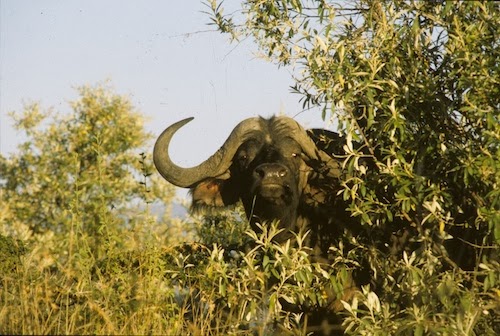
Cape buffalo - aka Ekuo in Ghana

Of course this process will inevitably lead to the law of diminishing returns. Species will simply disappear or become rare.

In Europe there are serious disease risks. Much of the continent has an endemic foot-and-mouth disease status. If the disease gets into UK, for instance, it will cause billions of dollars worth of economic damage. All it needs is for some improperly preserved meat to carry the virus to destination. A little bad luck or carelessness and the explosion would take place. If this seems unlikely one only has to look at my home province of Saskatchewan, where, in 1952, illegally imported smoked meat from Poland led to the last outbreak of FMD.

Fruit bats roositng in Uganda


It is not just livestock diseases. Ebola and the closely related and equally deadly Marburg virus can infect humans who handle primate and fruit bat carcasses (fruit bats are a popular bushmeat item).

 HIV/Aids came to humans via chimpanzees and sooty mangabeys. No doubt there are other examples.

In a TTWL chapter titled Bushmeat and Bureaucrats I tried to make the point that thousands of words on paper would achieve nothing much. One example of such verbiage came from the European parliament. A tome from that body that took four years to reach “Provisional Edition” status came out in 2004.

Bureaucrats the world over are famous for producing complex, usually lengthy documents about almost any subject one can think of. The more pen pushers involved the more complex the end product. Only this human sub-species could have come up with the title EuropeanParliament resolution on Petition 461/2000 concerning the protection andconservation of Great Apes and other species endangered by the illegal trade inbushmeat (2003/2078(INI).” 

The material has ten Having regards to” clauses, fifteen appearances of “Whereas,” and twenty-one “Urges” and the like, a few with sub-clauses. There are no teeth to the document, just urges.

It is obvious, from my airline steward’s account, that the teeth are either absent or false.


Friday, May 17, 2013

Bushmeat in Canada

-->
The April 22 issue of Maclean’s magazine carried a story by reporter Sarah Elton about bushmeat. I don’t know if she also came up with the title, Gorillas in our midst but it was a nice pun on the Diane Fossey book title and subsequent movie Gorillas in theMist

A similar article titled Monkeys on the menu  appeared in the April 15 on-line version of the magazine

A roadside bushmeat vendor in Cameroon. He\is just trying to make a living


It was good to see this important issue highlighted, but as someone who has witnessed the bushmeat trade first-hand and written about it in some detail I found that there were some missing elements that should have been covered.  I wrote the following letter to the magazine’s editor and in due course received a reply telling me that it had been forwarded to Ms Elton.

Of course I had the luxury, in my book The Trouble With Lions (U of Alberta Press 2008) of being able to explore the subject outside the restrictions of the kind of word limit required in a magazine article, but I believe that the disease issues I raised are important.

Here is the letter, unedited from what I sent, but with two of my own pictures slotted in at appropriate spots, as I cannot use the ones from the magazine.

Dear Mr. Stevenson,

Sarah Elton’s story on bushmeat, with its clever punning title Gorilla in our midst is, like the curate’s egg of Punch cartoon fame, good in parts. She misses a few really important points. I have worked in Africa for many years and also written books and blogs on the continent’s wildlife. I have three chapters in my book The Trouble With Lions that cover this subject in some detail. The third one is titled Bushmeat and Bureaucrats. Like the members of this corps worldwide it seems that Canadian ones are slow to act.

I realize that Elton was constrained by a word limit, but the Photoshopped image of the gorilla head on the meat counter made a nice point and was perhaps a worthy replacement for the 1000 extra words the article needed. She has however either missed out on or is misinformed about disease risks.

Foot and mouth disease is endemic in much of Africa and all cloven-hoofed species are susceptible. Canada’s last outbreak of this economically disastrous plague occurred in Saskatchewan in 1952. It was traced back to the importation of smoked meat from Poland. Bushmeat from Africa poses at least as great a risk.

Monkey pox is misnamed (not Elton’s fault). It is a disease of rodents – remember the outbreak in the USA that was linked to pet gophers in 2003. People in Africa, desperate for protein are eating species once considered taboo. The Wakamba of Kenya, a tribe famed as hunters, are amongst them.

Egyption fruit bats in a cave in Queen Elizabeth NP in Uganda
Fruit bats, a common bushmeat item, carry Ebola and the closely related Marburg virus. Both are deadly to humans. For several years I took senior veterinary students to Uganda and a highlight was a visit to a cave in Queen Elizabeth National Park that was the daytime home to an estimated 100,000 bats. That stopped after an unfortunate Dutch woman who had visited the cave contracted Marburg and died at home in Holland. The cave is now off-limits to all.

AIDS is a disease that crossed from primates into humans at least seven times in the 20th century. There are two main virus types, HIV1 and HIV2. 

A chimp feeding on fruit in Uganda
Beatrice Hahn, a professor at the University of Alabama showed that chimpanzees are the source of HIV1 while sooty mangabeys, a small almost uniformly grey monkey from West Africa are the source of HIV2. Even more fascinating is that the two viruses in humans are less closely related to one another than they are to their original primate hosts.

I realize that in this little précis I have exceeded the 300-word limit, but I do have lots of other examples and I also quoted Dr. Brashares in my book. I also have good pictures of those fruit bats and of a local bushmeat vendor with whom I had a couple of long chats. He is from rural Cameroon and is just trying to make a living in a forest region where livestock cannot be raised.

Yours sincerely

Jerry Haigh BVMS, MSc, FRCVS

I signed off using my Professor Emeritus status in the hope that I would be taken seriously. I just hope that foot-and-mouth disease does not get into Canada, or indeed North America, through the bushmeat route. This is a real case of my not wanting to be an accurate prophet. 

I have not heard another word, either from the magazine or the author.  Ah well!

Sunday, July 29, 2012

Ebola Outbreak in Uganda


There has been another outbreak of the deadly and highly infectious Ebola virus in western Uganda, in the district of Kibale. A report of July 29 about it appeared in the online Guardian newspaper

Ebola was first reported in 1976 in Congo and is named for the river where it was recognized, according to the Atlanta-based US Centers for Disease Control and Prevention 

As a CDC fact-sheet states states It “is a severe, often-fatal disease in humans and nonhuman primates (monkeys, gorillas, and chimpanzees”

It manifests itself as a haemorrhagic fever, is highly infectious and kills quickly. It is "characterized by fever, headache, joint and muscle aches, sore throat, and weakness, followed by diarrhoea, vomiting, and stomach pain. A rash, red eyes, hiccups and internal and external bleeding may be seen in some patients".


A chimp family in Kibale NP. Photo by one of 70 students, not sure who.
Those gorillas and chimpanzees, both of which have strong social groups, live closely together all year long. This undoubtedly helps the rapid dispersal of the virus, which is spread by close contact, not just with a victim, but also on communal food sources and other surfaces. So much so that Dr. Jane Goodall told me that one of her primate researching colleagues in the Congo basin had had her work utterly wiped out, not once, but twice, when entire families of habituated gorillas in her study died from the disease.

Of course grieving human family members also make close contact with their sick or deceased loved ones and hospital workers are very much at risk as there is no vaccine and no specific treatment.

Black and White Colobus monkeys
There are several things to think about, and perhaps the most important source of the outbreak has been skimmed over by either the newspaper or the investigators on site. In the July 29 report a brief mention is made of “contact” with monkeys. I’m sure there is more to it than that. About 8 years ago a case occurred in the most northwesterly part of Uganda when a man died of Ebola. He had been skinning out a black and white colobus monkey he had killed for consumption.

Red colobus in Kibale NP


However, it is by no means just great apes that can be involved.

There is a very strong and growing use of bushmeat in the area.  Traditionally Ugandans were averse to bushmeat, and in particular they did not eat primates. But over the last 15 or 20 years or so a large number of refugees have fled the events in the DRC and brought with them their hunting and bushmeat culture.  Of course relationships with locals have developed and so the consumption of bushmeat has risen steadily. 

For a really comprehensive review of the possible role of wildlife in Ebola epidemiology I would recommend an on-line article by a team from the Wildlife Conservation Society in the Emerging Health Threats Journal.

Canadian & Ugandan students on a forest trail


I made numerous trips to Kibale and other areas of Western Uganda between 2002 and 2009 when I took final year vet students there for one-month wildlife conservation externships. Our first field work took place in Kibale National Park

My students and I had what, in retrospect, were some very close calls. For one thing some of us handled monkeys. But primates may not be the only zoonotic source of the virus. 

There is a body of evidence that suggests that Egyptian fruit bats and even some other species may be carriers. They too are a major source of bushmeat and also certainly carry Marburg virus, which is very closely related to Ebola. So closely in fact that they are almost indistinguishable except by very detailed examination. The produce virtually the same symptoms and sufferers almost always die.

There is a fascinating cave in the Maramagambo forest in Queen Elizabeth NP that used to be part of the tourist circuit and we visited is several times. In this clip you can see some of us getting very close to the mouth of the cave in an attempt to see the resident python. He had surely found a perfect spot to hang out, practically a case of free lunches. The background noise is not a technical glitch. It is the sound of the chittering conversations of thousands of bats.

The cave is the roosting site for those thousand of bats.We all got quite close to them and lots of close-up photos were taken.

In the mid-2008 Dutch authorities confirmed that an unfortunate woman tourist who had had direct contact with a bat in the cave died of Marburg infection after she got back to Holland. 


In a report from the Center for Infectious Disease Research and Policy it was stated that three miners died of the same infection after bat contact in a different cave in another area of the country. 

Bats don't just roost in caves. Hundreds of them use the trees in the Makerere University grounds in Kampala and as the fast-falling dusk of the tropical evening approaches thousands of them can be seen swooping across the sky as they head out for their nightly feed.


I read about the Dutch woman through the wonderful ListServ of Promed and at once alerted my colleagues in Uganda. One of them, Dr. JB Nizeyi, was the chief in-country veterinarian for the Mountain Gorilla Veterinary Project and very much involved in our teaching. I understand that the cave in QEP has been closed to tourist ever since.

Bushmeat and the bushmeat trade is an emotional issue. I discussed it at some length in my book The Trouble With Lions. I feel that as Africa’s human population continues to increase the trade will expand. In some countries (Uganda, Kenya) the human population doubles about every 20 years. People get hungry. They kill wildlife for food and for revenge when their crops are destroyed or their cattle eaten by large predators. Of course that gets us into a whole other debate, about which I have posted before, but all of it is related.

Saturday, June 18, 2011

Elephants as bushmeat

Link
In a BBC science and nature report of June 15th author Victoria Gill recounts how the forest elephants of Africa face extinction. Her piece is titled Elephants Face Same Extinction Fate as Woolly Mammoth and you can find it here.

Quoting Professor Adrian Lister of the UK's Natural History Museum she relates how wooly mammoths that once roamed in their millions in the UK and across northern Europe and North America were squeezed into smaller and smaller areas. Professor Lister says that forest elephants are suffering from the same "double whammy" that claimed the woolly mammoths - habitat loss and hunting.
"Today both of those sides of the pinch are caused by humans."

Gill suggests that history may be repeating itself. This is because as the dense rain forests of central Africa are being opened up raided by logging companies who supply the needs and greed of wealthy people from Europe, North America and the Orient.

I took this picture in Cameroon in 1997. The truck was one of six that I saw in a two–hour drive from the coast to our work station when I was involved in an elephant research project with the Wildlife Conservation Society team in the mid-1990s.I have told the full story in The Trouble With Lions: A Glasgow Vet in Africa. Each load was worth about $100,000 to the suppliers. Of course the trees were being felled by men who did the grunt work and needed to eat.

The logging led to habitat loss in several ways. First, and most obvious, was the destruction of many hardwood trees. Second, the damage to the surrounding bush as heavy machinery smashed everything in its path. Third, and least obvious was the curtailment of elephant movement, which has become worse over time as the number of roads has increased and the number of elephants has declined.

The team leader in Cameroon was Buddy Powell who had started to examine how elephants affect their environment and spread trees around when they eat the fruit and then pass the seeds that germinate in another area of the forest.The plant diversity is amazing and when I asked Buddy about numbers he told me that there were likely as many as 300 species of plant in a ten metre radius of where we stood. As the elephant’s range is restricted and their numbers dwindle so the plant diversity will decrease.

Gill only touches on a part of the problem when she writes about the ivory trade. Although she is right when she says that the
“trade - fuelled by civil unrest and organised crime in some central African countries - supports the poaching.”
What she has missed is the other vital element.

In the January to March issues of Swara, the magazine arm of the East African Wildlife Society Dr. Dan Stiles has documented a bigger problem. His title says a lot: First Ivory, now meat: Elephants face second threat to survival. Unfortunately the article does not seem to be on line, but the magazine’s editor does state that the full report will be published this year by IUCN.

What it boils down to is that the loggers need to eat and that is the central problem for all the species that dwell in the forests.

During our walks though the forest I would hear a shotgun blast about once an hour and it was no surprise to see spent shells like this one planted on a bush.

I encountered a roadside bushmeat stall where a variety of species were for sale. They included birds, cane rats, monkeys and duikers.

Karl Amman, the Kenya-based wildlife photographer who permitted me to use some of his pictures in my book The Trouble With Lions has documented the bushmeat trade in startling detail. You can find many more pictures at his website.

Although the bushmeat hunters take anything they can Stiles quotes Amman stating that
“Elephant meat is worth much more than ivory.”

So much so, that this remarkable picture on the BBC site shows a shop somewhere in Africa where ammunition for elephant hunting is graphically advertised on the outside wall.

So, as all species, animal and plant, in the forests of central Africa are hammered, the elephant, which gives the greatest return on investment is taking a big hit.

Friday, April 30, 2010

Tortoise taboo

Linkhttp://www.wcs.org/, http://www.jerryhaigh.com/book/

Walking in the rain forests of Cameroon was a new experience for me in several ways. It had either just rained, or was about to rain all the time, that is if it wasn’t actually raining. This was 1996 and I was working on a forest elephant project for the Wildlife Conservation Society in the Korup forest on the west side of the country. As I recounted in chapter 10 of my book The Trouble With Lions I learned from our tracker, James Ako, that the hunting and eating of a tortoise was taboo. He did not explain why, and I forgot to ask.

Now I know at least one explanation.

It comes in a 1967 collection of folk tales from Ghana titled Tales of an Ashanti Father that I have just added to my little libray. The author, or maybe she should be called collector, of these tales was Peggy Appiah. In a story called The Hunter and the Tortoise, which I have shortened here, she tells how a hunter went into the forest with his gun and was enchanted by a tortoise playing an accordion. He challenged the animal and gave it the chance of returning to his village with him or being shot. “How can I not agree seeing you have the gun?” replied the tortoise.

As he bent to pick him up the tortoise warned the hunter “I am a creature of the forest and not of the town. If you take me to your home you will have only yourself to blame.”

At home the hunter rushed to the chief to tell of his find, and the skeptical chief told him that if he was lying he would be executed, but if he was telling the truth he would be richly rewarded. As you can guess, the tortoise merely sat and looked stupid when the hunter tried to exhibit him.

As the hunter’s head rolled in the dust the tortoise sang out
"Trouble does not look for man,
It is man who looks for trouble."

The upshot was that the chief decreed that that the tortoise be taken back to the forest where it was happiest. He also stated "From now on the hunting or capturing of tortoises in the forest will be taboo to my people. Anyone who is found interfering with them will be executed."

Of course the happy (sort of) ending was that the hunter, who had spoken the truth, was given a grand funeral and the tortoise was returned to his forest clearing.

Like many written folk tales this one is now in suspended animation for those reading this account, and of course I have cut it by about 70%. The conversations, the efforts of the hunter to get the tortoise to perform and the scene setting are up to the reader to convert back to the oral, but for me, it is nice to get an explanation after fifteen years. It also gives me another tale to tell that is linked to animal work in far-off places.

Thursday, April 15, 2010

Bushmeat in the USA


Linkhttp://wdin.blogspot.com/, http://news.discovery.com/animals/bushmeat-diseases-entering-new-york.html

Talk about serendipity!

Tonight I have a gig with the Saskatoon Nature Society and my topic is The Trouble WIth Lions: A symbol for Africa's wildlife. As I indicated I am using the lion only as a symbol and I have added an extra subtitle in my opening slide which is (and other continents).
I took this picture in Cameroon in 1997. In it you can see several species for sale as bushmeat. The three at bottom left are smoked monkeys of some kind, but the treatment has rendered them beyond identification, or at least field i.d.
This morning, when I opened up my email I found a letter from my main listServ source on wildlife issues which is theWildlife Disease News Digest, put together by Dr. Cris Marsh of the USDA. One of the links in that document reads Bushmeat Diseases Entering New York and so of course I opened it, as I have been following the bushmeat situation for many years now and my last post about it, of nine, was on Jan 11th. This concerned the trail of the Liberian woman who was convicted last year of trying to smuggle 720 pounds of baboon and warthog meat. She had used the innovative defense that the meat was for religious purposes and claimed the right to freedom of religious expression.

In the online Discovery News of yesterday it was reporter Jennifer Viegas who summarized the newer events and the finding by colleagues in the Wildlife Conservation Society of a virus called simian foamy virus in three primate species: two mangabey monkeys and a chimpanzee. This photo of a sooty mangabey was taken by Nick Gordon and was available n the Arkive image web site. For those familiar with the AIDS story, it was from these very same species that the disease has crossed into humans on at least seven occasions in the last hundred years.

Viegas goes on to report that Inspection and health officials have seized hundreds of samples of wildlife and wildlife products coming through luggage and mail parcels through main entry points for both people and goods into New York City and the United States. Samples have been taken from at least 14 species, including great apes, monkeys, rodents, and bats.

She also states that officials of the U.S. Fish & Wildlife Service say that more than one billion individual animals were imported into the United States from 2000 to 2004, along with over 11 million pounds of bushmeat and other animal products. That’s one billion animals – 1000,000,000!

Is this the forerunner of a coming plague?

Monday, January 11, 2010

Bushmeat smuggling and the illegal Wildlife Trade


Linkhttp://blogs.villagevoice.com/runninscared/archives/2009/12/monkey_meat_cas.php

I have been following the case of Mamie Manneh (aka Mamie Jefferson) in New York who smuggled bushmeat into the USA from Liberia. I first wrote about this extraordinary story in The Trouble With Lions and described how she had used a defense of the right to religious freedom as one of her reason for the smuggling. I again mentioned it in my blog of Sept 22nd.

In a report of Dec 12th from the New York Village News Blog the case seems to have finally come to an end, and the probationary sentence seems utterly trivial for a crime that involved the importation of 720 pounds of baboon and warthog meat. As the judge said, the deliberate circumventing of the law to hide the importation was the problem. It seems he was not swayed by Jane Goodall's written testimony about the severity of the situation, or indeed by the clear evidence of the potential diseases risks involved with such importation.

When I got my copy of the National Geographic magazine of January 2010 the whole thing came into perspective. A story by Bryan Christy, with disturbing photos by Mark Leong, tells about the Kingpin of Asia’s wildlife trade. His name is Wong Keng Liang, known to wildlife traffickers and officials around the world as Anson. His work (if this is the right word) makes Mamie’s crime seem utterly trivial. Christy’s figures are mind-boggling, almost impossible to comprehend, and the fact that Anson gets cooperation from some government officials in Asia just makes it worse. When he as arrested in 1998 Anson managed to plea bargain his way out of a sentence that might have involved 250 years in prison and a $12.5 million fine. He ended up with 71 months, with credit for 34 months already served. By all accounts the smuggling and trading continued throughout his time in gaol and continue to this day, the latest venture being a big interest in tiger farming.

Tuesday, September 22, 2009

Bushmeat smuggling from Africa


Linkhttp://www.silive.com/news/advance/index.ssf?/base/news/1252497614318590.xml&coll=1, http://www.nj.com/news/index.ssf/2009/05/seizure_of_bushmeat_from_lugga.html

In The Trouble With Lions I wrote about an unusual case of bushmeat smuggling in the USA. An immigrant woman from Liberia had been prosecuted for smuggling monkey parts. At her pretrial deposition in the Brooklyn federal court in Brooklyn she stated that she ate the bushmeat for religious purposes and
‘because monkey from the wildlife is a very smart animal’.
The case has moved along and a report by Frank Donnelly in the Staten Island Advance of Sept 9th states that the woman, named Mamie Manneh (or Jefferson) has pleaded guilty to smuggling illegal monkey parts. This happened after her church minister debunked her claim of bushmeat's religious significance. She will be sentenced on Nov 13th in Brooklyn Federal court.

One of the issues raised by the prosecution was the potential of disease spread from bushmeat. The prosecution veterinary expert mentioned Ebola, measles, tuberculosis, monkeypox and retroviruses similar to HIV but added that she was ‘she was unaware of any documented cases of such diseases being spread through consumer bushmeat.” It maybe that she was referring to such diseases occurring in the USA, but it is important to recognize that several of these diseases are known to have crossed into humans from bushmeat in other countries. The classic is the spread of HIV to humans from chimpanzees and sooty mangabeys on at least seven occasions in the last 100 years. Then there is the more recent finding of a gorilla derived form of HIV occurring in a human, which I recounted in this blog on August 4th under the title Gorillas and AIDS.

In a somewhat related case a Ugandan man was caught red-handed with bushmeat and fruit when his luggage was screened at Newark Liberty International Airport. Reporter Christopher N. Dela Cruz, writing in New Jersey Real-Time News, which is associated with the Star Ledger related that parts of antelope and cane rat were found along with fruit and other illegal commodities.

Lest anyone think that bushmeat smuggling is unusual, local authorities in Newark relate that this was the sixth seizure of bushmeat since October last year, totaling over 41 pounds. Last year, similar seizures weighed in at 88 pounds. Once again, and entirely appropriately, disease transmission to people from bushmeat was raised by federal authorities.

One of the slightly odd things about this report was that a picture accompanying the report showed a uniquely North American species, the pronghorn antelope. It seems possible that the newspaper lacked a picture of the most common antelope species in Uganda, the Uganda kob, (pictured here) which is often a target for poachers in Queen Elizabeth National Park and elsewhere.

In this case the man, whose name was not given, was fined $300 and released.

Thursday, September 17, 2009

Gorilla hunting in Congo


Linkhttp://news.bbc.co.uk/earth/hi/earth_news/newsid_8256000/8256464.stm, http://www.karlammann.com/

A recent headline on the BBC web site goes like this: “Scale of gorilla poaching exposed”. The story, by Earth News reporter Jody Bourton tells how
“An undercover investigation has found that up to two gorillas are killed and sold as bushmeat each week in Kouilou, a region of the Republic of Congo.”


Quoting Mr Pierre Fidenci, president of Endangered Species International (ESI) Bourton wrote:
"Gorilla meat is sold pre-cut and smoked for about $6 per 'hand-sized' piece. Actual gorilla hands are also available."


What Bourton did not mention is that there has been a culture of gorilla hunting and consumption in the Congo basin for a long time. In his autobiography On Safari: The Story of My Life (Collins 1963) Armand Denis published several remarkable photographs of gorillas that had been hunted by large gangs of Ituri hunters deep in the forests of the Congo basin when he accompanied pygmies on a well-orchestrated hunt in the forest. These hunters used home-made guns that fired anything that could be turned into a lethal projectile and were dangerous to use, as they might explode in the user’s face.

More recent photos of butchered gorillas and indeed the whole bushmeat saga have been published by Karl Amman, who allowed me to use some of his images in The Trouble WIth Lions. You can see some of them on his web site.

It is very likely that the current hunting is more systemic and highly organized than the events that Denis witnessed and it is also likely that it is unsustainable. The investigators found that half the population is killed each year. No population of slow-breeding animal can sustain itself under such pressure. The situation is compounded because the main targets are adult gorillas that carry the most meat.

Fidenci’s team estimates that there are perhaps 200 gorillas left in the area. That number won’t last long.

A worthy, but in my opinion unattainable, goal, is to stop the hunting by providing alternative income, increasing conservation awareness and creating a gorilla reserve.

Bourton ends by quoting Fidenci.
"Enforcement does not exist. Even though there are existing laws which protect endangered wildlife against such activities."


With war, inaccessible forests and many other problems to deal with it is difficult to see how antipoaching can be a high priority.

Wednesday, September 2, 2009

Bushmeat in Madagascar and Asia


Linkhttp://news.bbc.co.uk/earth/hi/earth_news/newsid_8210000/8210355.stm,
http://www.wildlifetrust.org/news/releases/flyingfoxes.shtml, http://www.scientificamerican.com/blog/60-second-science/post.cfm?id=worlds-largest-bat-being-hunted-int-2009-08-31, http://wdin.blogspot.com/

Two seemingly unrelated stories, one from the BBC and the other from the Wildlife Disease News Digest that came to me via their listserv once more showcase the subject of the bushmeat trade. The bottom line? Hunting is an old, old tradition and hungry people need to eat and will hunt the wild animals around them.

The first story comes from Madagascar and is headlined Lemurs butchered in Madagascar. Reporter Jody Bourton relates how the recent unrest and loss of law and order and “suspension of conservation aid” has led to wide-spread hunting and consumption of these already threatened or endangered animals. She sates
“The dead lemurs are sold to restaurant owners seeking to serve new delicacies.”
This may not be so much a story of hunger as of novelty.This picture shown in Jody’s report, taken by local non-government organisation Fanamby and released by Conservation International shows a basket of smoked lemurs available for sale.

Bourton concludes that
"The problem of illegal killing of lemurs in Madagascar will only be solved when authorities act and are empowered. Also, the big donor agencies, the United States and Europe need to reinstate funding for conservation activities there immediately, or the advances of the past 25 years will forever be lost."


The other story comes from Asia and concerns a different type of bushmeat. In this case it is the world’s largest bat, the so-called large flying fox that is being hunted. The story by John Platt is headlined World's largest bat being hunted into extinction

The study that Platt refers to was headed up by Dr. Jonathan H. Epstein of the Wildlife Trust in New York City. It was published in the August 25 online edition of the Journal of Applied Ecology.
In his report Epstein stated that in Malaysia alone, 22,000 bats are legally hunted every year, and an unknown number are also illegally killed.
He went further to say that
“this level of hunting is unsustainable
for the number of bats in the country and will decimate this ecologically important species."


The only real way to gauge the size of these animals is to look at the pictures (© 2009 Wildlife Trust) that appear on Dr. Epstein’s report. Keen observers will note that the man handling the bat is wearing protective clothing as well as a mask. I am sure that the garments are worn to protect not only the bat from human diseases, but vice versa. We do know that some really nasty viruses can be transmitted to people by Egyptian Fruit Bats in Africa. Check out Ebola and Marburg as a starter. I have not seen any similar reports about disease transmission from bats to humans in Asia, but who knows?

In this case the disappearance of the bats will have much wider implications than just one species. Epstein stated that the bats
"eat fruit and nectar and in doing so they drop seeds around and pollinate trees. So they are critical to the propagation of rainforest plants."


Tuesday, August 4, 2009

Gorillas and AIDS


Linkhttp://wdin.blogspot.com, http://www.promedmail.org/, http://news.bbc.co.uk/2/hi/health/8175379.stm, http://www.nature.com/nm/index.html

News that a newly discovered version of the virus that causes AIDS has cropped up in a woman from Cameroon has hit several new outlets. This is no surprise. They include Wildlife Disease News Digest, Promed Ahead and the BBC web site.

The original article was published in the prestigious journal Nature Medicine. Lead author Jean-Christophe Plantier and his eight colleagues describe the finding of SIV [simian immunodeficiency virus] in a gorilla. They state that the virus
"is closely related to gorilla simian immunodeficiency virus (SIVgor) and shows no evidence of recombination with other HIV-1 lineages. This new virus seems to be the prototype of a new HIV-1 lineage that is distinct from HIV-1 groups M, N and O. We propose to designate it HIV-1 group P."


It has already been established that the two most important versions of the virus (so far) are HIV1, which crossed into humans from chimpanzees some time in the last 100 years somewhere in the Congo basin and HIV2 which came from a small nondescript monkey called the sooty mangabey, a small, almost uniformly grey monkey whose range is restricted to Upper Guinea in West Africa. In humans these two viruses are genetically less closely related to one another than they are to their original primate sources. The SIV counterparts of these two forms of HIV have been introduced into humans on at least seven different occasions.

That gorilla SIV should have crossed into a human should not surprise anyone who has followed the history of the bushmeat trade. In his 1963 autobiography On Safari Armand Denis published several remarkable photographs of gorillas that had been hunted by large gangs of Ituri hunters deep in the forests of the Congo basin. He had accompanied pygmies on a well-orchestrated hunt in the forest.

However, the Cameronian woman was living in Paris and had never been in contact with bushmeat. The article’s authors suggest that she must have acquired the infection from someone else who was carrying it. While this is the first finding of its kind, it seems likely that others will now be made. The patient was not ill, but that does not mean she will not develop AIDS.

Wednesday, February 25, 2009

Visit to a Chimp Sanctuary


Linkhttp://www.ngambaisland.org/, http://www.vwb-vsf.ca/, http://www.pfizer.ca/english/our%20products/animal%20health/default.asp?s=1

After six days of Internet-free life we are back in circulation. I am writing this from the solar-powered office of Dr. Lawrence Mugisha, who is chief veterinarian and sanctuary manager at Ngamba Island, where forty-five chimpanzees rescued from poachers live out their artificial lives. Here are two of the group next to an artificial termite mound

It is a chilling thought that almost all of these chimps are by-products of the bushmeat trade, as are all the other in the several sanctuaries scattered across Africa from Senegal to Johannesburg in the Pan African Sanctuary Association.

This morning our students have been afforded the privilege of working on health-checks of chimps during the routine annual health-checks of the group.

Lawrence and his team do a thorough work-up and most important they make sure that each adult female has retained her birth-control implant. The island, about a two-hour boat ride from Entebbe, is only one square kilometre in area, which is about enough for one chimp, so the animals have to be intensively managed and their entire food supply comes from their four daily feedings supplied by the dedicated staff.

We were, through the generosity of Pfizer Animal Health and the Canadian branch of Vets Without Borders/ Vétérinarians Sans Frontieres some of the essential supplies and pharmaceuticals that are needed to help make this program a success. Pictured here is Dr. Mushiga with some of our Canadian students and a packet of the drugs used to reverse the effects of the immobilizing drugs that are needed to carry out this work.

Most exciting, I discovered from Dr. Mugisha that a serious look is being taken at the possibility of rehabilitating some chimps back into the wild. A small section of suitable forest has been found in the Labongo area of Western Uganda and teams of investigators are currently taking a hard look at the many components that will need to mesh to make this effort got forward. It will take some time, so maybe there will be something to report next year if things go well.

Just before the boat left for the return to Entebbe we watched as the chimps were given their 2.30 pm feed.

Wednesday, December 31, 2008

Giraffe taxonomy

For years there has been a usually friendly debate among taxonomists and biological scientists who fall into one of two camps. These are the “lumpers” and the “splitters”. I have always been a fence-sitter on this, as I do not know enough about the pure science to make a meaningful contribution. A recent report that reached me through the newsletter of the International Giraffe Working Group (IGWG) may lay the debate to rest, at least as far as giraffes are concerned. This beautiful image, which appears here in the on-line journal BMC Biology is not a fanciful depiction of a multi-coloured palm leaf, but shows how six different groups of giraffes can be divided at the species level through the wonders of DNA technology. Many of the species separated as long as a million years ago. The ten-author study was led by David Brown, from the University of California, Los Angeles.


There are some obvious differences in appearance among the species, the most striking of which is the chocolate-coloured and clearly delineated coat pattern of the reticulated giraffe from Kenya’s north-east, which here in the first picture, taken at Borana. For those who wonder, the mountain at the back is Mt. Kenya. As for Borana, you can find out more about the idyllic lodge and setting here.

A closer view of these striking beasts show four of them in close association. Two are “necking” a competitive activity which ecologist Richard Estes describes in these terms (the) “Movement and counter movement appear rhythmical and synchronized, imparting the sinuous grace of a stylized dance”.

There are two other species of which I have my own photos. This one shows a group of Rothschild's giraffe, in Uganda’s Murchison Fall NP.

This photo of Rothschild giraffes taking the midday shade under a Fever Tree, was taken in Lake Nakuru NP, to which the founding herd had been translocated from western Kenya when the land they lived on had been developed for farming. Lake Nakuru is outside their traditional range, but the herd has been used as a source for subsequent translocations, notably back to Uganda, where numbers have been in decline ever since the ravages of Idi Amin and his armies.

And then there is the Masai giraffe, which is the first kind that I saw as I left Nairobi Airport (before it was named after Kenya's first president) in 1965, three days after graduating from veterinary school in Scotland and 16 years after leaving the country of my birth. I saw this group below the Ngong Hills, just outside Nairobi a few months later. Sadly there are not may there now, as poaching pressure with gun and snare has been relentless.

The speciation may not stop at six. Author David Brown and his colleagues in their paper in the BMC online journal state that
"The discovery of potential giraffe species may not be over. The Thornicroft's giraffes are a morphologically distinct population of giraffes endemic to the Luangwa Valley in Zambia, and a key link between the African continent’s north and south populations. The population is biologically isolated from other giraffe populations and as such is ecologically and potentially genetically unique."

In common with much else in the wildlife world, all over the globe, the numbers of giraffe are declining, in concert with expanding human populations. As Brown and his colleagues state
"There has been an estimated drop of 30% decade to less than 100,000 giraffes remaining on the continent."

Nowhere is this more apparent than in West Africa, where bushmeat hunting activity is rampant. Here is what Brown and his co-authors have on this part of the story.
"Within the peralta group of West-Central African there are only about 200 giraffes remaining in all of West Africa west of Cameroon where until the mid-20th century there were perhaps thousands"
.
There are several other fascinating articles in the IGWG newsletter that is edited by Dr. Julian Fennessy, so for those as captivated by these magnificent animals as am I, I suggest that you make contact with him. I cannot give you his email address here - that would be inappropriate, but he may choose to add it in the comments section to this posting.