Showing posts with label Uganda. Show all posts

Friday, September 19, 2014

A Container of Medical Supplies to Uganda

In 2013 Dr. Christine Dranzoa, whose remarkable history I have blogged about a few times, wrote to ask me if I knew anything about an organization in Hamilton, Ontario who were able to send medical supplies Uganda.  
An artist's plan of what the new university campus will look like
  
Christine talks to the builders
The nursing station under construction
She was in the throes of organizing the construction of a nursing station as part of the new university in her home district of West Nile at the town of Aura. She has been appointed vice-chancellor of the university and the recently sent me a photo of the early construction of the station.


It took but a moment to realize that we in Saskatchewan could surely do something without going further afield. After all we have a long history of philanthropic activity. It was time to put on my Sherlock Homes costume, the deer-stalker headgear (minus the meerschaum pipe and the cape) and see what I could find out.  

It did not take long. I started out by contacting Dr. Pammla Petrucka, a nursing PhD based in Regina who has had a great deal of experience is this sort of activity.

Those exchanges eventually led me to Mr. Lindsay Brucks, who heads up the Saskatoon branch of the organization Canadian Food for the Hungry. He has shipped 295 such containers to many countries, including Uganda and its neighbours Sudan and Southern Sudan. He in turn contacted Diane Larivee who volunteers with Regina Qu'Appelle Health Region and she too got involved

I had two other essential tasks. I soon found out that it would cost about twenty-five thousand dollars to ship from Saskatoon to Arua.  It was easy to contact all the students who had accompanied my wife Jo and me to Uganda in the eight years up to my retirement from the Western College of Veterinary Medicine . The students quickly bought into the idea and we soon had enough money to cover most of the costs. The funds were deposited with the Hospitals of Regina Foundation under the watchful eye of Nora Yeats. 

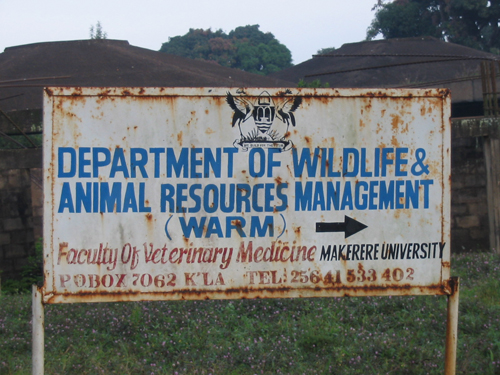
Our program involved in a study of the complex relationship between wildlife, humans and their livestock. The rotation lasted a month each year and we all learned a great deal. Without Christine, who had been head of the Department of Wildlife and Animal Resource Management at the Makerere University College of Veterinary Medicine at the time the rotation would never have taken place.

The other task was to find out from Christine more about her exact needs. She quickly designated one of medical staff to send me a list. At the last minute she wondered if we could help with a supply of mosquito nets which are so essential in that environment. For this part of the project I contacted our neighbour’s son who is a first year medical student. He invited me to tell his class-mates about Christine and before I knew it we had $468.51 in my hat. That went directly to Uganda as nets purchased there would be a great deal cheaper than any we might find here (about 10% of the cost).

Books for Uganda
Lindsay lost no time in finding everything that Christine needed, and a whole lot more. Jo and I made a bunch of phone calls and were soon given about eighty fairly modern textbooks on nursing and medicine by her former colleagues. The folks at the WCVM and St. Paul’s Hospital gave us seven excellent microscopes.

We then went to visit Lindsay at his warehouse when the container was two-thirds full. We were astonished at the quantity and variety of equipment ready to ship to any destination.
 
There were whole rows of wheelchairs, crutches, beds, a baby incubator and an ultrasound machine and anything else you can imagine.    
 
The full container on Sept 15th 2014
The container was soon full and is now on its way to Kampala where it is has to clear customs. With any luck it should reach Arua by Christmas. Wouldn’t that make a great Christmas present?

Ready to roll!

Wednesday, December 4, 2013

Christine Dranzoa - a remarkable person.


I’d like to share a story from Africa that is very much linked to a small slice of Saskatoon life.

Chrsitine Dranzoa outside the Faculty of Vet Med, 2002
I have a long history in Africa and for the last eight years of my career as a wildlife veterinarian I took Canadian students from the Western College of Veterinary Medicine to Uganda. We would not have been able to carry out this program if it had not been for the head of the Department of Wildlife and Animal Resource Management at the Makerere University veterinary school. Her name is Christine Dranzoa and through several exchanges of letters and email she laid on a tour for me in 2002 to see what was what before I actually took students there.
 
After that introductory tour it was relatively simple for me to convince the powers-that-be in Canada that there was a really worthwhile opportunity for Canadian students to learn a huge amount about veterinary medicine, and much more, in a new setting.

I also found out that Christine has a remarkable history, which I will compress (and which does not appear on any website). She was born in West Nile, the region of the country where Idi Amin came from. When he was ousted the equally gruesome despot, Milton Obote, targeted everyone in West Nile. Christine, aged 12, fled to Sudan as a refugee. She managed to get out of that nightmare and finished high school, got her BSc and went on to her PhD work. At age 27 she spoke to the dean at the vet school about the lack of a wildlife department and soon found herself not only founding one, but also becoming its head! We worked with her near the end of that tenure as this rather grainy old footage, shot with an early version of a digital camera, shows.

 
For the first three years Dr. Dranzoa traveled with us in the field and worked with the students on her specialty, which is birds. Her thesis work had been on the nesting ecology of birds in partially logged forest fringes. We visited Kibale National Park where Christine did her studies and used mist nets to capture birds, ring them, and collect blood samples for disease studies. We even found a couple of cases of avian malaria.

We were also able to secure funding at the WCVM to bring Christine to Saskatoon to deliver a moving talk about issues related to wildlife in her country. When my wife and I took her to one of our favourite places, Prince Albert National Park, we were lucky enough to see a huge swirl of snow geese above a slough near the appropriately named town of Duck Lake.  

Snow goose cloud. Photo by Trudy Janssens, Photogrpahy One2One


When her eight years as department head were up Christine was promoted to the post of Deputy Director of the School of Postgraduate Studies for the entire university (30,000 students, 3,000 graduate students) at age 35!

Artist's impression of the new campus
Dr. Dranzoa has gone on to meet new challenges. Two years ago (in her forties) Christine was tasked as one of the team founding a new university in her home region, in the district of Arua in the West Nile sub-region. This was after elders in the community petitioned Uganda’s president, Yoweri Museveni.  It  was founded in 2012 and has now been registered as Muni University. Christine is the current Vice Chancellor.

It comes as no surprise to learn that Christine has been active in other fields, especially in ones related to women’s issues in Uganda and beyond. Although we came to know her well and enjoyed our many visits with her, she never told us that she co-founded and is Chairperson of Nile Women Initiative an NGO which aims to address gender disparities in her home region. She is also Honorary Secretary of the pan-African Forum for African Women Educationalists.

Christine (r) with Fifi in 2003 and Angela, Chrstine's sister
Over and above these remarkable achievements she has now raised 18 children, none of them her own (she has never married). Most are kids of her siblings who were either killed in Obote’s pogroms or died of AIDS. The youngest, Fifi, is about to finish high school. A few are not even relatives, but just orphan children who are friends of her extended family. When we visited Christine’s home we discovered that the bedrooms were set up as dormitories – boys and girls. How could it have been otherwise?

The nursing clinc is under construction
Christine has written to me seeking help with equipment for a nursing station, a small but much needed part of the campus, especially during the construction phase when not only builders but also the  general public, will have it handy. She had heard that there were organizations in Canada who could ship containers of stuff to needy areas. After a bit of sleuthing I met (so far only by phone and on line) a Regina-based nursing PhD who has shipped 79 containers to 19 countries in the last 10 years. Her name is Pammla Petrucka. Dr. Petrucka has a well-oiled system and access to a large warehouse in Regina. She can also get hold of a full array of medical equipment ranging from bangages to bedpans, tilt beds to tubing and walkers to wheelchairs. On top of that she has a team of volunteers who can fill a container in a single day. All the equipment is donated, in good condition, and free. The problem is the shipping. It costs about $25,000 to ship a container. This covers the cost of the container, the physical act of transport, and the paperwork. The container is not returned and is likely to end up being a useful addition at the destination. I have even heard of containers being fitted with air conditioning before shipment.

My wife and I, and several of those former students have managed to raise part of the funds needed to get one container to Uganda, but cannot reach the full $25,000 needed to complete the shipment. We are channeling our funds through the Hospitals of Regina Foundationwhich has NFP charitable status so that our donors will receive tax receipts.

Apart from being an author and retired professor I am a storyteller and have told stories about my career as a wildlife vet on 4 continents. The Africa stories often have threads about Christine in them. I hope that this comes as no surprise.

Friday, August 10, 2012

A Story About Bats

-->
Just finished the annual gathering of the Storytellers of Canada – Conteurs du Canada which took place in Montreal this year. Four days of great stories, workshops, meeting old friends and making new acquaintances.

One thing I am always on the lookout for at the sale counter is books of African stories and I found four of them. By chance the first one I opened, published by Beacon Press of Boston in 1962, is called Umbundu: Folk Tales from Angola. It was translated and collected by Merlin Ennis and had a story in it that linked directly to my last post about bats in Uganda.

The story is called Fruit Bat and Sun. I have edited it slightly. It explains quite nicely why it is that bats spend their daylight hours in dark places and ties in with my last post about Ebola.

§§§§§§§§§§§§§§§

When the only child of Sun was sick, Sun went to the house of Elder Fruit Bat, and said to him, “Save my child for me.” Fruit bat went and soon cured the child.

Not long after this marvelous cure Elder Fruit Bat’s child got sick and so of course he went at once to Sun’s house and said, “Now my child is sick. Will you please come and save him for me in your turn.”

Sun replied “Come tomorrow very early and seek me. Don’t be late for once the day has started I never turn back.”

So, Fruit Bat came good an early, but not early enough for Sun, who said “Didn’t you listen to me? I said come early because I never turn back. Come again tomorrow but make sure you arrive while the ground is still black.”

Next day, when he arrived Sun said “You are late.”

Fruit Bat again turned for home, but when he arrived he found that his child was dead. Of course he was very sad and he swore an oath that he would never again speak to or see Sun.

From that day forward he has never once seen Sun, for, as he says, “He has done me a wrong.”
§§§§§§§§§§§§§§§§§§

So, now we know.


Sunday, July 29, 2012

Ebola Outbreak in Uganda


There has been another outbreak of the deadly and highly infectious Ebola virus in western Uganda, in the district of Kibale. A report of July 29 about it appeared in the online Guardian newspaper

Ebola was first reported in 1976 in Congo and is named for the river where it was recognized, according to the Atlanta-based US Centers for Disease Control and Prevention 

As a CDC fact-sheet states states It “is a severe, often-fatal disease in humans and nonhuman primates (monkeys, gorillas, and chimpanzees”

It manifests itself as a haemorrhagic fever, is highly infectious and kills quickly. It is "characterized by fever, headache, joint and muscle aches, sore throat, and weakness, followed by diarrhoea, vomiting, and stomach pain. A rash, red eyes, hiccups and internal and external bleeding may be seen in some patients".


A chimp family in Kibale NP. Photo by one of 70 students, not sure who.
Those gorillas and chimpanzees, both of which have strong social groups, live closely together all year long. This undoubtedly helps the rapid dispersal of the virus, which is spread by close contact, not just with a victim, but also on communal food sources and other surfaces. So much so that Dr. Jane Goodall told me that one of her primate researching colleagues in the Congo basin had had her work utterly wiped out, not once, but twice, when entire families of habituated gorillas in her study died from the disease.

Of course grieving human family members also make close contact with their sick or deceased loved ones and hospital workers are very much at risk as there is no vaccine and no specific treatment.

Black and White Colobus monkeys
There are several things to think about, and perhaps the most important source of the outbreak has been skimmed over by either the newspaper or the investigators on site. In the July 29 report a brief mention is made of “contact” with monkeys. I’m sure there is more to it than that. About 8 years ago a case occurred in the most northwesterly part of Uganda when a man died of Ebola. He had been skinning out a black and white colobus monkey he had killed for consumption.

Red colobus in Kibale NP


However, it is by no means just great apes that can be involved.

There is a very strong and growing use of bushmeat in the area.  Traditionally Ugandans were averse to bushmeat, and in particular they did not eat primates. But over the last 15 or 20 years or so a large number of refugees have fled the events in the DRC and brought with them their hunting and bushmeat culture.  Of course relationships with locals have developed and so the consumption of bushmeat has risen steadily. 

For a really comprehensive review of the possible role of wildlife in Ebola epidemiology I would recommend an on-line article by a team from the Wildlife Conservation Society in the Emerging Health Threats Journal.

Canadian & Ugandan students on a forest trail


I made numerous trips to Kibale and other areas of Western Uganda between 2002 and 2009 when I took final year vet students there for one-month wildlife conservation externships. Our first field work took place in Kibale National Park

My students and I had what, in retrospect, were some very close calls. For one thing some of us handled monkeys. But primates may not be the only zoonotic source of the virus. 

There is a body of evidence that suggests that Egyptian fruit bats and even some other species may be carriers. They too are a major source of bushmeat and also certainly carry Marburg virus, which is very closely related to Ebola. So closely in fact that they are almost indistinguishable except by very detailed examination. The produce virtually the same symptoms and sufferers almost always die.

There is a fascinating cave in the Maramagambo forest in Queen Elizabeth NP that used to be part of the tourist circuit and we visited is several times. In this clip you can see some of us getting very close to the mouth of the cave in an attempt to see the resident python. He had surely found a perfect spot to hang out, practically a case of free lunches. The background noise is not a technical glitch. It is the sound of the chittering conversations of thousands of bats.

The cave is the roosting site for those thousand of bats.We all got quite close to them and lots of close-up photos were taken.

In the mid-2008 Dutch authorities confirmed that an unfortunate woman tourist who had had direct contact with a bat in the cave died of Marburg infection after she got back to Holland. 


In a report from the Center for Infectious Disease Research and Policy it was stated that three miners died of the same infection after bat contact in a different cave in another area of the country. 

Bats don't just roost in caves. Hundreds of them use the trees in the Makerere University grounds in Kampala and as the fast-falling dusk of the tropical evening approaches thousands of them can be seen swooping across the sky as they head out for their nightly feed.


I read about the Dutch woman through the wonderful ListServ of Promed and at once alerted my colleagues in Uganda. One of them, Dr. JB Nizeyi, was the chief in-country veterinarian for the Mountain Gorilla Veterinary Project and very much involved in our teaching. I understand that the cave in QEP has been closed to tourist ever since.

Bushmeat and the bushmeat trade is an emotional issue. I discussed it at some length in my book The Trouble With Lions. I feel that as Africa’s human population continues to increase the trade will expand. In some countries (Uganda, Kenya) the human population doubles about every 20 years. People get hungry. They kill wildlife for food and for revenge when their crops are destroyed or their cattle eaten by large predators. Of course that gets us into a whole other debate, about which I have posted before, but all of it is related.

Tuesday, May 1, 2012

Equipment and Supplies for a Ugandan Field Trip


For several years I took students from Saskatoon's Western College of Veterinary Medicine to Uganda on a month-long field trip. We met people from the Makerere University veterinary school and in particular the Department of Wildlife and Animal Rescource Management.


During the trip we worked on the human x wildlife x livestock interface, which, in Africa is a very complicated matrix.

One thing I always prepared for our students was a check list.  First of course was the list of essentials. Then the basic supplies. Some I considered essential, others less so.  

Even today, three years after I retired, students come to me every year for advice. This year another group  of 2nd year students are off to Kenya and Uganda on a Global Vets program. Here is the blog from the WCVM 2008 group.

Here is a slightly edited version of the list that I used.


Equipment and supplies required for Uganda

ESSENTIAL
Ensure that your travel insurance covers medical emergency evacuation. 

Must , MUST Bring
  •   Passport; 3 copies of passport ID pages
  •   international student card (park entrance)
  •   money (US $), use high denomination notes. The Forex bureaus don’t like 20s. (watch date, this changes every year. As a general rule bring no notes that are more than 5 years old)
  •   Credit card or bank card
  •   vaccination records
  •   travel insurance
  •   ticket...for airlines
  •   malarial prophylactics

Clothing

Take old clothes that you don’t want to bring back. They can be left behind as gifts.

  •   jackets
    wind/ waterproof, LIGHTWEIGHT
    fleece/ sweater – it can drop to +15 at night
    (rarely, a bit colder)
  •   shirts
    •   long sleeve shirts (2)
    •   cotton shirt
    •   quick dry/ wicking shirt (i.e. polyester)/ short sleeve?
    •   tank top?(1) –
      Spaghetti strap shirts are OK (for certain folks)
    •   no white clothes (red dust everywhere)
  •   Pants
    bug pants/ nylon pants cotton pants (1-2)
  •   shorts
    respectable (e.g. hiking) shorts (1)
  •   socks
    hiking/ wicking socks (3-6 pairs). Long enough to allow you to tuck in your trouser
    bottoms in mosquito & tick areas – prevents ankle bites
  •   unmentionables (used to be known as “smalls”)
    you decide
  •   My wife (who came along on all these trips) suggested loose cotton (drip dry) dresses or skirts as they are cool (to wear, if not sartorially splendid)
  •   shoes
    •   hiking boots or similar for field work.
    •   sandals – for use in showers etc) Shoes tend to be bulky, so keep them to minimum. If you really want to bring runners as well, that’s fine.
  •   extras
    •   swim suit – almost everyone takes to the pool on the day off in Queen Elizabeth NP
    •   camera & good sized card (4 or even 8GB)
    •   If camera is digital, I have a card reader and can download (as long as my laptop doesn’t
      fry.
    •   Someone needs to make sure we have plenty of CDs for downloads
  • SUPPLIES
  •   Cell phone and charger (almost essential) SIM cards can be purchased locally. Air time is cheap and renewable almost everywhere. The network is superb. Everyone texts as a routine matter (known locally as sms). Land lines are either very unreliable or non-existent. Incoming calls are free, so get family members to call from Canada
       toiletries
    towel (divers/ swimmer’s towel→ wring & it dries fast), face cloth  
  • toothbrush, toothpaste, floss etc
    lotion: unscented, vit E lotion (99%) for people who sunburn easily  
  • shampoo, soap (unscented)
  •   sleeping bag and sheet/ liner (It will not likely get any colder than about +10C at night)
  •   therma-rest – bulky, but as there are only a limited number of dense foam mattresses it will prove useful if you have to camp.
  •   Treated mosquito net for sleeping - available in Uganda and can be ordered ahead at about $15 per, compared to about $40 for ones purchased here. Can be left behind as gifts or for the next lot of students.
  •   bug dope: DEET approx 20% (we use 33%)
  •   sun screen; at least 25 SPF. Higher the better. Lip balm with sun screen (not with Camphor/menthol)
  •   sun glasses with UV protection
  •   hat→wide brim for ear coverage
  •   canvas duffel bag/ back pack for day-to-day use. If you have a backpack that has an extra outside daypack compartment, it might well prove useful. If not, the sort of thing that is used for folks to bring lunch & books to school would suit
  •   Money belt or fanny pack
  •   Head lamp and spare batteries. Essential (or flashlight if you want).
  •   Personal first aid (headaches, a few bandaids (blisters) etc)
  •   crib board, cards, backgammon or whatever takes your fancy
  •   At least one book to read. Try and liaise ahead and make sure no duplication. Then swaps can
    occur.
  •   Swiss army knife/ multi-purpose tool
  •   Some sort of hardy water bottle (You will get thirsty – frequent re-hydration is essential –
    probably at least 1.5 L per day of water, maybe 2.5 on hot days (it can get up to almost 40 Celsius)

    Treats
    Bring some sort of snacks (Granola bars for instance) BUT - not ones that melt in heat (This is bad luck for chocaholics). Your biggest challenge will be not to eat them all in the first 2 days. These will act as what is known as comfort food as you find yourselves in a strange environment.

    Optionals 
      mP3. I have a solar iPod charger (will also charge the phones) 
      Binoculars
  •   H2O filter - bottled water is available everywhere, but tends to run out.
  •   Lonely Planet Travel Guide
  •   For anything electronic, bring plug adapter. Most systems are on 240 V.
  •   Note book(s) with water proof paper, pencils & eraser for those who wish to keep a journal
  •   Water purification tabs – no need to go overboard - (bottled water is widely available, but
    may be difficult to get in camp at Lake Mburo NP).
  •   Motion sickness pills if needed
  •   When at swimming sites, or relaxing around camp in the day time have a sarong type wrap
    for going to the bar, or away from the pool. These are known as kikoi for men, kitenge for
    women. Obviously worn at different levels. Readily available in Kampala if you lack one.
  •   String & clothes pegs (not everyone needs this, but 3 sets or so will prove useful)

    Medications
    Malaria prophylactics, antibiotics (at least one full course), headache meds,
    bandaids, wound ointment, laxative, diarrhea med, powder (Johnson’s baby or equivalent). Consult your physician or health centre well before you leave. Some vaccination courses require 6 months for complete coverage..
    Eyeglass prescriptions (glasses can be replaced in Kampala at much less cost than in Canada).
    For those who wear contacts, bring a pair of glasses – dust, etc can be a problem, also bring some eye ointment, as conjunctivitis can be a problem if you wear contacts
Surprises
Folks not used to travel in developing countries and tropical environments may be surprised by the fact that flush lavatories are rare and almost non-existent in remote spots.   This is the more likely option.


You will not be surprised that after a month of teaching and "mother henning"  almost 24/7 I got tired, or even exhausted. Someone in one of our groups caught me out in a day-time nap.

Thursday, April 19, 2012

Big Bustards


There are at least eight species of bustard (yes you read that correctly) in Africa and if you include the korhaans from southern Africa and its neighbours then the numbers climb to about a dozen. The largest of all is the kori bustard (Ardeotis kori) , which is certainly the largest bird on the continent capable of flight.

The males weigh in at about 13.5 kg, but may be heavier, even up to 20 kg. The largest specimens may top a metre in height. The females are somewhat smaller. I have seen them, usually as singletons, in many areas of Kenya and Uganda, as well as further south in Namibia, Botswana and South Africa

I saw these three together at Borana, which lies to the north of Mount Kenya. (Number 3 is in the background and the focus is fuzzy, but it is there!

They are grassland birds and only seem to fly occasionally. They seem to prefer to walk and as they do so one can see them searching for food. You can find a short Youtube video from Tanzania’s Ngrongoro crater that shows a pair of them.

My late father, who was a keen wing shot, described his efforts to bag one during World War II told me that it was very difficult to get them on the wing but on the one occasion that he did so, and got it, there was enough meat to feed the entire officer’s mess. 

There is another very large bustard that ranges across Europe and into temperate Asia. It is known as the great bustard (Otis tarda) and there seems to be a lack of agreement among scientists as to which is the two is the larger.

Like other species they once occupied much wider ranges and we know that the Great Bustard occurred on England’s Salisbury Plain is historical times, having been extirpated in about 1832. An active program in the UK led to their reintroduction in 2004. One can visit the release site, details here. You can see footage of these huge birds at the centre by linking here. Perhaps the most striking thing about the film is the remarkable display by the males, during which the head almost disappears in a mass of white feathers that puff up from the throat. At the same time the tail fans out, again revealing a mass of white. All this is to attract females. I have only witnessed a bustard display once, in Kenya, but unfortunately I did not have a movie camera, so I cannot share it with you.

Wherever the great bustard of Eurasia hangs on, from Portugal eastwards, it only does so in small numbers, often in protected areas.  Much of the decline has been due to changes in agriculture and human development, not only houses, but roads and other infrastructure.

Great bustards also feature on stamps. The 1994 Hungarian 1.50 florint stamp showed a single bird and there was a 1.10 koruna stamp issued in Slovakia in 2011 depicted two great bustards. I found this image on a stamp website here.

Saturday, April 7, 2012

Flamingos, salty water and salt mining in Africa


Another collection of pictures from Africa. This time it’s birds and more particularly, flamingos. With two exceptions they come from Kenya. The last two are from Uganda and Namibia. Even the Kenya ones are not all from the same spot.

It is, or was, Lake Nakuru that was always famous for the masses of these striking birds. Indeed it was said that there were, at times, over a million of them on the lake. That has changed dramatically. I took this picture over 40 years ago, and there appear to be more birds than water.  

On our visit there in December we saw very few, maybe a couple of dozen at most. 


We did see thousands, standing, feeding and flying at Lake Baringo, the next-most northerly lake in the chain that appears in the Rift Valley. The storm clouds had gathered in dark masses about the eastern wall of the Rift as we stood and marveled at the sight. The photos at Baringo were taken by one of thre three of us with cameras. Our daughter Karen, her husband Robert, or me.


These pictures do nicely show the difference in both size and bill colour between the Lesser and Greater species. On the left they are all Lessers. The fully dark beak with its small dark pink spot near the tip shows clearly On the right a single Greater, with his pink bill and dark tip stands out. The lesser also has a pinker hue to the body feathers.  How obliging of them to stand so still for the camera.

Feeling the cold?


I’m not sure if this one was feeling the cold, but he/she does seem to have a scarf around the neck.


Sart your engines!

Near the finsih line


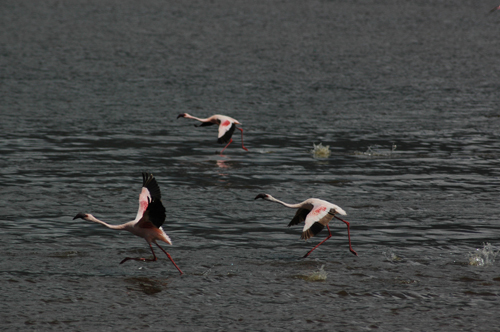
They are truly spectacular when they fly as the colurs stand out.


On previous trips we have also seen them at Lake Elementaita, the next lake south from Nakuru. The hill in the middle background is known as the Lord’s nose. The nasal shape does not show up well in this view, but the Lord name is a reference to Lord Delamere the famous, or infamous, English settler whose ranch, Soysambu, covered most of the land you can see beyond the lake, including the hill. Soysambu is now a conservancy and borders on Lake Nakuru National park effectively extending the area set aside for the purpose.


There are other lakes in the Rift Valley system, and of course the Rift divides into two arms. During our many trips with veterinary students to Uganda and the western arm, or Albertine Rift, we saw small numbers of flamingos in Queen Elizabeth NP, but not in the big lakes named in the 19th century for members of the British Royal family – they are Edward and George. We did seem them in the salt lake nearby, most frequently in Lake Katwe. The birds were never in huge numbers but perhaps because they saw so many humans mining the salt on a daily basis they were quite unconcerned about close approach. 

These pictures show a few of the saltpans that provided about half the village residents with their income. You can see a single bird at the very bottom right of this wide view of the pans. I can assure you that it has not been “Photoshopped” in. I even wonder if the photographer realized that she/he had snapped this single bird.

The briny water is trapped in pans about ten metres across and allowed to evaporate. As the salinity increases so the salt precipitates and can be harvested. You can see big piles of light or dark salt, some covered in plastic, stacked on the pan edges. The pans are individually owned and are traded for substantial sums of money or passed down in families. This is the only place in the world that I have ever visited where rain is simply not wanted. Indeed it is considered impolite to even suggest that the rainy season is approaching. Rain means less evaporation and the risk of spoilage or loss of a hard-won harvest.


These pictures were taken by me or one of the 79 students who joined me on those memorable trips, but I have no idea who. We shared thousands of photos every year, so thank you someone. I wrote about those Uganda teaching trips in The Trouble With Lions.


My wife and I had not expected to see flamingos a long way further south, so, in 1997 we were pleasantly surprised when we saw them at Walvis Bay, wading, feeding and stretching in the river estuary at low tide just south of this Namibian city. The one at left centre is graciously stretching his wings to give us a spectacular view.