Thursday, January 10, 2013

Better news about rhinos – I hope.

-->Folks maybe fed up with a series of gloom and doom stories about rhinos and the devastation that human greed is creating among them.  I have come across recent posts that shed a much more positive perspective, but sadly not about African rhinos. In December an online magazine called Global Animal carried a story about rhino in Indonesia.

We know that in 2012 the Javan (or Sunda) rhino (Rhinoceros sondaicus) in Vietnam was declared extinct, but according to Lauren Mellela of Global Animal the situation in Indonesia has happier components. The article has an embedded video showing several cow-calf pairs of this species caught on remote sensor cameras in Ujung Kulon National Park. Apparently some 35 different individuals have been filmed or identified. The video is just under 3 minutes in length and is worth a look-see, especially if you have never seen this species. There are few, if any in zoos, anywhere. They bear some resemblance to the Indian one-horned species.

Sumatran rhino at the Molucca zoo. (Note the site of the sawn-off horns)
The Sumatran rhinoceros (Dicerorhinus sumatrensis) is the only Asian one with two horns. It is also the smallest and the hairiest one of all five remaining species. I saw what was probably the first one captured in modern times in the Molucca Zoo in Malaysia in 1985 and was even able to give some medical advice and arrange for some much-needed antibiotics to be delivered to the zoo vet.

Since then a few more have been captured and some success with captive breeding has occurred. In this video a male calf is shown being born in a conservation centre in Indonesia. It is reported to be only the fourth time that such a captive birth has occurred.

As reported in this National Geographic article there are thought to be fewer than 400 members of this species left, so any breeding successes are a positive sign,

FINGERS CROSSED.

Thursday, January 3, 2013

Rhino poaching and possible solutions


Rhino killing in Africa continues more or less unabated. 

The “official” figure for 2012 is 633 rhinos poached, the majority in South Africa’s flagship Kruger National Park. This is likely to be a low-ball number. One source dated in mid-December has suggested 699. I would not be a bit surprised if the true number was well over 700.

Then of course comes the question of how many of these victims were pregnant females. 
This poignant picture, sent by Dr. CR “Bossie” Boshoff to all members of a wildlife vet listserv shows a tiny foetus found in the uterus of one such animal. 
 
 
Here is another pair of photos, these ones from Dr. Lin-Mari de Klerk-Lorist the State Veterinary office in the Kruger

The lactating cow was already pregnant, and her accompanying 2.5 year-old calf was killed. Three animals down in one nasty raid!


There are reports that about 600 people have been arrested in connection with this crime, but how many of them will actually be found guilty, or receive sentences that will send the preventive message?

The recent sentence of 40 years given to  Chumlong  Lemtongthai  might have some effect, but it might not. Life sentences and the death penalty have not stopped murders.

As I have written before, paltry sentences have been quite useless in Kenya and I still wonder how many links in the money chain there are so that the actual real cash goes to some high-placed politician or a person with those sorts of contacts. When the price of horn exceeds the price of gold by a factor of two, temptation is enormous. 

Forty years ago, as Ian Parker wrote in his book What I Tell You Three Times is True, the president’s wife was a major player in the export of ivory. Nobody was going to be able to stop that.

The critical thing to remember is that so far any and all attempts to stop the poaching have more or less failed, at least in parts of Africa. It would seem that an alternative strategy and thinking process is needed. If not an alternative, at least an effective parallel one.

On Dec 16 Robert Godec, the United States ambassador to Kenya, wrote a 134 word op-ed piece in Kenya’s Daily Nation  newspaper titled “We need to work together to save Africa’s threatened wildlife from greedy poachers.”

His most crucial sentences were as follows:
“And most importantly, we need to persuade individuals to stop buying ivory, rhino horn, and other products that require the slaughter of wildlife.

In short, we need to galvanise bold, comprehensive, worldwide action against poaching. We need to stop the organised and criminal slaughter of wildlife.”

In the Oct-Dec issue of Swara  the magazine arm of the East African Wildlife Society there are two articles on the subject of rhino poaching. The first is an opinion piece by Kenneth K. Coe, who styles himself as an Asian American. He is chairman of the Nature Conservancy's volunteer Africa council.   He makes the point that we are wasting our time if we try to change thousands of years of TCM culture. We are also wasting our time if we target the heart of the rhino horn user by appealing to a sort of inner "love" of rhinos. The real approach, he suggests, is to get at the brain of the users by telling them that they are being scammed or "defrauded by rumor-mongering criminals and others on the take.'" His key paragraph starts like this:

This is the message that needs to circulate in Asia. "You are being conned! Who do you think is spreading the cancer cure rumour? It's the rhino horn dealers! Such a rumour is slap in the face to TCM, a 3,000 year old art of healing.

Another way of putting this is that buyers are being sold useless goods by what used to be called snake oil salesmen. They were vilified and run out of town by the (usually) white-hatted sheriff in many a spaghetti western. Let’s get that vilification onto the television, radio and print media in Vietnam, where the cancer cure nonsense seems to be strongest.

In another highly relevant article in the same issue, Esmond Martin and Lucy Vigne have a piece titled Strategies To Decrease Rhino Poaching In Africa: Our Personal View. These two have tracked and followed the rhino and ivory story for three decades. They provide a comprehensive figure of rhino poaching, covering the period 2007 to 2011, of at least 1370 animals. Add the 2012 figures and we are two thousand and counting!

In their article Martin and Vigne compare the protection of rhino in the Indian sub-continent with the apparent failures in some parts of Africa.

The bottom line is that where the poaching is less rampant there is a more coordinated effort by government. Villagers on the fringes of the Indian parks are helped with all sorts of agricultural enterprises and far more money is spent per km2 than in Africa. In a couple of parks there are two field staff per square kilometre. Of course this leads to far more buy-in by villagers and if poachers are arrested and tried the local judiciary “usually gives sentences of several years in prison that act as an adequate deterrent.”

In a few African countries (Namibia, Swaziland) there has been much less poaching, which can probably be ascribed to much lower human densities than in South Africa as well as lower rhino numbers, stiff sentences for those found guilty,  and greater buy-in by local communities. One of the problems that plagues the Kruger efforts is the huge size of the park (at 20,000 km2 it is about the same area as Wales or about four times the size of Prince Edward Island) and the much lower density of staff (one person per 33 km2). On top of that there is a more-or-less open border with Mozambique all along the eastern boundary of the park. As Martin and Vigne report “There have been a number of arrests of poachers, but overall intelligence and cooperation with official across the border has been inadequate, and Mozambique’s penalties for wildlife crimes are ineffectual.”

It's an interesting read, accompanied by several telling pictures, including ones of fake rhino horns for sale in China.

Friday, December 21, 2012

Rhino horns, real and false

A television series made in 1967 and 68 called Cowboy in Africa was shot in Kenya. It led to a Hollywood movie, starring Chuck Connors playing world champion cowboy Jim Sinclair. You can see a YouTube clip for the opening scenes here. (WARNING The scenes are not exactly animal welfare friendly). In my rating system the movie would not score many stars, if any. There used to be "B" movies that were shown before the main event. This one might not have even qualified for such a position.

Tony (blue shirt) and I prepare darts in Rwanda for an elephant translocsion
My friend Tony Parkinson, with whom I worked on several projects through the late 60s and early 70s was not only the animal advisor but also the film double for several scenes that involved animal capture.

Below left Tony appears in an old Candanian Club whisky advert shot in the days before drugs were used to capture rhino. I began workingwith him a few months after the scene was shot.

In almost all of the roping scenes in the movie it is Tony, not Connors, who is on the horse and twirling the lariat. He learned to use one from the real cowboys who also came on the set and worked in several scenes.

One of the animal stars was a rhino that Tony had captured earlier and held in a pen for the movie scenes. Unfortunately, before the filming was over, the rhino broke his horn off very near the base and so there was a bit of a crisis. He could no longer perform and be accepted by the audience. Solution? Well, Tony had a second skill. He was a boat builder and skilled craftsman. Building a fiberglass replacement horn, and gluing it on with a 5-minute epoxy resin (a version called Araldite was the only one available in Kenya at the time) was no problem.

Fast-forward 45 years and we have more dummy rhino horns being built, but for an entirely different reason. Nowadays museums are having to resort to subterfuge in an effort to deal with theft. In another case in South Africa a would-be thief was fooled by more fiberglass, in this case it was an entire synthetic head, which is now hornless. 
  
There have been recent convictions (and some jail sentences) for other would-be and successful museum thieves in England, Spain, and Germany but in these and no doubt other cases the horns were real.

The most impressive sentence was handed down in South Africa, when a Thai man named Chumlong Lemtongthai was convicted of rhino poaching linked to prostitution and sentenced to 40 years.

The material is so valuable (double the price of gold) that the temptation is obviously severe.

Next week I will take a close look at the new(ish) efforts at prevention, including reports from Swara the magazine arm of the East AfricanWildlife Society, which arrived in the post yesterday.  I need time to organize my thoughts on these issues and of course to prepare the goose for Tuesday’s lunch time bash with family.

Saturday, December 8, 2012

A woodwork project with scraps

Any woodworker will accumulate scraps.  It's unavoidable.
It is what happens next that I’m interested in here.

Smaller bits, pieces with blemishes like knots, cracks and old screw holes can go into the bin. From there they can become kindling or simply go to the dump. In my case I try to keep what remains in more-or-less organized piles, according to the wood type. 
 
-->
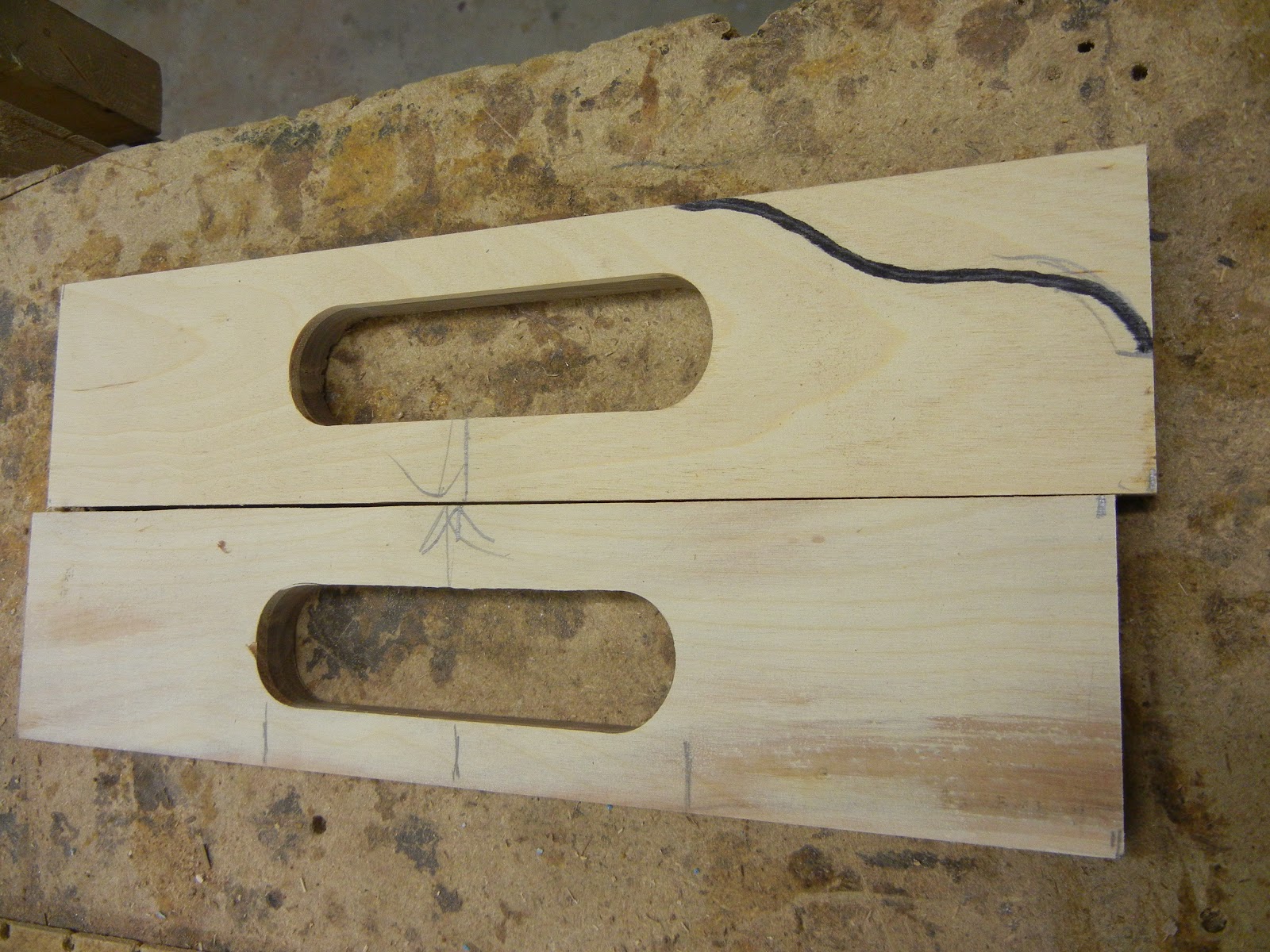
What next? Well, one solution I have developed is the making of trays, cheese boards and similar pieces. One can even make them in sets, which saves a lot of re-setting of equipment. Here, step-by-step is the process for a set of trays, each unique in terms of wood types, laminating pattern and size.

Even the least promisiing pieces have potential. Both of these ended up as parts of a tray.

-->
Laying out the lengths in a rough pattern is a good place to start. It can be fun to choose attractive colours and wood textures.

Once that has been done it is essential to makes sure that each piece is squared up, which is done on a jointer. Two sides are set first. The other two can be matched in a planer.


 Safety first is the cry here. No fingers, sleeves or other bits anywhere near these fast-spinning blades.


-->
Now the gluing can begin. I like to use newspaper between the work, the clamps and the cauls. It makes things much easier later on.

The cauls are essential. Without them the laminated wood strips will buckle. For those who have not met this word before in the context of woodwork, you are like me, until about two years ago. Before that the only meaning for caul that I knew of was the membrane that sometimes lies over the head of newborn babies and is supposed to bring good luck. Of course I checked the dictionary and there is another meaning. My Concise OED has this: “ a woman’s close-fitting indoor head-dress.” How these two definitions have been adopted into the woodwork lexicon is beyond me. 

-->
While the tray base is drying the handles are jointered, measured, cut and glued. The wood vise is an ideal place to glue them, but here it is really important to use newspaper. Without it the handles could become part of the vise. Tricky!

-->
After the glue has set the excess glue needs to be removed.
--> I sometimes do this with a paint scraper, sometimes with a sanding tool. The yellow random orbital sander will be in use again as the work progresses.

Now one can make things really smooth with a thickness planer.

After that the orbital goes to work, taking the board through 80, 120, 150 and eventually 220 grit smoothmess. 

After the base planing the sides, which had also been made earlier, are glued in place.  


When  all that is dry the shooter board comes up from its hiding place under the saw and is used to cut everything at right angles.
-->
The handles provide some more opportunity for creativity. There is also one practical element. By laminating two different woods one prevents the handle from splitting.

 
I use the router table to make the holes in the handles and then to shape their edges and the base of the tray.


One also can make different shapes. I like to do this with a scroll saw. With the first end shaped, it is easy to make the other three and then sand them all to accurate matches.
Then comes sanding. The drum sander on the drill is a  new acquistion. I like it, but of course hand sanding gives the final touches.


Contoured edges give the handles a nice feel. This is done with the router and again smoothed off by hand.


With several trays nearly ready it is time for some gluing and scraping, more sanding and finally staining.


Gifts for friends, charity raffles, retail sales. There are lots of possibilities, and all from scraps.

walnut, birch, maple, mahogany, purple heart, paduque, fir, hickory.

Tuesday, November 27, 2012

Stories of Africa, and telling them


I was recently invited to do a guest blog by Karen Chace. In it I discussed the use of images during storytelling sessions and my hypothesis that they may have a very ancient origin that goes back as far as the artists who made petroglyphs and pictographs. Some of the art work is of stunning quality, and as good an example of that as any lies in the extraordinary Chauvet caves of southern France, a subject I have blogged about before .

Giraffe, eland and freinds at Twyfelfontein
Of course these are not the only examples of cave art. I have chosen this one, a photo taken at Twyfelfontein in Namibia because of what comes below.

You can easily link to that guest blog here.

I posted the link to several of my contact pages and it has generated a lively discussion on one of the LinkedIn ones. a members only group one can join StoryTellers - The Oral History Group.
A general conclusion is emerging that there are many ways to tell stories and we should open our minds to them.

I mentioned that I use both oral and visual telling techniques, sometimes in one presentation. For those who use PowerPoint (the latest evolutionary form of cave art) this is simply done in the middle of a talk by hitting the “B” key (I'm a Mac guy, don't know about PCs). The screen goes blank and one can then step up and let the audience focus solely on the teller. Hit the “B “ again and one is back to the picture.

Here is a brief example from a recent school tour. Using no pictures I opened with a bit about myself and how my first memory was of a giraffe’s legs heading away through the trees. Then I told the children about my return to Kenya after vet school in Glasgow and how the very first animals I saw were three giraffes peering at me from inside Nairobi National Park.

Next up was a description of how, three days after arriving as an intern at the Kenya vet school I had to treat a giraffe with footrot. This term is self-descriptive, and needs no gory technical explanation. However, some of my audiences have been in rural schools and many of the kids knew exactly what I was talking about. Of course this gave me the chance to link to their own experiences of watching a vet or parent medicate a cow with the condition.

This let me describe the problem of injecting a giraffe and let me use this phrase: “Of course there were as many giraffe in Glasgow (where I graduated from vet school) as there are in "Homeville" (name the community I'm in). I then climbed the imaginary walls of the chute where the giraffe was standing to inject him high above my head. (Actions: climb, stretch, grunt, inject)

With the three giraffe images now established I switched to the old folk tale about how the giraffe became so tall.  It involves a conversation with an owl, a long walk, a witch doctor, a magic potion and the failure of giraffe’s friend the none-too-intelligent rhino, to arrive on time at dawn to get his own helping of the potion.

Of course this set up later folk story about another stupid rhino, again told after the “B” has been touched.

After that fun account I ran the projector again and showed the kids an entirely silent movie clip that I made myself in the early 1970s of rhino capture. It runs about 4 minutes and as it has no script I made the odd remark, telling the tale of how and why we did the work. I can't add it here, but if you haven’t seen it, it lies embedded under the video tag on my website. The kids were enthralled.

Mum waits in case the little guy needs help. He didn't
To wind up this post I have added a few pictures that I showed the children. These ones were of the Aaaah, or Ooooh variety and needed few words. They are examples of things that the kids may not have seen or can enjoy for the images' own sake.

The shy little girl with her Teddy Bear, knitted by ladies of a group who call themselves "Teddies for Tragedies" is probably receiving her first ever gift. She is one of 147 kids in an AIDS orphanage school we linked with and supported.

I showed the baby rhino being bottle fed after the capture movie. A winner!

 
This is a humorous one, again needing no script.  As one teacher said to me after the talk, "Anything with bums or poop stories will be a winner."

If it itches, scratch it.


Wednesday, November 14, 2012

The Chinese Ivory Industry


Reporter Bryan Christy recently attended a meeting convened by US  Secretary of State Hillary Clinton. The subject was the illegal wildlife trade entitled Wildlife Trafficking and Conservation: A Call to Action.

Here are some of the statements that Christy made in his blog about that meeting. You can see the rest of this material and links to other reports he has made by dipping into the site.

The Chinese government, through its company China National Arts and Crafts Group Corporation (CNACG), aka Goalmark, is the world’s largest ivory purchaser, carver, and retailer. It purchased two-thirds (40 tonnes) of the roughly 62 tonnes of ivory sold at auction to China in 2008, and it controlled the import price on the remaining 20 tonnes sold to the three other Chinese bidders.

The Chinese government is expanding its ivory consuming capacity. In 2009, it built China’s largest ivory carving factory.

Chinese ivory carving is big business involving a small number of individuals—perhaps a few hundred, based on my observations—only about a dozen of whom are recognized national master carvers.

As long as the Chinese government is in the business of expanding the ivory trade, ivory-related crime will flourish.

On the other side of the story, Chinese basketball star Yao Ming has recently been trying to raise the profile of this issue. A couple of UK newspapers, the Guardian and the Times ran stories about his visit to Kenya. He is reputed to be much loved and respected in his home country. Will his efforts make any difference? I do hope so, but I’m not overly optimistic. He is fighting a “City Hall” but one with serious muscle.


Monday, November 12, 2012

Polar Bear Studies

-->
I’ve started on a new manuscript, hoping to get it done in a year or so. My working title is From Polar Bears to Porcupines. No subtitle yet, but obviously something to do with wildlife vets.  Met with my writers group yesterday for a first run through with one of the chapters about bears that will likely be somewhere in the middle.

Here is the first draft of the last 580 or so words. The events took place in the early 1980s and were part of a large study of bear ecology and population structure in the days before the polar bear became the poster child for global warming.

We have finished working with a sow and her two tiny cubs south and east of Pond Inlet on Baffin Island. They have been weighed and measured. All the samples have been collected and there is one last task to carry out before we let her go back to a normal life. I’m working with wildlife technician John Lee and helicopter pilot Tex Walker.
Out on the sea ice near Pond Inlet. John weighs a cub during our work on the bears
§§§§§§§§§

Now came the last mucky task. Once more into the bag. This time John emerged with his tube of Lady Clairol hair dye and a brush. Before long a huge black X, each arm about sixty centimetres long, followed by the number 5 covered the bear’s back from side to side. I had deduced, on the first bear we had worked on, that this unconventional use of a famous product was to prevent us from capturing this bear again this same year.

“How long will it last?” I had asked. “Quite a while,” John had replied. “Long after we are done with our capture program this year. It’ll be gone by next year.” 

There was no need to paint the cubs, as they would be with their mother for the rest of the season. I wonder if the folks at the Clairol company had ever imagined the scene we now saw.

I did the rounds with the stethoscope again and John read off his checklist to make sure that we had not forgotten some vital element. I took care to avoid getting the dye on myself, as John had inevitably had after dippng his brush into the black goo, and smearing it over the bear.

Now we had to hunker down and wait for the cubs to recover.  For the mother bear I had an antidote to the carfentanil that we had used to immobilize her. Not so for the ketamine/Rompun mixture that was keeping the cubs quiet. Of course I could not wake the mother up until we knew that the little guys were alert, but that did not take long. In fact they had already started to show signs of recovery, moving their tongues and heads as we finished up collecting our various samples. From that point their recovery was rapid and they soon snuggled up to their mother.

Ten minutes later, and after yet another check of the vital signs, I drew up the antidote into a syringe and injected it into the vein on the underside of her tongue. John and I had already packed up a our bags and closed the lids, as neither of us wanted to be fiddling with that sort of detail when the bear awoke, as she would do within a couple of minutes, if our experience was anything to go by.

John had already signaled Tex to start up his engines by whirling an arm above his head. Tex needed time to get his machine warmed up and airborne. Again, should my patient decide to turn and come for us we wanted to be up and away before she reached us, and a bear can cover a lot of ground very quickly if it decides to.

We walked as briskly as the snow would allow, rather than run and risk falling, back to the chopper and climbed in.  Tex upped the revs as we put on our headsets. When the bear rose, stumbled once and moved away Tex lifted us off.

         With the work on this bear finished we climbed above the site and I looked down. I could see our tracks and the trampled snow where the helicopter had been and realized that the evidence of our approach and work pattern closely resembled the symbolic shape of a Valentine’s Day heart. The chopper had been at the pointed bottom. Our own footprints and the deeper scars left where we had crawled made the arches and the trampled snow where we had worked on the bears was the point in the middle where those arches meet. 

I looked over to where she was walking with her cubs.  The hair dye stood out clearly and we could avoid harassing her again. It was time to move on.