Friday, July 1, 2011

Travel in Uganda

Link
A couple of days ago I got a letter out of the blue from Derek, a Washington father worried about his son who is off to Uganda. Food was a major concern. We exchanged a coupe of mails and here is what came out of it.

Jerry, do you have any Uganda guidelines you have sent out about what to eat and what not to eat for westerners who don't want to get sick or distressed stomachs? .... some kind of "DON'T EAT THIS IN UGANDA".

Immediately after my son gets back to the USA from this 3 week trip, he plans an extremely rigorous climb of a very high mountain in Wyoming and I am worried that he might get sick from eating strange foods and drinks in Uganda and have difficulty in Wyoming or even in Uganda.

Now it seems that I have to go too because my wife wants to make sure it is a safe trip.

So, we fly there July 1 and go away into bush driving from Kampala on the 7th and return to the USA around the 23rd or so.

You would know best what is safe there.

I asked Derek how he had tracked me down and he said that he had read my book The Trouble With Lions: A Glasgow Vet in Africa and found me on Google.

Here is some of what I wrote back.

On food, we ate almost anything and did well. Wonderful fruit everywhere.

When Derek and Seth get to Uganda one of the most spectacular things they will see are the wonderful fruit and veg stalls alongside the roads. Common fruits in the right season include mangoes, avacado, watermelons and jackfruit. In some parts of the country delicious pineapples are abundant.
Here they are piled in Kampala ready for distribution.
These ones are set in a customised frame in the town of Mbarara.vThey are so much better than the ones in our local supermarkets that we have given up buying them here.

I also gave them a few food tips.

“If you are lucky enough to stop at a roadside stall that sells grilled green bananas (matooke), tasty (very tasty) chapatis and a variety of meats you should make sure the meat is cooked through. My favourite is "chicken-on-a-stick." It's delicious but the vendors, usually young people, will mob the vehicle with several sticks each. Choose one person and ignore the others. Then go back to the charcoal brazier and insist that the chosen piece of meat be cut to the bone to show if it is cooked through. If not (likely) then it should be put back on the heat and carefully watched. Once done it can be thoroughly enjoyed.”

“French fries are called chips. On potatoes in general, if you ask for potatoes you will get sweet potatoes. If you want potatoes as we know them ask for Irish.”

Another thing that I was asked for was an emergency medical supplies list advisable for self drives in the extreme back country. Of course I could not do much here as I am not a physician, but I did reply briefly as follows:

“On meds, you should seek advice from a physician. We only had one surprise in 8 years. We had all the usual things, antibiotics, antihistamines, ointments, headache stuff, diarrhea stuff, band aids, etc., etc. We did not have laxatives. As you may have read in my book The Trouble With Lions one very uncomfortable student said to my wife "I would do anything for a fleet enema right now." She had not passed stool for 3 days!

On a final note the family will travel connected. Here is what Derek wrote
“I am thinking of getting a USB data modem from *both* of the two cell carriers in that country, and then plugging them both into my router, which will default over to the best connection at all times, unless you feel that one carrier is so clearly superior to the other that there isn't a need for that.

I'll want a good connection to data so I can GPS drive with Google Earth data displayed on the laptop.”

Here is my reply.

“I'm sure that the Internet over a laptop has improved a lot in the two years since I was there. Good luck with it. Here, Jen Curragh is on the phone with her family in Manitoba and we are in the middle of Queen Elizabeth NP at least 40 km from the nearest town. The cell phone service is way superior to ours here and much, much cheaper. For one thing you don't pay extra for incoming calls or texting, which we do here. I consider this an absolute rip-off and have written to our local provider to tell them. Got me nowhere of course.”

Folks in UG use texting a massive amount.

One funny story about cell phones.
I delivered a lecture at the vet college & asked a colleague whether it would be okay to ask the audience to urn off their phones. "No way," he said. "They go to church to hear a message from God, but if the phone rings they take that message right away!'

So, if you plan to travel in that part of the world make sure you are fully vaccinated, make sure you have good mosquito nets and make sure you get started on malaria prophylaxis before you travel. As for food, if you are sensible it will be the least of your worries and you will no doubt have some very pleasant surprises.

Saturday, June 25, 2011

Serengeti road

Link
Good news from my posts of June 15 & 16 about the Serengeti and the proposed tarmac road.
In a nutshell, the project has been canceled!
Yeah!

Tuesday, June 21, 2011

Humour in Storytelling

Link
I’m posting this as a storyteller and member of the national storytellers association http://www.sc-cc.com/ rather than any one of my other alter egos. Last Sunday I was one of nine members of the Saskatoon Storytellers Guild (we are on Facebook) who joined moderator and workshop leader Kevin Mackenzie (find him here)in a 3-hour session on humour. After a relaxation exercise we all told brief anecdotes about a memory of something in an early part of our lives, or in my case, in my grandson's five-year old life.

This was about the time that he caught his first fish. We were camped by Namekus Lake in Prince Albert National Park and were out in our canoes. Mathew had cast his own line while his dad, Charles, paddled along about twenty metres from me as we worked our way a hundred metres or so out from the shore. Suddenly I heard Charlie say, “Son, you’ve got one on.” Pretty soon the fish was alongside the canoe as the lad acted on the advice to keep his rod tip up and wind away on the reel.

As Charles brought the pickerel (walleye) into the boat the boy exclaimed, “So that what this is all about.”

We turned back towards camp in order to show the rest to the family the spoils of the excursion and Charles said, “Would you like to put your line back in again?”

He sort of sighed and said, “No Dad, my nerves are having party, I don’t think I could handle it.”

We all shared similar little vignettes and then got to the meat of the workshop. This was to watch Elna Baker perform a set at what was called the Rejection Show, a stand-up comic storytelling session in New York. It’s must-see for anyone, just as a great piece of humour. As an exercise it is amazing.Kevin had himself been at a workshop given by Doug Stevenson and from that session he developed a list of twelve techniques that work in humour.

There may be more, but these are the ones we tried to identify. Self effacement; hyperbole (which can be over or understatement); juxtaposition of illogical ideas; creating a context and then breaking it; the use of similes, which can be ridiculous; metaphors (which are like similes☺; tongue ties; triple or “rule of three”; idioms; false assumptions, double entendre (which does not need to be naughty); and puns. We had no trouble finding ten of the twelve.

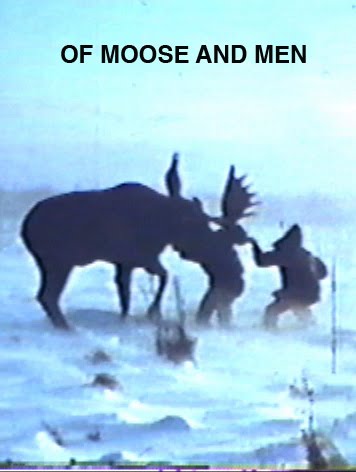
Our last exercise was to work in pairs and try the techniques in our own stories. I used a brief extract from my new book Of Moose and Men from a chapter titled Sex and Antlers in which I demonstrate that size really does matter. This picture comes from the book.

My work partner, who also works as a face artist, clown and a country newspaper reporter, was Danica Lorer who told me story in which she advised that one should never give one’s seven-year old the car keys. You can find out more about her here

It was a well-spent afternoon.

I have deliberately not given you think link to Elna’s piece up to this point, because you would have moved away and then lost your train of thought as you laughed. Now is the time, here is the URL. You can also look her up on Google and find other pieces. Enjoy!

Saturday, June 18, 2011

Elephants as bushmeat

Link
In a BBC science and nature report of June 15th author Victoria Gill recounts how the forest elephants of Africa face extinction. Her piece is titled Elephants Face Same Extinction Fate as Woolly Mammoth and you can find it here.

Quoting Professor Adrian Lister of the UK's Natural History Museum she relates how wooly mammoths that once roamed in their millions in the UK and across northern Europe and North America were squeezed into smaller and smaller areas. Professor Lister says that forest elephants are suffering from the same "double whammy" that claimed the woolly mammoths - habitat loss and hunting.
"Today both of those sides of the pinch are caused by humans."

Gill suggests that history may be repeating itself. This is because as the dense rain forests of central Africa are being opened up raided by logging companies who supply the needs and greed of wealthy people from Europe, North America and the Orient.

I took this picture in Cameroon in 1997. The truck was one of six that I saw in a two–hour drive from the coast to our work station when I was involved in an elephant research project with the Wildlife Conservation Society team in the mid-1990s.I have told the full story in The Trouble With Lions: A Glasgow Vet in Africa. Each load was worth about $100,000 to the suppliers. Of course the trees were being felled by men who did the grunt work and needed to eat.

The logging led to habitat loss in several ways. First, and most obvious, was the destruction of many hardwood trees. Second, the damage to the surrounding bush as heavy machinery smashed everything in its path. Third, and least obvious was the curtailment of elephant movement, which has become worse over time as the number of roads has increased and the number of elephants has declined.

The team leader in Cameroon was Buddy Powell who had started to examine how elephants affect their environment and spread trees around when they eat the fruit and then pass the seeds that germinate in another area of the forest.The plant diversity is amazing and when I asked Buddy about numbers he told me that there were likely as many as 300 species of plant in a ten metre radius of where we stood. As the elephant’s range is restricted and their numbers dwindle so the plant diversity will decrease.

Gill only touches on a part of the problem when she writes about the ivory trade. Although she is right when she says that the
“trade - fuelled by civil unrest and organised crime in some central African countries - supports the poaching.”
What she has missed is the other vital element.

In the January to March issues of Swara, the magazine arm of the East African Wildlife Society Dr. Dan Stiles has documented a bigger problem. His title says a lot: First Ivory, now meat: Elephants face second threat to survival. Unfortunately the article does not seem to be on line, but the magazine’s editor does state that the full report will be published this year by IUCN.

What it boils down to is that the loggers need to eat and that is the central problem for all the species that dwell in the forests.

During our walks though the forest I would hear a shotgun blast about once an hour and it was no surprise to see spent shells like this one planted on a bush.

I encountered a roadside bushmeat stall where a variety of species were for sale. They included birds, cane rats, monkeys and duikers.

Karl Amman, the Kenya-based wildlife photographer who permitted me to use some of his pictures in my book The Trouble With Lions has documented the bushmeat trade in startling detail. You can find many more pictures at his website.

Although the bushmeat hunters take anything they can Stiles quotes Amman stating that
“Elephant meat is worth much more than ivory.”

So much so, that this remarkable picture on the BBC site shows a shop somewhere in Africa where ammunition for elephant hunting is graphically advertised on the outside wall.

So, as all species, animal and plant, in the forests of central Africa are hammered, the elephant, which gives the greatest return on investment is taking a big hit.

Thursday, June 16, 2011

Serengeti Highway

Link
In my post of June 15 I alluded to the simmering controversy about the building of a new highway through the heart of the Serengeti. Now comes a front page article by Geoffrey York in the Globe And Mail of June 14 that offers a balanced view of the issues.
You can view the article and the lively discussion that follows here and also see better versions of the maps that I have photographed and attached.

For the conservationists it is a simply matter of the desecration of a pristine environment where the greatest animal migration on earth still occurs. Of course the wildebeest gets the biggest mention and also both of the photos. A brief mention of other species is made, but everyone tend to forget that zebras are also an integral part of the events and that the predators that act as camp followers also move around with the great herds.

For the protagonists of the road it is really quite simple and boils down to two issues. The first is that the land was originally occupied by humans but they were kicked out by colonial governments when the park was formed. It began as a small game reserve, mainly to protect over-hunted lions in 1921 and was finally established in 1951. The second issue is that the people to the west of the park are almost cut off from easy commercial activity because all trucks have to skirt a long way to the south before heading to the commercial centre of Dar es Salaam.

There are other issues that are relevant.

The people in the region are living on less than a dollar a day. The human population has ballooned since 1951. According to Guardian.co.uk website statistics in 1950 there were just over 7 millions people in what was then Tanganyika. Now there are over 46 million, an increase of 504%. They need to eat. It is impossible to imagine that poaching will not increase as road access becomes easier.

A quick look at the map and the proposed route for the new highway shows that it cuts right across the path of the migration as the animals head north into Kenya and the Masai Mara, the county’s major tourist magnet. Nobody knows how that will affect the movement of the animals, but I’ll bet that the Kenyans are concerned.

The second thing that gets little mention is the potential for a huge number of traffic accidents. In my new book Of Moose and Men I have quoted statistics from Sweden about vehicle x moose accidents. They have long been a major problem and in 2010 there were 7227 reported to police. What, you may ask, has this got to do with the Serengeti?

There are about 350,000 moose in Sweden, and they do not engage in mass migration. There are said to be about over a million wildebeest, and another 250,000 zebra in the Serengeti/Mara system. One environmental study quoted by York has it that trucks will be traveling down the highway at a rate of one every thirty seconds. When I round the African figures to 1.5 million animals that is about four times as many accidents-in-waiting on a single road in the Serengeti as on all the roads in Sweden. I think that spells carnage. Carnage for the animals, carnage for the trucks and other vehicles.

I hope I’m wrong.

Wednesday, June 15, 2011

Snares and poachers

Link
In my post of June 10 I wrote about the real situation in Kenya’s Masai Mara and the decline in wildlife numbers. I also referred to poaching and the numbers of poachers caught on a regular basis. Poaching is so widespread in Africa that one hardly knows where to start, but I did refer to the experiences of one park warden in the Serengeti. This was Myles Turner, who was there for 16 years and documented his work in his fascinating 1987 book titled My Serengeti Years: The Memoirs of an African Game Warden. I suggested that his book might just as easily have been subtitled The Poaching Wars.

One of the major tools for poachers is the snare. Here are a few examples of ones I have seen in various places. In Namibia’s Etosha National Park there is even a sort of “rouges gallery” in the park offices where this display case shows various types of snare that have been found over the years.

When I worked on an elephant project in Rwanda in the 1970s we found that 27% of the animals had injuries related to snares. There was one that had a cable deeply embedded in the creatures leg, while several animals had lost part or all of their trunks because they are ever curious and made the mistake of picking up snares meant for buffalo and the like.

When I was with veterinary students in Uganda’s Queen Elizabeth National Park we never failed to see animals damaged by snares, or find snares, usually at waterholes. We were able to free this warthog after immobilizing him, but I do wonder how he got on.

We found a collection of wire snares including the nasty tin can lid type that is designed to ride up an animal’s leg if it is unfortunate enough to stand upon the thing. Just have a look at the picture and imagine what will happen.

It is easy enough to condemn the poachers, but the issue is not that simple. "Poacher" is a term used by landowners to describe people who might otherwise be known as hunters. If you have no source of protein, virtually no income, and a family to feed, and a wild animal hangs out near your home, what are you to do? This is not the same as the commercial, crime syndicate type of poaching that has led to the decimation of rhino and tiger populations, to mention but two of hundreds of species.

The news about a major highway that will cut through the heart of the Serengeti has been simmering for quite a while, but now seems to have surfaced in major print media. More on this when I drop by again.

Friday, June 10, 2011

Two truths about the Masai Mara

Link
My first trip to the Serengeti / Mara region of East Africa was in 1966. I have been back a few times and of course enjoyed every minute of it while being sadly aware of what is happening there. My wife still dines out on the story of waking in the middle of the night to the sounds of something large and noisy just outside our tent. When I peeked out (there was no way she was going to) and told her we had been joined by a large herd of cape buffalo she was not impressed. She was even less impressed with having to navigate the dozens of fresh patties in the morning.

There has been an interesting contrast in two recent reports about the fabled Masai Mara region. There can surely be nobody reading this blog who has not heard of the Mara and especially the migration of the wildbeest. I’ll further bet that all readers have seen at least five nature program on TV about the area, the crocs on the Mara river, their ambush of wildebeest and zebra and so on and so on.

The article in the Toronto Globe and mail of June 8th written by Robin Esrock of the OLN/CITY-TV series World Travels is yet another in the long string that perpetuates the beauty and wonder of a trip to this fabled spot. His piece, which you can read here is titled Catch Africa’s Great Migration – in great luxury.

I imagine that Esrock had a wonderful time but one must note that as a travel writer he probably has a vested interest. He, like so many of the TV producers who make those magic films, has somehow avoided the flip side of the coin. Perhaps nobody told him it even exists. Perhaps this was his first trip to the Mara.

For a much more discouraging, but entirely accurate perspective it is worth looking at Matt Walker’s report of June 2nd that appeared on the BBC website.

This one it titled Wildlife Crash in the Mara region of Kenya, Africa. Walker cites recent work that appeared in the prestigious Journal of Zoology. The key message is that wildlife populations have crashed in the past three decades. He quotes Dr. Jospeh Ogutu who has led research into the situation and the most worrying statement is that
“The status of Masai Mara as a prime conservation area and premier tourist draw card in Kenya may soon be in jeopardy.”

Ogutu’s team concluded that the Mara has lost two-thirds of its wildlife since 1977. Even the wildebeest migration now only has 64% of the numbers that existed in the early 1980s. As if that is not bad enough, the non-migrating wildebeest numbers have dropped by 97%.

There are two main reasons and both are related to human activity and particularly the growth of the human population. The cattle density has increased three-fold while the density of sheep and goats, which are usually herded together, has increased seven-fold. Both of these domestic species compete for grazing with the wild animals and of course also displace them.
In this picture, taken twenty years ago, a herd of cattle in the background grazes near a Masai manyatta while wildebeest dot the foreground.

That’s bad enough, but Ogutu also stated that
“over 1500 poachers have been arrested within the Mara conservancy between 2001 and 2010, with more than 17,300 snares collected by rangers in the same period.”
Walker reports that “the African buffalo are all but gone.”

Despite these worrying numbers I will be back in November, when my granddaughters will join us and their parents on a Kenya trip.

We may be lucky and see topi bulls sparring like this but the teeming herds of a hundred years ago, or the huge numbers I first saw 45 years ago will mean little to them.

We can at least be fairly sure that my wife and the next two generations will not have to worry about buffalo patties near the tent. Of course cow patties look pretty much the same.