Showing posts with label Of moose and Men. Show all posts

Sunday, November 4, 2012

Litfest 2012 in Edmonton

Last weekend I was lucky enough to be involved in Canada’s only purely non-fiction literary event. Litfest takes place each year in Edmonton and runs over ten days. Dozens of authors are involved and talks of varying length and styles were given in several venues.
-->

David Cheoros and Jerry (l) sorting out some admin details. (ph Kim Fong)
David Cheoros and his wonderful team organized everything to a “t”. My flights were booked and when I arrived in my hotel I was astonished to find an empty beer carton with a carefully labeled sticker attached. The sticker stated “beer in fridge.” Many volunteers ran me to and fro  - thanks to Pamela, Kathy and John.

Dr. Ole Nielsen at Litfest
My presentations started in the Strathcona County Council chambers in the community of Sherwood Park.  It was here that friend and former dean of the Western College of Veterinary Medicine, Dr. Ole Nielsen, introduced me. I was given 40 minutes, which is a long spot at a literary event, and so that rather than reading from my “Of Moose and Men” book I told some stories in the style of the ancient Cantastoria tellers who used picture boards and drawings to engage the audience. Of course the most modern form of this art is electronic and I used a PowerPoint presentation to share some of my experiences with this most remarkable animal. To pay homage to Ole I also started with the opening paragraph of the book, which is a telegram sent to him from Rwanda after he had offered me the job that launched me on my university career. It reads:

UNDERSTAND JOB OFFER SASKATOON STOP ON SAFARI IN RWANDA TRANSLOCATING ELEPHANTS STOP WILL MAKE CONTACT ASAP ON RETURN TO KENYA STOP HAIGH

In one segment of the presentation I told about how moose have been domesticated through the ages. There does not seem to be an old history of domestication in Eurasia, but we do now that the Aboriginal peoples of North America were using them in this way from at least the 1600s.

School bus, or fun outing in Russia.
They have been ridden, used to pull sleighs and buggies and kept as pets. The grainy B&W pic showing a sleigh full of small children being pulled by a cow moose caused much amusement. Was it a “school bus” or an outing for fun? I have no idea.

Tatiana Minaeva at milking time
In Russia there are at least two moose farms, and it was from Dr. Alexander Minaev that I learned about a farm at Kostroma where moose are routinely milked every day. He has a fascinating web site that shows many aspects of the operation and here are some pictures from that site. The milk goes to a local sanatorium for medical use, particularly for patients with stomach problems.

One account of a moose farm in Sweden has it that this is the source of the world’s most expensive cheese. I know that one audience member tweeted this little gem and before that day was over she received notice that it has been RT’d four times. I wonder if this was because the price, at last report, was a mere eleven hundred dollars per kilo. That is $1100! Any orders out there?

My next event was at a dinner in the Santa Maria Goretti Centre as one of four authors. This centre uses the same parking lot as Commonwealth Stadium, so it was a good thing that the CFL's Edmonton Eskimos were not playing at home that night. After a chicken meal served “family style” and some excellent wines sponsored by Naramata Bench Wines we all read or told sections from our books.

First up was Marcello Di Cintio who read a section about the Mexico / US fence from, his book Walls. As he said, the entire book, by its very nature, is pretty dark. For instance one of the walls he visited during his research was the one that divides Gaza from Israel. His fence piece told the story of a musician who ”played” the wall.

Telling about large antlers after dinner (ph Kim Fong)
Then I came on. I read a short piece about the confusion caused by the Scottish use of moose as opposed to mouse and Robbie Burns’s famous poem. I followed this with a reprise of my Montreal Story Slam about the role of antlers in during the rut of moose. I have posted this one on YouTube and if you haven’t seen it you might enjoy it.

After the dessert Carmen Aguirre read from her book Something Fierce: Memoirs of a Revolutionary Daughter. The story she tells is a harrowing one and as she read an account of her struggles against the Pinochet regime in Chile I was much moved.    

AndrewNikiforuk wound up the session with a piece from his book Empire of the Beetle. He chose an account of the role of bark beetles in forest ecology. Of course, as far as Canadians are concerned the pine beetle that has wreaked such havoc in British Columbia was the main theme. As he pointed out, the beetle has been the principal regenerator of forests from time immemorial, long before humans began to try and manage the resource.

Pamela, Candace, me and Andrew at the panel session. (ph Kim Fong)
The final event of the entire festival found me at a panel session in the Milner library in downtown Edmonton alongside Andrew Nikiforuk again and also Saskatoon’s and East End's own Candace SavageOur topic was Fauna. We each read short pieces from our work, Candace from her book A Geography of Blood. Then we had to try and field questions from our moderator, Pamela Anthony, and from the floor. We tried to answer some of the questions, but as Candace carefully dodged one impossible one I realize that we would need weeks, if not years, to make any kind of meaningful reply.

We all, panel and audience alike, realized that humans are the main driver of changes in both Canadian and global fauna. I did make a point from my African experiences. Why would a family living on a dollar a day be concerned about preserving the lions that kill their cattle or the elephants that devastate an entire year’s supply of staple foods such as maize or millet in a single night’s feeding? Thoughts of conservation are all very well for us in Canada, but these folks may have a different view, and who would blame them?

In the spirit of the whole event. Jerry and Pamela (ph Kim Fong)
All-in-all the festival was an amazing experience. Thanks to David and his team for all their hard work.

Sunday, March 18, 2012

World Storytelling Day


March 20 is World Storytelling day and around the globe tellers will gather and share. Not just the 20th, but on dates near it. In Saskatchewan the Saskatchewan Aboriginal Literacy Network Inc. and the Saskatchewan Indian Cultural Centre
 help coordinate events around the province and I was able to get to several such affairs in and around Saskatoon. This fabulous piece, titled Circles Close was designed and crafted by Leah Dorion was used as major drawing card by the SALN. You can see an array of her work at her website.

I have already written about the Saturday night get-together at the Wanuskewin Heritage Park.
A major event, designed primarily for school children, was actually two events, two weeks apart, at the SICC’s White Buffalo Youth Lodge. I was able to get to part of both days and meet up with Barry Akenakew and Darryl Chamakese, who were both so helpful in sharing stories and letting me use them in Of Moose and Men. I was more or less lost in the crowd of several hundred children from schools all over the city, but I did have a chance to meet and listen to new-to-me tellers and heard new stories.

John Spyglass had four sessions, two on the 15th, and two more on the 29th. He is an experienced teller and delights in using his large collection of artifacts to build his stories.  With pupils from the smallest grades he used a mixture of reading, games and “dressing up” to keep the children enthralled for some eighty minutes – quite an achievement for this age group.


One thing he did was classic. About 45 minutes in, when the children might have become restive, he suddenly switched and got all the kids (and the teachers) going with versions of “Incy Wincy Spider” (aka itsy bitsy spider). Of course they started with the standard one, but John then took it all to new levels by having us perform the rhyme in various voices, angry, sad, funny, quiet, loud and so on.

On either side of the rhyme he showed us many different pieces of traditional art. A beautifully decorated cradleboard and moss bag had a big doll inside it and one of the children must have had a memorable moment when she was selected to wear it. Other children donned headdresses and various garments.

In the session on leap day John’s audience were older – from grade nine. The room was packed and John changed up his performance to fit the group. Partly because we hardly had room to move and partly because of the ages of the audience he only demonstrated the various items. Here he is holding a buffalo headdress as he explains its significance.


 I leap-frogged between various sessions but made sure that I heard Barry Ahenakew’s wonderful tale of the buffalo child in full. Like many (maybe most?) good stories this one can go on for a long time, but Barry crafted it to fit the time available. Of course I am not going to even try to re-create Barry’s telling, with is voice changes, actions and mood swings, but basically the story revolves around the challenges faced by a young boy who grows up among buffalo (bison) but returns to his human village to marry and have children. He goes back and forth between the two societies, shape-shifting all the while. For the ending, you will have to find a way of hearing the story from Barry.

Darryl was not so much a teller during these two days as he was a facilitator, but I did manage to capture a quick snap of him and Barry, with crowd of children behind them at the end of the morning session.

I was only able to take in one other event. Elaine Greyeyes, daughter of renowned storyteller, the late Freda Ahenakew gave us an account of her mother’s legacy. Freda compiled, edited and wrote twenty books of Cree stories. As Elaine said, her  mother was preserving the culture in an important way.  We both feel that the writing down of these stories is vital. At a time when so may old cultures are falling under the hammer of lost language, modern toys (smart phones and the like) and a general wish of the younger generation to “modernize” the ancient stories, be they from Africa, Canada or any other culture, can only be preserved in the writing.
One Cree elder told me that by writing the stories one kills them. Most of the people I have met, and all those I have mentioned in this post, agree that they are not so much killed as placed into suspended animation. When re-told they are resurrected. Indeed that may often be adapted ot the audience, something that is often a vital part of the storytelling craft.


Friday, March 2, 2012

Wanuskewin Stories

In Saskatchewan February is Aboriginal Storytelling month.


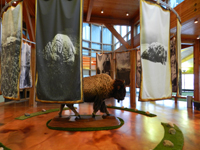
On Saturday the 25th a small but enthusiastic crowd braved a nasty storm to get themselves to the Wanuskewin Heritage Park (found here)This is the striking entrance to the building.


As one enters the main section another buffalo, surrounded by hangings, stands out.


We all had the chance to wander round the gallery and admire the fascinating collection of materials dedicated to the horse. There was a full-sized horse front and centre, and some forty paintings, many by Allan Sapp, of scenes depicting the use of the horse in (relatively) modern times. The most striking items were five beautifully decorated elk hides, each one depicting scenes of some brutality, with horse-mounted cavalry and aboriginal peoples at war. It was not until I leaned over and took a close look at the work under the glass covers that I realized that every item in the entire series, containing hundreds of figures in excruciating detail, down to pistols, head dresses and the caps of the cavalry, was created with beads, thousand of tiny beads.  It would have been great to be able to show you a picture of at least one of the hides, but of course galleries do not allow one to take them, and I could not get hold of one electronically. If I get the chance I will post again, as they are truly stunning.

Andrew McDonald, the marketing and sales manager of the centre, had organized the evening’s events and it was he who told me, in an email, that these beaded elk hides were given to the Wanuskewin Heritage Park by George Pekwawa for the Mistatim Exhibit. The hides depict the Battle of Little Bighorn, where Chief Sitting Bull defeated General Custer. It is thought that descendants of Sitting Bull, who fought in the battle, created the works. Following the battle Sitting Bull found asylum here in Saskatchewan where he stayed at Ft Walsh. The hides are thought to be based on a series of drawings that Chief Red Cloud was later commissioned for.

Before the main event we had a chance to sample Chef Kevin Merasty's delicious berry crumble, mostly Saskatoon berries, as you might expect, and everyone who had braved the winds had a bowl of his creation and a dollop of ice cream. Hot chocolate optional. Not too shabby!

 
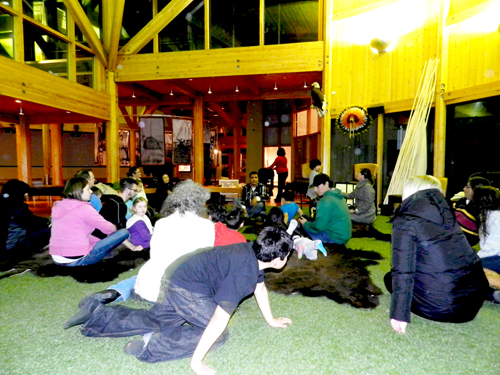
Lamarr Oksasikewiyin of the Traditional Native Games Organization (found here) led off the activities, focusing on the children who had come out on a stormy night. He first got everyone involved in one of the oldest indoor games, which most of us learned at a very early age. Here you can see one of the parents about to pass on her start to the string game. 


Lamarr then began with children’s games that were originally designed as preparation for the vital art of hunting or for learning patience in the harsh dark days of winter. He told us that the storm was a hidden blessing as it was on nights like this that games and storytelling became important because it mirrors the winter camp and times in the tipi. He had the youngsters playing a game we all recognized. Today we can purchase a fancy version called pick-up sticks. The old version involved willow twigs, and Lamarr selected a marker that was the key to unlocking the fallen sticks. The kids were quickly involved.


Then he called for volunteers, who promptly stood and started to try and hit a ten centimetre toy bison with a weighted turkey feather from a range of about two paces. Of course the two paces varied with the size of the child. It is not as easy as it sounds. You can see the bison (pale brown, hanging on a string) right of centre about 1/3 of the way from the top, level with the top of the window. No wonder there were no hits.


While the other adults visited the gallery I stayed to watch the puppet show being put on by Cheryl Hoftyzer. I've been trying to post a short clip here for the last 45 minutes, but the Blogger program is having a hissy fit. It is defintely home movie stuff as the lighting was not the best, so perhaps it doesn't matter. Cheryl ran the puppets as we learned the entrancing the story of the beaver and his tail with its moral issues about pride.

Alex Ahenakew gave us part of his family history after explaining the importance of the smudge. As he performed this ancient ceremony his grandson joined him and then a little girl who could not have been more than about two, left her father’s lap in the story circle, crossed the floor and went over to lean into the smoke spiral. She has obviously been shown the ropes. Alex wound up with a delightful explanation of his maternal grandfather’s name, which is Atimoyoo, or in English, dog’s tail. It involved shape shifting and the acquisition of a beautiful horse.

Darryl Chamakese, seen here in the checked shirt beyond his audience is the Cree language developer at of the Saskatchewan Indian Cultural Centre (found here). It was he who gave me two fascinating stories for my book Of Moose and Men (publishers web info here). Darryl did a wonderful job with one of the many Wesakechak stories, this one about the time that the hero of that long-running saga fooled a bunch of waterfowl into giving up their lives for his meal, only to be outwitted by that cunning carnivore, the fox. Of course in the end Wesakechak got his revenge and forever changed the coat colour of the wily beast.

Finally Lisa Wilson gave us a brief reading from her history of the Gabriel Dumont Institute. You can find out more about the institute here.

Then it was time to head home. Luckily the storm had abated, but we did hear that further south it had been severe enough to lead to closure of some highways. A good evening to be indoors with like-minded people and out of the cold.

Thursday, February 9, 2012

Of Moose and Men - Covers

Exciting development for me today as I just received the final version of the cover pages of my new books. Of course they appear here with the back cover (and me seeming to stroke a moose’s nose) on the left.

I’m going to quote the “blurbs” written by two well-known Canadians because the photo may not enlarge enough to be legible, but before I do that here are the chapter headings for the first few chapters.

1. A Breathtaking Start
2. What’s in a Name?
3. A Trip to Banff
4. Of Moose and Men
5. Petruska
6. Simplicity
7. Scales and Weights
8. Capture Problems
9. Moose at the Zoo
10.Moose Invader
11. Moose in a Front-end Loader
12. Where Men Walk With Moose

The last one on this list (there are more chapters, which I’ll deal with later) is a story about the folks at Mutual of Omaha’s Wild Kingdom and work we did with Marlin Perkins and his film crew in the Saskatchewan River Delta. Professional photographer Peter Drowne, who was the dirctor of the show took this picture of us with Marlin. I have the DVD and even the old 16mm film of the show.

Here is one of the “blurbs,” this one written by Myrna Kostash, award winning author from Edmonton and co-founder and first president of the Canadian Non-Fiction Collective.

I have never been in the presence of a moose — I’m a city-dweller through and through — but now that I’ve read Jerry Haigh’s vividly observed veterinarian’s memoir of his own encounters, Of Moose and Men, I feel that I’ve been up close and personal to the whole species myself. Haigh is an energetic and entertaining storyteller who provides his reader that most delightful of sport: the armchair big game spotter.


Monday, January 2, 2012

Of Moose and Men - final edits

Of Moose and Men- final edits.
It's the second day of the New Year and a spectacular sunrise to greet us. Also the day that I have completed my final edit of the new book Of Moose and Men. The subtitle has been chosen and appears as A Wildlife Vet’s Pursuit of the World’s Largest Deer. I’ve been working off an “advanced reading copy” which lacks the colour plates and an index, but they will come, along with appropriate quotes and so on. I can share a couple of things. The first is my opening quote, that comes from a speech made by Sit James Barrie at the St. Andrews University convocation in 1922. He said:
“It is not real work unless you would rather be doing something else.”
The second is some of the material about the taming, not quite domestication, of moose through the ages. This comes near the end of the book after I have discussed many of my own experiences with them, and a bunch of other stuff about their lives, their antlers (and the role of these in moose sex) and the carnage they cause on the roads. The first written records of tamed moose in North America come from the early 1600s when French priests reported that there were moose in captivity in New France, but it seems highly likely that Aboriginal people had tamed them long before that because those same priests and later European explorers commented on how easy moose were to train, and many authors and raconteurs mention how remarkably tame a moose can become.
This photo, by Ernest Brown, will be in the book courtesy of the Provincial Archives of Alberta. It is simply titled “Moose in harness.” Unfortunately the photographer provided only a brief caption to the image: “Moose Yoked.” No other information about the location or history of this photo has been found. In 1770 Samuel Hearne, who was the first European to reach the Arctic Ocean by a mainland route across North America, noted that moose “are also the easiest to tame and domesticate of any of the deer kind.” He went further in describing the details. “I have repeatedly seen them at Churchill as tame as sheep, and even more so; for they would follow their keeper any distance from home, and at his call return with him, without the least trouble, or even offering to deviate from the path.” The deviation, or lack of it, is not constant. In 1910 a man named D.E. Lantz, who worked for the U.S. Biological Survey, gave a pithy account of this when he wrote the following about a pair of moose that had been trained to pull a buggy, “which they did with great steadiness and swiftness, subject, however, to the inconvenience that, when they once took it into their heads to cool themselves in a neighbouring river or lake, no effort could prevent them.” Also in 1910, author, explorer, and naturalist Ernest Thompson Seton wrote that that moose were “much more tractable and valuable than reindeer . . . they are docile, easily trained, exceedingly swift, and, being natural trotters, are well suited for light travel.” There are several even earlier accounts of tamed moose, especially ones that were shipped to Europe, to men like England’s King George III and to dukes who could no doubt afford the considerable costs involved. Many of these animals, however, died soon after arrival or even while on board ship. The year 1770 crops up again in this context because the first bull moose to make it alive to England was sent that year by Guy Carleton, Governor General of Canada, to the Second Duke of Richmond, who later imported two more. The duke must have acted quickly after the animal arrived in order to engage an artist, because that first one is the subject of a work, also dated 1770, by one of the great animal painters of all time: George Stubbs, best known for his wonderful pictures of horses.
The photo of this famous painting, which will appear in the colour section of the book, was kindly shared by the folks at the The Hunterian Museum, University of Glasgow, my alma mater. The animal had only his first set of antlers, and those at bottom left were included to show what a mature set would look like. © The Hunterian, University of Glasgow 2011 There are fewer records or claims of moose being used as saddle animals and some of these may be more fancy than fact. Among others these accounts include descriptions of attempts to use moose for postal delivery and as cavalry mounts in Sweden. An urban myth has it that either King Karl XI of Sweden, or his successor Karl XII, even went so far as to invade Russia with moose-mounted hussars in the late 17th or very early 18th century. This story seemed to be too good to be true and the dangers of the Internet soon showed themselves as some entries appeared to confirm it, while others made no mention. I did some digging and received this email from my colleague and friend Dr. Bengt Roken.
There is no documentation to be found in the historic literature about moose used by the ancient military. Not even their use for postal deliveries is true. During the 19th century a number of moose calves were reared and got tame and some of them could pull a sledge or carry a rider. One farmer, Darelli, published his experiences with a pair of hand-reared moose and speculated about the possible use of trained moose as superior to horses in the cavalry. From his speculations most of the tales about moose cavalries have evolved.
Hope these tidbits tickle your fancy.

Monday, October 10, 2011

Of Moose and Men

I now have the front cover for my new book to share with everyone. It is due out in the spring – probably May 1.

You might ask how I got this picture. The story is told in full in the book, but here is a summary. The animal had been immobilized (obviously) and in order to get accurate data I had designed a sling made of old webbing material that had once been used to make visual i.d. collars for moose. We borrowed a scale from the vet college and using this technique we were able to gather data on weights of over 40 moose and tabulate them according to sex and age. Using a variety of body measurements we were able to get reasonably accurate data that would give others, who lacked a scale, a good indication of the weight of the moose by simply measuring head length, spinal length, heart girth and so on. From those data they could use an equation we developed to give a reasonable estimate of the animal’s weight.

Another way of viewing this is to link to my Youtube video. This was shot in the snow, and the book cover was not set at that time, so I selected a dramtic one that was unforunately too grainy to use in print as it came from a Super 8 footage clip.Here is the link.

Friday, September 9, 2011

Talking books on TV

Link
For a change I'm uploading a video of a TV show I did with Saskatoon author and host Wes Funk who hosts a show about books and writing. It is called Lit Happens and is shown on the local Shaw TV station. Wes and I talk about two of my books. Mainly about The Trouble With Lions, but also about Of Moose and Men. I'm stil struggling with a possible subtitle of the latter. Right now I favour A Glasgow Vet's Journey With The Moose, The Whole Moose and Nearly Nothing but The Moose. Hope you enjoy the video. You can find it here on Youtube.

Book talk on TV

Link

For a change I'm uploading a video of a TV show I did with Saskatoon author and host Wes Funk who hosts a show about books and writing. It is called Lit Happens and is shown on the local TV station at Shaw. Wes and I talk about two of my books. Mainly about The Trouble With Lions, but also about Of Moose and Men. I'm stil struggling with a possible subtitle of the latter. Right now I favour A Glasgow Vet's Journey With The Moose, The Whole Moose and Nearly Nothing but The Moose. Hope you enjoy the video.

Tuesday, August 30, 2011

Of Moose and Men and Tony Bubenik

I thought I would share with you a little of the material from my new book Of Moose and Men. The subtitle is not yet firm, but may well end up as something like The Moose, The Whole Moose, and Nearly Nothing But the Moose.

One character whom I met several times through the years, and who was highly regarded among deer biologists around the world was Tony Bubenik. I fist met him in Prince Alberta in 1978, and then several subsequent times, including when he stayed in our home.

He was never backward in coming forward with new ideas or extending discussions. Not all his ideas proved to be correct, but he was the first to acknowledge it when they did not pan out, and to the end of his life at age eighty-two he kept abreast of developments and technology.

His output included something over three hundred articles and contributions in numerous books. He was also fluent in six or seven languages (accounts differ, probably because of differing definitions of fluency) and wrote in thirteen.
To top it all off, Tony was an accomplished artist, and we have two large watercolour crayon works of his. This one shows a scene which he witnessed when walking in the bush. He told me that the look of surprise on the animal's face was exactly what he saw. The sketches that illustrate the story I have below were also his, made from Super8 movie clips shot by his biologist wife Mary.

Tony’s early life was not easy. He first suffered persecution from the Nazis in his native Czechoslovakia (as it was then) and then dealt with the Communist takeover after World War II, when he was forced to work as a labourer. He came to Canada in 1970 and was soon recognized as one of the most innovative thinkers in the field of deer biology.

Because he was fascinated by the role of antlers in deer society Tony carried out a series of experiments related to the pre-flight displays that occur just before and during the rutting season. He loaned me a copy of Mary’s footage and his son George kindly allowed me to use the sketches for the book.

For the moose study he built a dummy head to which he could attach antlers of various sizes. Even with only two legs, as the sketches showed from these and other experiments, the wild animals reacted to them. He found a bull that had taken up residence near a pond in Ontario and proceeded with his study.
First, he put on a tiny set of antlers that matched those of a sixteen-month-old spiker and walked out from behind his hiding place when the wild bull appeared. The movie shows the bull lifting his head briefly from the water, taking one glance at the intruder, who was showing the correct behaviour in moving lateral to and not facing the dominant animal, and ignoring him. This was much as expected.

Next, as his experiment escalated, Tony exchanged the spikes for a set of super antlers, far bigger than those of the resident. This time, when the bull saw him, he again took a look, but he did not hang around. He simply retired from the scene and ghosted into the spruce trees.

Then Tony showed his true scientific inquisitiveness. He put on the last set of antlers, a set that he had constructed to match those of his subject as nearly as possible. This time he was neither ignored nor avoided.

As Tony’s drawing from the film clip shows, the bull came round the side of the pond and began the ritualized threat that precedes a serious fight among bull moose of equal rank. He dropped his head so that the massive palms would show to maximum effect and rocked his head from side to side, showing off his “stuff.” He walked forward with his forelegs spread wide and locked as if they were stilts, like Frankenstein figures in early horror films.

Not surprisingly Mary’s filming technique suffered a bit at this point as she began to retreat behind a tree. Tony dropped the dummy head, having no wish to take his proof to its inevitable conclusion.

The dummies were so convincing that, as Tony wrote:
“On two occasions moose cows offered themselves for copulation even though a short while earlier they were courted by a bull of lower rank antlers.”


Sunday, August 14, 2011

Moose sounds - moans and grunts

Link
In the past week I have learned a whole lot more about moose calls. I had known that during the rut bulls make a noise that has been variously described as a grunt, a hiccup and even, somewhat bizarrely, as sounding like “a human being in the throes of seasickness.” This last description was made by Frederick Selous, the famous hunter of African big game who came to Canada in the early 1900s.
I wonder if this bull, painted by the late Tony Bubenik, was grunting.


I also knew that cow moose make a moaning call during the rut and had believed it to be a protest to courting bulls, especially youngsters.

Then a BBC Nature story written by Ella Davies appeared about a second reason for the moan. Davies had interviewed Dr Terry Bowyer, who used to work in Alaska before moving to Idaho State University. What Bowyer showed, after many hours of observation, was that the moan has a second surprising purpose. His paper was recently published on line in the journal Behavioural Ecology and Sociobiology. He and his team showed that the moan is used as a tool to attract bigger bulls if a small male approaches. When that happens females moan more and this triggers aggression in larger males.
In fact, As Terry said in the interview
“Male aggression was more common when females gave protest moans than when they did not, indicating that this vocalization incited male-male aggression. Protest moans allow females to exert some female choice in a mating system where males restrict choice of mates through male-male combat.”

In this regard it echoes shades of human behaviour and clearly shows that there is a considerable element of female choice during the rut. When I chatted to Dr. Bowyer he told me that one of his colleagues, who read the manuscript, said to him, “This is not unique to moose, I have seen it in bars in Wisconsin.” I replied,” Not just Wisconsin, I saw it during my student days in Glasgow.” Of course we both acknowledged that this comparison is an oversimplification. As Terry said in that same BBC interview,
“Human females have far more opportunities for mate choice than do female moose because of differences in mating systems.”

The grunt of the rutting bull and the moan of the cow are not the only sounds that moose make.

As we sat over a beer during our recent writer’s retreat at the Sage Hill Writing Experience naturalist and long-time moose watcher Roy Ness of Whitehorse told me of two encounters with moose during which he heard more than just the moans of a cow.
In mid-September 1983, at the height of the rut, “I was in what's locally called the Teslin Burn,” he said.
“I was camped at the end of Grayling Lake, south of Teslin Lake, an area of regrowth that had the highest moose density in the Yukon.”
As he sat on a three-metre tall knoll at the end of the lake in the gathering autumn dusk he listened as a cow accompanied by her calf came to the shore from quite a distance away."

As I read Roy’s subsequent emailed graphic description of the next ninety minutes I got goose bumps.
“I was sitting there as it got dark and I heard the cow call. It started high and went down the register for about 10 seconds, closely repeated several times, each shorter than the last, until it ended in a couple of short grunts. She would call every five or ten minutes, each time getting closer and each time getting answering grunts from a bull at the far end of the lake.”

There was no moon that night and by the time the animals arrived in the meadow just below the knoll only the stars gave any light. It must have been magic.
“Even though they were only a few meters away,” he wrote, “I could barely discern their shapes. She continued to call for about an hour while her calf seemed to be playing—fits of running about then standing still for a while.”

I called him and as we chatted about his experience he told me that the cow suddenly became aware of him, although there was no wind to speak of. At that point “she let out the loudest sound I've ever heard escape the lungs of any animal. It was a lion’s roar with a deep loud belch mixed in. I nearly jumped out of my clothes.”
The cow took off at a great rate, down the meadow and through the willows, crashing though the bushes and letting out the same call as she went.
I wonder if the cow and bull ever got together, as happened in this picture taken in Prince Alberta National Park by Gerhard Stuewe.

This alarm call is made by both sexes.

On another occasion, in early June Roy watched a cow and her small calf feeding in some willows. “I could not see them a lot of the time,” he said during our conversation, “and they certainly could not see each other all the time. However, they both let out a series of high-pitched calls, almost like squeaks, as they stayed in touch. I couldn’t tell which was the calf, and which the mother.”

Vince Crichton from Manitoba is Canada’s senior moose biologist and has witnessed and videotaped a play fight encounter between two young bulls during which they both made sounds that closely resembled the moan of the cow during the rut. He told me “ If I had not seen them and heard their moaning I would have said it was cows – quite amazing – have video of this and I was about 20 feet from them.”

Monday, August 1, 2011

Sage Hill and Writing

Link
Getting over the highs and lows of my ten days at the Sage Hill Writing Experience, which took place at St. Michaels Retreat in Lumsden, in Saskatchewan’s beautiful Qu’apelle Valley.

The Highs?

1. Meeting an amazing array of writers, about fifty of them, from all across Canada. Nine were faculty, working in poetry, fiction and non-fiction. You can see their mug shots and bits about them on the Sage Hill website.

2. Watching Philip Adams conduct, compére, entertain and organize everyone. While not as tough as herding cats, his job required him to sleep little, laugh a lot, drive to and from the aiport at crazy hours and keep us all on track.

3. Listening to everyone read from their work. On three evenings about a dozen of the “students” had five minutes to read something. Each was introduced by the person who read before them. On three other evenings faculty had the chance to read for a longer period, up to half an hour.

4. Camaraderie and friendly chats over a glass or two of whatever takes your fancy.

5. Good food, amazingly good for institutional grub. Hats off to the team in the kitchen.

The Lows?

1. First up, the fact that I found out that my camera had been stolen on the way to the retreat. It almost certainly happened at a Subway stop in the town of Davidson. Not only my little point-and-shoot digital, but the specialized and expensive 400 mm lens that I use for bird photography. I have quite a number, like this one of a hammerkop who looks as if his eyes were bigger than his stomach at this spot on my website.

The one below, of a kildeer in our driveway with her newly hatched chick, is the last one I took with the big lens. With neither piece of equipment to use I cannot give any new photos here.

2. My bum knee – I won’t bore you, except to say “think twice (or many more times) before you go for a full knee replacement.”

There was a joint class for “beginners’, but from the quality and tone of their readings they were far from neophytes. There was a poetry colloquium. There were sessions on creative writing and on mystery.

I was in the smallest group, who were all working on non-fiction stories. Here we are. From left to right, Jean Crozier, Me, Myrna Guymer, Ted Barris, Ayelet Tsabari and Evonne Garnet.
We were led by award-winning military historian Ted Barris.

Ted has not only won awards for his books, but he had to leave early in order to attend a ceremony for veterans. As he said himself, “I am not a veteran,” but his work has highlighted many veterans issues and he has told their stories from both world wars, Korea and other conflicts. His commendation read, in part:
"Ted Barris has made such exemplary contributions by generously giving of himself and so both benefiting veterans and making manifest the principle that Canada’s obligation to all who have served in the cause of Peace and Freedom, must not be forgotten.”


Jean Crozier, Evonne Garnett and Ayelet Tsabari were my class-mates. One other person, Myrna Guymer, started with us but had to leave at very short notice on the second day when she received news that a tornado had ripped through her home town and knocked everything, including her own home, sideways. With her husband unwell and awaiting surgery she felt she had no choice but to head home.

Jean is working on the tricky subject of widowhood, her own and the same for others. Her initial idea had been to document her life with her late husband, whose photography she so admires, but Ted persuaded her that the subject may have a much wider scope.

Evonne has, as Ted put it in his blog written on the 26th, “the greatest and worst story to tell.” "She is struggling with her mother’s story of growing up in a household where rape, paedophilia and abuse were the norm." Her mother kept a meticulous journal of everything she suffered and Evonne’s challenge will be to find a way to use it. Ted quotes Evonne when she writes “with only the aid of her (her mother’s) journals and her faith, she broke free of the abuse cycle to find a measure of peace and freedom.”

Ayelet is working on what she delightfully calls “a suite of essays” that Ted stated “explores her own travels as a woman apparently unable to settle in one place”. Ayelet read from her darkly comical story about her time in the Israeli militry and being subjected to a lie detector test on suspicion of gun theft.

Ted has also steered me in a new direction and urged my to write about bears, and drop the “porcupine” segment of my planned book. He reckons there is enough about bears, particularly polar bears, to make an important book. I’m still wrestling with that as I last worked in the Arctic in the mid-1980s, but with lots of research and interviews I might be able to tackle it. I suppose that I did this with Of Moose and Men, with interviews and emails to over 80 people world-wide.

Sunday, July 17, 2011

Of Moose and Men

Link
UNDERSTAND JOB OFFER SASKATOON STOP ON SAFARI IN RWANDA TRANSLOCATING ELEPHANTS STOP WILL MAKE CONTACT ASAP ON RETURN TO KENYA STOP HAIGH.


It was 1975, and I was working in Rwanda on an elephant project. The team had taken a brief break and come to Kigali, the capital, in mid-April 1975 and had not long come off the phone with my wife Jo, who was at our home in Kenya. After the normal greetings she said, “A man called Nielsen called from Saskatoon in Canada. They have offered you the job at the vet college.”

She read out the long number, which I tried to memorize, and then I realized that with the nine-hour time difference it would be 4 a.m. in Saskatoon. Not a good time to call. Conversely, by the time Nielsen would be in his office it would be 1 a.m. in Kigali, and I would not be able to use a phone, as the post office would be closed. In those pre-Internet, pre-fax days, a telegram was the only solution to my problem. And I was intent on getting my response to him as quickly as I could.

In the half-dark of a crowded post office jam-packed with Rwandans and three other “Europeans” (as any white person was called), I struggled to compose the telegram.
Eventually I got to the front of the queue, where I found that I could hardly see the clerk behind the grime-covered glass sheet. I bent down and spoke through the grate.
“I’d like to send this cable to Canada,” I said to him, only to receive a blank stare. I had forgotten that I was in a francophone country. I switched to French, which was also a mistake, as I ran out of vocabulary after the initial, “Je veux.” I changed gears again to Swahili, which allowed us to understand one another.

Dr. Nielsen was offering me a post as a zoo and wildlife veterinarian at the University of Saskatchewan’s Western College of Veterinary Medicine. I had applied several months earlier and been waiting to hear for some time.

It was this opportunity that has led to my 36 years in Canada and the writing of Of Moose and Men. Moose are the first free-ranging species on which I carried out research work and they have fascinated me ever since. Here is the first moose that I ever worked on and his new collar. The book is now in the editing stage with publisher ECW Pressof Toronto, so I’m moving on to the next phase. Tomorrow, Monday I head to Saskatchewan’s Quapelle Valley and the Sage Hill Writing Experience (see more here) to start work on anew project that I’m calling, for now, From Polar Bears to Porcupines. Let’s see if that title holds up after 10 days of work, but meanwhile, here is one of the pictures I would likely include.

I'm not sure how good the Internet contact will be at the retreat, but if it works I will certainly keep you posted.

Monday, July 11, 2011

Of Moose and Men

Link
Just signed a contract with Jack David of ECW Press for my new book and things are moving ahead towards a spring launch. Very exciting!

The title is fixed at Of Moose and Men. The subtitle is still under discussion. Watch this space!

Here is a brief outline of what it is about.

The book provides a wealth of information about moose from all corners of the world. It covers not only my personal experiences with both tame and wild moose but also an overview of moose biology, including their specialized diet and the relationship between sex and antlers, where size really does matter. It also covers the history of moose on earth and the marked fluctuations in populations that have occurred over time. There are chapters on moose diseases (not too technical), moose and traffic, moose as a resource, and the use of live moose in several ways that range from transport to clothing, as dairy animals and as pets.


Here is a section from my acknowledgements that shows the sort of coverage that I did in researching it.

In order to do as thorough job as possible, one of my self-imposed tasks was to try and gain an understanding of the status of moose in the early twenty-first century, and to that end I contacted biologists from just about every range country, US state, and Canadian province where moose exist. I read as many volumes as I could of the Proceedings of the North American Moose Workshop, not just the publications from the workshops I was lucky enough to attend. These workshop proceedings morphed into the journal Alces, whose front-cover mandate reads: “A Journal Devoted to The Biology and Management of Moose.” I owe the contributors and editors sincere thanks for their hard work. I also consulted several books that contained useful information. When those attempts failed, I went, with some care, to the Internet. In the end I was able to obtain information on fifty-five regions—including five separate ones in Russia, which I think is excusable because there are nine time zones involved.

This is not the place to list all those who gave me valuable information, but they are of course listed in the acknowledgements.

Of Moose and Men

Link
Just signed a contract with Jack David of ECW Press for my new book and things are moving ahead towards a spring launch. Very exciting!

The title is fixed at Of Moose and Men. The subtitle is still under discussion. Watch this space!

Here is a brief outline of what it is about.

The book provides a wealth of information about moose from all corners of the world. It covers not only my personal experiences with both tame and wild moose but also an overview of moose biology, including their specialized diet and the relationship between sex and antlers, where size really does matter. It also covers the history of moose on earth and the marked fluctuations in populations that have occurred over time. There are chapters on moose diseases (not too technical), moose and traffic, moose as a resource, and the use of live moose in several ways that range from transport to clothing, as dairy animals and as pets.

Here is a section from my acknowledgements that shows the sort of coverage that I did in researching it.

In order to do as thorough job as possible, one of my self-imposed tasks was to try and gain an understanding of the status of moose in the early twenty-first century, and to that end I contacted biologists from just about every range country, US state, and Canadian province where moose exist. I read as many volumes as I could of the Proceedings of the North American Moose Workshop, not just the publications from the workshops I was lucky enough to attend. These workshop proceedings morphed into the journal Alces, whose front-cover mandate reads: “A Journal Devoted to The Biology and Management of Moose.” I owe the contributors and editors sincere thanks for their hard work. I also consulted several books that contained useful information. When those attempts failed, I went, with some care, to the Internet. In the end I was able to obtain information on fifty-five regions—including five separate ones in Russia, which I think is excusable because there are nine time zones involved.

This is not the place to list all those who gave me valuable information, but they are of course listed in the acknowledgements.