Showing posts with label antlers. Show all posts

Sunday, November 4, 2012

Litfest 2012 in Edmonton

Last weekend I was lucky enough to be involved in Canada’s only purely non-fiction literary event. Litfest takes place each year in Edmonton and runs over ten days. Dozens of authors are involved and talks of varying length and styles were given in several venues.
-->

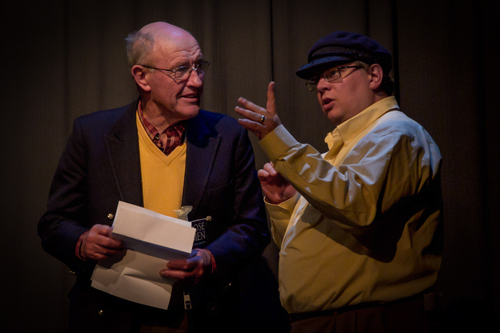
David Cheoros and Jerry (l) sorting out some admin details. (ph Kim Fong)
David Cheoros and his wonderful team organized everything to a “t”. My flights were booked and when I arrived in my hotel I was astonished to find an empty beer carton with a carefully labeled sticker attached. The sticker stated “beer in fridge.” Many volunteers ran me to and fro  - thanks to Pamela, Kathy and John.

Dr. Ole Nielsen at Litfest
My presentations started in the Strathcona County Council chambers in the community of Sherwood Park.  It was here that friend and former dean of the Western College of Veterinary Medicine, Dr. Ole Nielsen, introduced me. I was given 40 minutes, which is a long spot at a literary event, and so that rather than reading from my “Of Moose and Men” book I told some stories in the style of the ancient Cantastoria tellers who used picture boards and drawings to engage the audience. Of course the most modern form of this art is electronic and I used a PowerPoint presentation to share some of my experiences with this most remarkable animal. To pay homage to Ole I also started with the opening paragraph of the book, which is a telegram sent to him from Rwanda after he had offered me the job that launched me on my university career. It reads:

UNDERSTAND JOB OFFER SASKATOON STOP ON SAFARI IN RWANDA TRANSLOCATING ELEPHANTS STOP WILL MAKE CONTACT ASAP ON RETURN TO KENYA STOP HAIGH

In one segment of the presentation I told about how moose have been domesticated through the ages. There does not seem to be an old history of domestication in Eurasia, but we do now that the Aboriginal peoples of North America were using them in this way from at least the 1600s.

School bus, or fun outing in Russia.
They have been ridden, used to pull sleighs and buggies and kept as pets. The grainy B&W pic showing a sleigh full of small children being pulled by a cow moose caused much amusement. Was it a “school bus” or an outing for fun? I have no idea.

Tatiana Minaeva at milking time
In Russia there are at least two moose farms, and it was from Dr. Alexander Minaev that I learned about a farm at Kostroma where moose are routinely milked every day. He has a fascinating web site that shows many aspects of the operation and here are some pictures from that site. The milk goes to a local sanatorium for medical use, particularly for patients with stomach problems.

One account of a moose farm in Sweden has it that this is the source of the world’s most expensive cheese. I know that one audience member tweeted this little gem and before that day was over she received notice that it has been RT’d four times. I wonder if this was because the price, at last report, was a mere eleven hundred dollars per kilo. That is $1100! Any orders out there?

My next event was at a dinner in the Santa Maria Goretti Centre as one of four authors. This centre uses the same parking lot as Commonwealth Stadium, so it was a good thing that the CFL's Edmonton Eskimos were not playing at home that night. After a chicken meal served “family style” and some excellent wines sponsored by Naramata Bench Wines we all read or told sections from our books.

First up was Marcello Di Cintio who read a section about the Mexico / US fence from, his book Walls. As he said, the entire book, by its very nature, is pretty dark. For instance one of the walls he visited during his research was the one that divides Gaza from Israel. His fence piece told the story of a musician who ”played” the wall.

Telling about large antlers after dinner (ph Kim Fong)
Then I came on. I read a short piece about the confusion caused by the Scottish use of moose as opposed to mouse and Robbie Burns’s famous poem. I followed this with a reprise of my Montreal Story Slam about the role of antlers in during the rut of moose. I have posted this one on YouTube and if you haven’t seen it you might enjoy it.

After the dessert Carmen Aguirre read from her book Something Fierce: Memoirs of a Revolutionary Daughter. The story she tells is a harrowing one and as she read an account of her struggles against the Pinochet regime in Chile I was much moved.    

AndrewNikiforuk wound up the session with a piece from his book Empire of the Beetle. He chose an account of the role of bark beetles in forest ecology. Of course, as far as Canadians are concerned the pine beetle that has wreaked such havoc in British Columbia was the main theme. As he pointed out, the beetle has been the principal regenerator of forests from time immemorial, long before humans began to try and manage the resource.

Pamela, Candace, me and Andrew at the panel session. (ph Kim Fong)
The final event of the entire festival found me at a panel session in the Milner library in downtown Edmonton alongside Andrew Nikiforuk again and also Saskatoon’s and East End's own Candace SavageOur topic was Fauna. We each read short pieces from our work, Candace from her book A Geography of Blood. Then we had to try and field questions from our moderator, Pamela Anthony, and from the floor. We tried to answer some of the questions, but as Candace carefully dodged one impossible one I realize that we would need weeks, if not years, to make any kind of meaningful reply.

We all, panel and audience alike, realized that humans are the main driver of changes in both Canadian and global fauna. I did make a point from my African experiences. Why would a family living on a dollar a day be concerned about preserving the lions that kill their cattle or the elephants that devastate an entire year’s supply of staple foods such as maize or millet in a single night’s feeding? Thoughts of conservation are all very well for us in Canada, but these folks may have a different view, and who would blame them?

In the spirit of the whole event. Jerry and Pamela (ph Kim Fong)
All-in-all the festival was an amazing experience. Thanks to David and his team for all their hard work.

Tuesday, August 30, 2011

Of Moose and Men and Tony Bubenik

I thought I would share with you a little of the material from my new book Of Moose and Men. The subtitle is not yet firm, but may well end up as something like The Moose, The Whole Moose, and Nearly Nothing But the Moose.

One character whom I met several times through the years, and who was highly regarded among deer biologists around the world was Tony Bubenik. I fist met him in Prince Alberta in 1978, and then several subsequent times, including when he stayed in our home.

He was never backward in coming forward with new ideas or extending discussions. Not all his ideas proved to be correct, but he was the first to acknowledge it when they did not pan out, and to the end of his life at age eighty-two he kept abreast of developments and technology.

His output included something over three hundred articles and contributions in numerous books. He was also fluent in six or seven languages (accounts differ, probably because of differing definitions of fluency) and wrote in thirteen.
To top it all off, Tony was an accomplished artist, and we have two large watercolour crayon works of his. This one shows a scene which he witnessed when walking in the bush. He told me that the look of surprise on the animal's face was exactly what he saw. The sketches that illustrate the story I have below were also his, made from Super8 movie clips shot by his biologist wife Mary.

Tony’s early life was not easy. He first suffered persecution from the Nazis in his native Czechoslovakia (as it was then) and then dealt with the Communist takeover after World War II, when he was forced to work as a labourer. He came to Canada in 1970 and was soon recognized as one of the most innovative thinkers in the field of deer biology.

Because he was fascinated by the role of antlers in deer society Tony carried out a series of experiments related to the pre-flight displays that occur just before and during the rutting season. He loaned me a copy of Mary’s footage and his son George kindly allowed me to use the sketches for the book.

For the moose study he built a dummy head to which he could attach antlers of various sizes. Even with only two legs, as the sketches showed from these and other experiments, the wild animals reacted to them. He found a bull that had taken up residence near a pond in Ontario and proceeded with his study.
First, he put on a tiny set of antlers that matched those of a sixteen-month-old spiker and walked out from behind his hiding place when the wild bull appeared. The movie shows the bull lifting his head briefly from the water, taking one glance at the intruder, who was showing the correct behaviour in moving lateral to and not facing the dominant animal, and ignoring him. This was much as expected.

Next, as his experiment escalated, Tony exchanged the spikes for a set of super antlers, far bigger than those of the resident. This time, when the bull saw him, he again took a look, but he did not hang around. He simply retired from the scene and ghosted into the spruce trees.

Then Tony showed his true scientific inquisitiveness. He put on the last set of antlers, a set that he had constructed to match those of his subject as nearly as possible. This time he was neither ignored nor avoided.

As Tony’s drawing from the film clip shows, the bull came round the side of the pond and began the ritualized threat that precedes a serious fight among bull moose of equal rank. He dropped his head so that the massive palms would show to maximum effect and rocked his head from side to side, showing off his “stuff.” He walked forward with his forelegs spread wide and locked as if they were stilts, like Frankenstein figures in early horror films.

Not surprisingly Mary’s filming technique suffered a bit at this point as she began to retreat behind a tree. Tony dropped the dummy head, having no wish to take his proof to its inevitable conclusion.

The dummies were so convincing that, as Tony wrote:
“On two occasions moose cows offered themselves for copulation even though a short while earlier they were courted by a bull of lower rank antlers.”