Showing posts with label traffic accidents. Show all posts

Tuesday, June 26, 2012

Urban Deer - Risks to Deer


In my last post I discussed the risks to humans when deer move into urban areas. They can become a pest and a risk to humans, but also a risk to themselves. 

When I mentioned traffic accidents I was referring to damage to people and their vehicles, but of course the deer are usually the losers in these encounters. It all depends upon the size of the deer. A mule deer fawn may not damage a car at all and is unlikely to survive the encounter.  A moose will likely do terrific damage to the car or truck and may survive, but is just as likely to be severely injured and suffer before someone puts it down.

A much more serious problem for the deer arises when well-meaning folks begin to offer supplementary feed to these creatures. Of course for the people there is likely a perceived “feel good” emotion to the action, which makes it very difficult to stop them doing it. After all we all like to feel good. It’s a sort of “Disney” effect.

Few if any such folks realize that they are upsetting the natural order of things in several ways. These fall under the headings of habituation, prolonging the breeding season, inappropriate diet and increased disease potential.

Habituation
If deer, particularly the females, deliver their young in a certain area they are likely to see this as a “home” area and deliver in the same place year after year. Their fawns or calves, raised in that area, are quite likely to repeat the whole thing, but not of course in exactly the same garden or park. They will disperse a little when their mothers reject them when new youngsters appear each year and so the “occupy town” effect spreads little by little. The deer become habituated and pretty soon a “herd” of them are searching for food, mates and a predator-free place to live. Just about the only predator they have to face is the motor vehicle.

It is not just the females that fancy town life. The males also enjoy the relative safety, easily found food (more of this below) and of course, for the brief (4-6 week) period of the rut they have access to lots of females. This is where one of the major problems begins to appear.

Late breeding and birth seasons
In natural systems the males and females disperse after the rut. Indeed they may have completely different home ranges, miles apart in some cases. If the males have become habituated and the females do not have anywhere different to go the two sexes are likely to encounter one another on a regular basis, maybe more than once a day. Some of the females, especially the younger ones that are not yet big enough, may not have been bred or may not have conceived during the regular rutting time. In either case they may come into heat again and again, which inevitably brings the males into contact again. Those pheromones wafting on the breeze are powerful aphrodisiacs.

The net result is that the males hang around, perhaps for the chance to breed, or maybe just for the grub. This unnatural situation is stressful for both sexes.

In the males the stress manifest itself in prolonged retention of antlers. In normal environments the antlers fall off naturally when testosterone level decline. However, other hormones, particularly steroids, can mimic the effect of testosterone when it comes to antler cycles.  Once natural steroid levels decline and the antlers drop the males are infertile.

If the breeding season is prolonged then of course the calving or fawning season is extended. That can be very bad news for the late-born fawns.
 
 (Note here that I’m referring to deer with seasonal breeding patterns. Tropical deer like these chital or axis deer in India dance to a different drummer). There are eight does in the picture.Can you spot them all?


Of course the more late fawns that are born and survive until next year (some do) the more the breeding season is extended. It is a self-perpetuating phenomenon that can get worse over time.

Across Canada and indeed all temperate zones of the world, winter is a determining factor in the life history of deer. It may be the bone-chilling dry cold of the prairies and steppes, or the wet windy blasts of coastal regions of Europe or North America, but wherever it is some sort of protective mechanism is essential. For deer, the mechanism is to be born early and gain lots of weight and strength during the long summer days.

There is evidence that the dam’s milk may have lost some nutritional value when calves arrive late. Whether this is a seasonal effect or simply the fact that the spring and early summer forage has lost quality when those latecomers arrive is not clear.

It is not only the milk quality that is affected. Just as for the dam, the length of time before those green shoots become golden red or yellow to brown autumn leaves is reduced. As the leaves age they lose their nutritional value. All in all the fawn or calf simply lacks the opportunity to gain weight in preparation for the hard times ahead.

Late-born deer may not have developed the fat reserves or body size to withstand those winter conditions. This applies to deer of all sizes. Late-born moose calves, only six weeks behind schedule, seldom survive the winter. I once watched a late-born mule deer fawns fade and die over a few days outside our home in Saskatoon. At necropsy it had no fat reserves anywhere in its body, not even in its bone marrow.

Inappropriate diet
The country mouse and the town mouse cannot get along. One of the reason for that is that they are not used to one another’s feeding regimes. The same sort of thing applies to deer, except that for the urban deer there is none of the natural feeds available. Wild deer are real cafeteria eaters. They may browse or graze on upwards of 150 different plants over the course of a year. If they end up in town the array of feed is greatly reduced. Many of the plants with which they have evolved over tens of thousands or millions of year are simply not available.

They may end up eating poor quality, low energy, high carbohydrate feeds, especially if well-meaning people feed them bread and other “tidbits” like bread, apples, grass, alfalfa, and grains. Just like the Morgan Spurlock, the director and star of the movie “Supersize Me” they end up nutritionally impoverished.

Such diets lead to an ugly end. The deer can and do end up with grain overload, disruption of the rumen, diarrhea or impaction. Handling exacerbates the problem and they cannot be medicated or fed back to health.

All this leads to an end stage of severe metabolic problems, hypothermia, hypoglycemia, exhaustion and death.
Yellow Azalea - image from poisonous plants website


The diets are not only impoverished, but the deer also run the risk of eating poisonous plants, some of which are grown in people’s gardens.

Azalea oleander, and yew are examples among many that may surprise you.


Diseases
The increased density, poor diet and overall debility expose the deer to a range of diseases that they would normally shrug off. Many of the deer show up with poor to extremely thing body condition, poor hair coats (even almost bald) and greenish soft to liquid diarrhea.

Mule deer with lice
One example of this situation has been the arrival of exotic lice that parasitize the coastal black-tailed deer of Oregon, Washington State and Vancouver Island. This picture was taken from the Washington State information sheet on lice. Thousands of lice have been found on a single deer and not surprisingly the coats are in terrible shape.

The bottom line?
Curb your inner Bambi fixation. By encouraging deer into urban settings and feeding them remember that fawns will starve to death and many deer will die.  

THIS IS AN ANIMAL WELFARE ISSUE


Sunday, June 24, 2012

Urban Deer - Risks to Humans


Have just returned from a great trip out to very western most part of Canada. We got as far as Tofino on British Columbia’s Vancouver Island after visiting friends along the way. I also did a talk on various things related to wildlife for the Victoria Academy of Veterinary Medicine. Most present were small animal practitioners, but there were a few wildlife rehab folks there as well. I may have surprised some of the attendees by suggesting that the feeding of urban deer is simply a bad thing.

Of course it is bad for the humans in several ways.

Perhaps the mildest ”bad” is that the deer eat people’s gardens. Not just veggies, but also ornamental flowers. Most of our friends on the island have erected deer-proof fences and on the offshore Saltspring Island I think everyone has done the same.

Another concern is the potential for Lyme disease to crop up in humans. Here is an authoritative site about it. The deer do not carry the disease itself, but they do carry the ticks that spread it. The more deer, potentially the more ticks. There were ten reported cases of this nasty condition in humans in British Columbia in 2011.

Traffic accidents are of course a major hazard. There are YouTube videos to show it. 

Habituated or tame deer can be very dangerous. The females are especially so when they have very young fawns.  In this clip shown on TV news, a doe attacks a pet dog in the Victoria suburb of Sannich. Imagine if that had been a toddler.

Dr. Jay Rolfe, whom I had not seen since his graduation from the Western College of Veterinary Medicine about 25 years ago, related how a doe had emerged from hiding and flattened a young 18-year old male. In the city of Fairbanks, Alaska, a cow moose attacked and killed a pedestrian.  Newly calved wapiti are very aggressive and are a real hazard in Jasper National park. They seem to view dogs with great dislike and will attack them. I am convinced that small children (say under ten) are seen as potential predators.

If does are potential bad news rutting stags or bulls of any member of the deer family become incredibly dangerous during the rut. Each fall there are reports of so-called tame deer, usually white-tailed deer, changing almost overnight from “stroke-my-nose-please, I-love-it” to crazy killers hell-bent of destruction. One client of mine was treed for several hours by such a buck after it hit him from behind. He was lucky to escape up a nearby poplar with torn jeans and some dramatic bruises. 

As the person who posted this YouTube video wrote:
This is video of the elk rut in Estes Park, CO in the fall of 2009. The elk are in a frenzy, and don't care about people around! 
If that shows how things can get wild with non-imprinted cervids, this story shows how things may turn out.

I wrote this in Of Moose and Men.

My own scary experience with an enraged “tame” bull occurred with three hundred kilos of mind-bent, testosterone-crazed, but luckily de-antlered wapiti. He was part of a research group that I had been working with for several months. I used to visit them almost daily but had missed seeing them over the first weekend in September. On the Monday morning I entered the pen without taking due note of the changes that had happened. The bull came straight for me and pinned me against one of the uprights in a corner of the yard. As long as I stood fairly still he simply leaned on me, albeit with some force, pressing my back against the post so that I could feel each of my vertebrae creating a dent in the wood. If I tried to move he leaned a bit more—quite a bit more. I wondered if I was ever going to get out of this mess, but luckily I was with one of my students, who was outside the pen, and so I called out to him to help me. He had the presence of mind to grab a handy length of two-by-four, lean around the nearby gatepost, and give the bull a good thump on the rump. Happily the bull turned to face this new threat, giving me a chance to break the world’s standing high-jump record over the three-metre fence.

The student was Jay Rolfe, but I had failed to catch up with him before publication of the book and felt I could not use his name without his permission.  He certainly saved me from some serious injury and may have saved my life.

This sharp testosterone peak is central to the whole business of the rut and in this graph that I developed almost 30 years ago from work I did on wapiti (North American elk) I show how quickly it happens.
 
In wapiti the jump takes place about the beginning of September. In other species the date changes, but not the event. If you look closely at the scale you will see that this is a log scale. There would not be room on this page to show the actual rise in real numbers. It is about 1000 fold!

It is not just tame animals that will become aggressive. On the eleventh tee of the beautiful Lobstick golf course in Prince Albert National park a bull wapiti once took over the ground. Wise golfers used ”local rules” and teed up a hundred or so yards down the fairway. I don’t know if the scores for the shortened hole improved, but I doubt it. Golfers would have had heightened excitement levels after a meeting like that. The steadiness needed to play god golf might have been suspended.

I shall explore how the development of an urban deer culture, and especially the feeding of urban deer is an animal welfare issue in my next post.

Monday, July 11, 2011

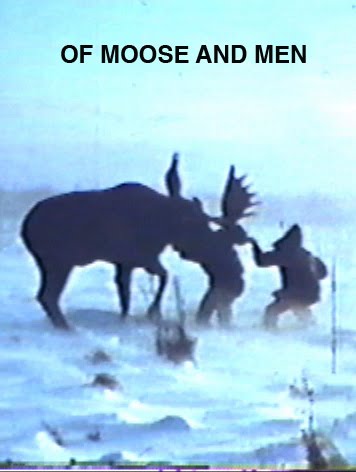
Of Moose and Men

Link
Just signed a contract with Jack David of ECW Press for my new book and things are moving ahead towards a spring launch. Very exciting!

The title is fixed at Of Moose and Men. The subtitle is still under discussion. Watch this space!

Here is a brief outline of what it is about.

The book provides a wealth of information about moose from all corners of the world. It covers not only my personal experiences with both tame and wild moose but also an overview of moose biology, including their specialized diet and the relationship between sex and antlers, where size really does matter. It also covers the history of moose on earth and the marked fluctuations in populations that have occurred over time. There are chapters on moose diseases (not too technical), moose and traffic, moose as a resource, and the use of live moose in several ways that range from transport to clothing, as dairy animals and as pets.


Here is a section from my acknowledgements that shows the sort of coverage that I did in researching it.

In order to do as thorough job as possible, one of my self-imposed tasks was to try and gain an understanding of the status of moose in the early twenty-first century, and to that end I contacted biologists from just about every range country, US state, and Canadian province where moose exist. I read as many volumes as I could of the Proceedings of the North American Moose Workshop, not just the publications from the workshops I was lucky enough to attend. These workshop proceedings morphed into the journal Alces, whose front-cover mandate reads: “A Journal Devoted to The Biology and Management of Moose.” I owe the contributors and editors sincere thanks for their hard work. I also consulted several books that contained useful information. When those attempts failed, I went, with some care, to the Internet. In the end I was able to obtain information on fifty-five regions—including five separate ones in Russia, which I think is excusable because there are nine time zones involved.

This is not the place to list all those who gave me valuable information, but they are of course listed in the acknowledgements.

Of Moose and Men

Link
Just signed a contract with Jack David of ECW Press for my new book and things are moving ahead towards a spring launch. Very exciting!

The title is fixed at Of Moose and Men. The subtitle is still under discussion. Watch this space!

Here is a brief outline of what it is about.

The book provides a wealth of information about moose from all corners of the world. It covers not only my personal experiences with both tame and wild moose but also an overview of moose biology, including their specialized diet and the relationship between sex and antlers, where size really does matter. It also covers the history of moose on earth and the marked fluctuations in populations that have occurred over time. There are chapters on moose diseases (not too technical), moose and traffic, moose as a resource, and the use of live moose in several ways that range from transport to clothing, as dairy animals and as pets.

Here is a section from my acknowledgements that shows the sort of coverage that I did in researching it.

In order to do as thorough job as possible, one of my self-imposed tasks was to try and gain an understanding of the status of moose in the early twenty-first century, and to that end I contacted biologists from just about every range country, US state, and Canadian province where moose exist. I read as many volumes as I could of the Proceedings of the North American Moose Workshop, not just the publications from the workshops I was lucky enough to attend. These workshop proceedings morphed into the journal Alces, whose front-cover mandate reads: “A Journal Devoted to The Biology and Management of Moose.” I owe the contributors and editors sincere thanks for their hard work. I also consulted several books that contained useful information. When those attempts failed, I went, with some care, to the Internet. In the end I was able to obtain information on fifty-five regions—including five separate ones in Russia, which I think is excusable because there are nine time zones involved.

This is not the place to list all those who gave me valuable information, but they are of course listed in the acknowledgements.

Saturday, June 25, 2011

Serengeti road

Link
Good news from my posts of June 15 & 16 about the Serengeti and the proposed tarmac road.
In a nutshell, the project has been canceled!
Yeah!

Thursday, June 16, 2011

Serengeti Highway

Link
In my post of June 15 I alluded to the simmering controversy about the building of a new highway through the heart of the Serengeti. Now comes a front page article by Geoffrey York in the Globe And Mail of June 14 that offers a balanced view of the issues.
You can view the article and the lively discussion that follows here and also see better versions of the maps that I have photographed and attached.

For the conservationists it is a simply matter of the desecration of a pristine environment where the greatest animal migration on earth still occurs. Of course the wildebeest gets the biggest mention and also both of the photos. A brief mention of other species is made, but everyone tend to forget that zebras are also an integral part of the events and that the predators that act as camp followers also move around with the great herds.

For the protagonists of the road it is really quite simple and boils down to two issues. The first is that the land was originally occupied by humans but they were kicked out by colonial governments when the park was formed. It began as a small game reserve, mainly to protect over-hunted lions in 1921 and was finally established in 1951. The second issue is that the people to the west of the park are almost cut off from easy commercial activity because all trucks have to skirt a long way to the south before heading to the commercial centre of Dar es Salaam.

There are other issues that are relevant.

The people in the region are living on less than a dollar a day. The human population has ballooned since 1951. According to Guardian.co.uk website statistics in 1950 there were just over 7 millions people in what was then Tanganyika. Now there are over 46 million, an increase of 504%. They need to eat. It is impossible to imagine that poaching will not increase as road access becomes easier.

A quick look at the map and the proposed route for the new highway shows that it cuts right across the path of the migration as the animals head north into Kenya and the Masai Mara, the county’s major tourist magnet. Nobody knows how that will affect the movement of the animals, but I’ll bet that the Kenyans are concerned.

The second thing that gets little mention is the potential for a huge number of traffic accidents. In my new book Of Moose and Men I have quoted statistics from Sweden about vehicle x moose accidents. They have long been a major problem and in 2010 there were 7227 reported to police. What, you may ask, has this got to do with the Serengeti?

There are about 350,000 moose in Sweden, and they do not engage in mass migration. There are said to be about over a million wildebeest, and another 250,000 zebra in the Serengeti/Mara system. One environmental study quoted by York has it that trucks will be traveling down the highway at a rate of one every thirty seconds. When I round the African figures to 1.5 million animals that is about four times as many accidents-in-waiting on a single road in the Serengeti as on all the roads in Sweden. I think that spells carnage. Carnage for the animals, carnage for the trucks and other vehicles.

I hope I’m wrong.